
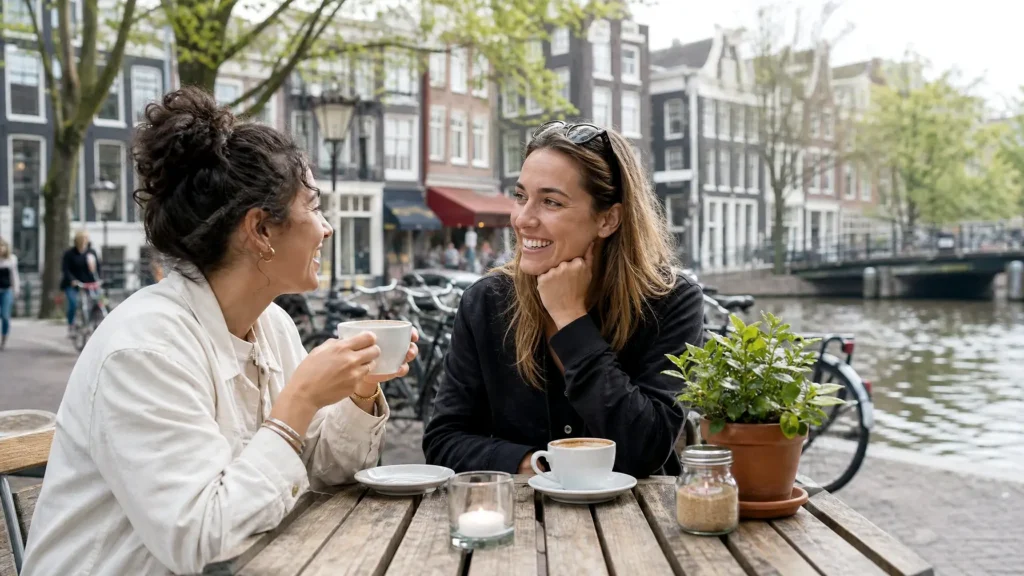
Meeting people in Amsterdam is one thing.
Turning those acquaintances into real friends is another.
Research into male and female friendships suggests women are especially likely to build their social lives around one or two close relationships - and offers some clues about how those friendships develop.
Amsterdam offers no shortage of opportunities to meet people.
There are work drinks, language classes, running clubs, neighbourhood events, school-gate conversations, yoga studios, volunteer groups and enough cafés to schedule a coffee with someone different every day of the year.
But meeting people and making a close friend are not quite the same thing.
Research into friendship suggests this distinction may be particularly important for women.
In a study of best friendships and romantic relationships, researchers Eiluned Pearce, Anna Machin and Robin Dunbar found that 98% of the women surveyed said they had a best friend, compared with 85% of the men.
That does not mean every woman needs a designated BFF.
But the study found broader differences in the way male and female friendships tended to work - differences that may be useful to think about if you are trying to build a new social life in Amsterdam.
For women, friendship seems to be more about depth than numbers
The researchers studied 260 heterosexual adults aged 18 to 80.
Most lived in Europe or North America, and 201 of the participants were women, so the findings should not be treated as a universal description of how every man or woman behaves.
Nevertheless, the pattern was striking.
Women not only reported having a best friend more frequently, but their closest friendships tended to be more intimate.
Previous research cited by the authors has similarly found that women tend to favour one-to-one relationships, while men are relatively more inclined towards group-based socialising.
A separate cross-cultural study described the pattern rather neatly in its title: “Women favour dyadic relationships, but men prefer clubs.”
That distinction matters when you are new to Amsterdam.
Joining a large social group can certainly introduce you to people.
But if your aim is to make a genuinely close female friend, the research suggests the important part may come afterwards: seeing the same person again, talking one-to-one and gradually turning an acquaintance into somebody you can actually rely on.
In practical Amsterdam terms, the coffee after the group event may ultimately matter more than the group event itself.
What turns an Amsterdam acquaintance into a friend?
The study looked at the characteristics associated with intimacy in best friendships.
For women, close friendship was associated with similarities in sense of humour, dependability, education and happiness.
Mutual support was also particularly strongly associated with intimacy.
That offers a somewhat different model of friendship from simply finding someone who likes the same activities.
You might meet through a book club in De Pijp, a workout class in Oost, your children’s school, an international women’s group or a neighbourhood WhatsApp chat.
But sharing an activity is only the introduction.
The friendship itself develops when you discover that you make each other laugh, can depend on each other and actually show up when something matters.
Interestingly, the study found that shared history was not essential to intimacy among women.
In fact, greater reliance on shared history was associated with lower reported intimacy in women’s friendships.
The researchers suggest that present-day conversation, disclosure and mutual support may matter more.
That is encouraging if you have arrived in Amsterdam as an adult.
You do not necessarily have to compete with somebody’s childhood friend from Utrecht or university roommate from Groningen.
A friendship does not need twenty years of history before it can become important.
You may be better off pursuing one friendship than twenty
There is a familiar problem when trying to make friends in a new city: you can become extremely socially busy without actually becoming close to anyone.
Tuesday is drinks with colleagues.
Thursday is an international meetup.
Saturday is a group dinner.
Sunday is padel.
Your calendar is full, but there is still nobody you would call when something goes wrong.
The research suggests that, for many women, the route from one situation to the other may involve narrowing rather than expanding the social circle.
If there is someone you consistently enjoy talking to, ask her for coffee rather than waiting for the next group event.
Suggest a walk through Vondelpark.
Invite her over.
Send the message instead of wondering whether you know each other well enough yet.
The study cannot tell anyone how to make friends in Amsterdam.
But its findings do suggest that female friendship tends to be built around qualities that require repeated personal contact: humour, dependability and mutual support.
Women were also more likely to have both a partner and a best friend
One of the more interesting findings concerned romantic relationships.
Among the female participants, only 2% had a romantic partner but no best friend.
Among men, that figure was 15%.
Overall, 98% of women reported a best friend, regardless of whether they were also in a romantic relationship.
In other words, for most of the women in the study, having a partner did not appear to replace the role of a close friend.
Best friendships were also overwhelmingly same-sex.
Around 15% of women with a best friend reported that their best friend was male, compared with about 22% of men whose best friend was female.
So if you are a woman trying to establish yourself in Amsterdam, finding a female friend you genuinely connect with may be more significant than simply accumulating a large network of people you occasionally see.
The city can provide the introductions.
The friendship still has to happen one person at a time.
Main study: Eiluned Pearce, Anna Machin and Robin I. M.
Dunbar, “Sex Differences in Intimacy Levels in Best Friendships and Romantic Partnerships”, Adaptive Human Behavior and Physiology, published October 18, 2020.
Related research: Dávid-Barrett et al., “Women Favour Dyadic Relationships, but Men Prefer Clubs: Cross-Cultural Evidence from Social Networking”, PLOS ONE.
Earlier research: Benenson and Christakos, “The Greater Fragility of Females’ Versus Males’ Closest Same-Sex Friendships”, Child Development.


![Top [count] Travel Blogs to Follow - OnToplist.com](https://www.ontoplist.com/images/ontoplist31.png?id=6a8dcf108f478)