
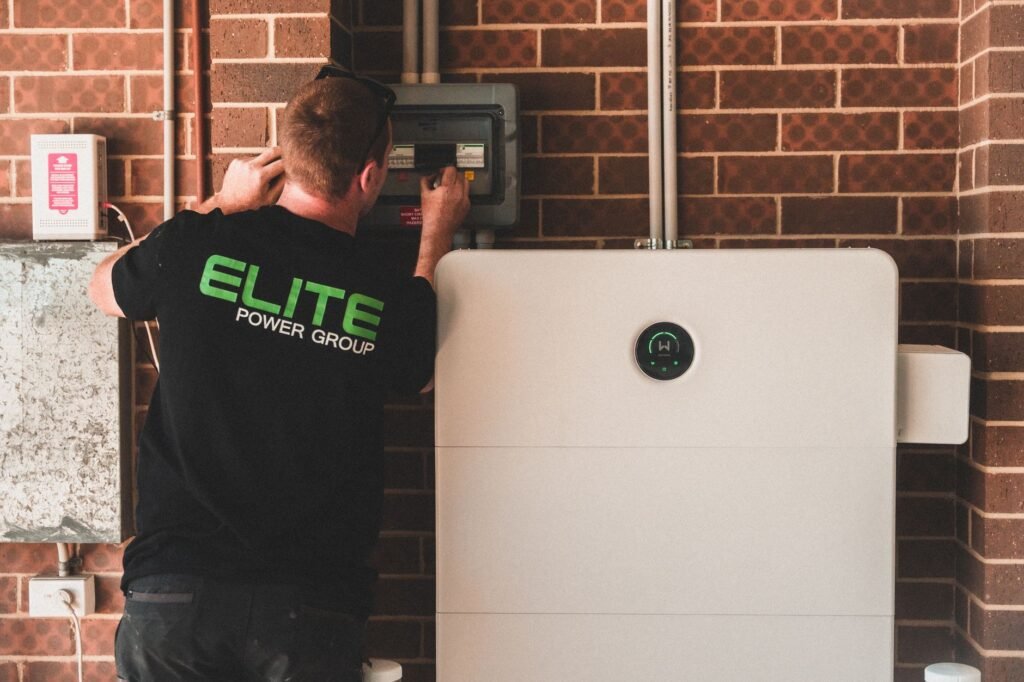
Sales of plug-in home batteries are climbing sharply across the Netherlands as households look for ways to offset rising energy bills and the phasing out of the net metering scheme for solar panel owners.
An average Dutch household now pays around 1,993 euros a year for energy, according to the national statistics office CBS, roughly 550 euros more than five years ago.
The net metering scheme, which lets solar panel owners offset the power they generate against their overall usage, ends on 1 January 2027.
Once it does, households with solar panels are expected to see their costs rise by an estimated 170 to 540 euros a year, according to calculations by Vereniging Eigen Huis and Energievergelijk.nl.
Consumer body Milieu Centraal advises solar households to use as much of their own generated power directly as possible, for example by running a washing machine or charging an electric car during the day, rather than exporting it to the grid.
Plug-in batteries are compact units that experts recommend connecting directly to a grounded wall socket, without an extension cord or power strip.
They store surplus solar power generated during the day for use a few hours later, though multi-day storage is not yet possible with this type of battery.
Because they typically do not require an installer, they are cheaper and more accessible than a fixed home battery system, which usually needs changes to a household’s meter cupboard.
According to figures from Sunergy Research, more than 37,600 plug-in batteries were sold in the second quarter of this year, nearly double the first quarter, with monthly sales climbing from 11,644 in April to 13,408 in June.
An estimated 80,000 plug-in batteries are now in use in Dutch homes, though the real number is likely higher, since not every battery purchase is formally registered.
Prices vary by capacity: a 2 kilowatt-hour unit currently costs between 600 and 650 euros, while a 5 kilowatt-hour unit runs from 1,200 to 1,600 euros.
An average household uses around 7 to 8 kilowatt-hours a day, and because usage tends to peak in the evening, experts suggest buyers look specifically at their consumption between five and eleven at night when deciding what size battery they actually need.
The financial payoff is not guaranteed. In ten thousand simulations run by ThuisbatterijApp.nl, 67 percent of fixed, professionally installed battery systems failed to pay for themselves within fifteen years, compared with 30 percent of the cheaper plug-in batteries.
Independent energy advisor Dennis van der Meij notes that the return depends on a household’s own consumption, its solar panels, its energy contract, and the battery’s capacity and lifespan.
A dynamic energy contract, which around one in twelve Dutch households already has according to regulator ACM, can improve the numbers by letting a battery charge when electricity is cheap and discharge when it is expensive, though experts caution that advertised returns are often calculated under ideal conditions.
Fire safety is a real concern with plug-in batteries specifically, since the user chooses which socket to use rather than having an installer assess the circuit.
The fire service recommends giving a battery its own dedicated circuit, with no more than one battery per circuit, and keeping it in a cool, well-ventilated spot outside the main living area, such as a shed, garage or attic, as long as the space is reachable from outside and fitted with a smoke detector.
Industry body Techniek Nederland advises checking that a home’s meter cupboard is suitable and using a qualified installer, and also recommends paying attention to warranty terms and correct sizing before buying.



![Top [count] Travel Blogs to Follow - OnToplist.com](https://www.ontoplist.com/images/ontoplist31.png?id=6a8dcf108f478)