
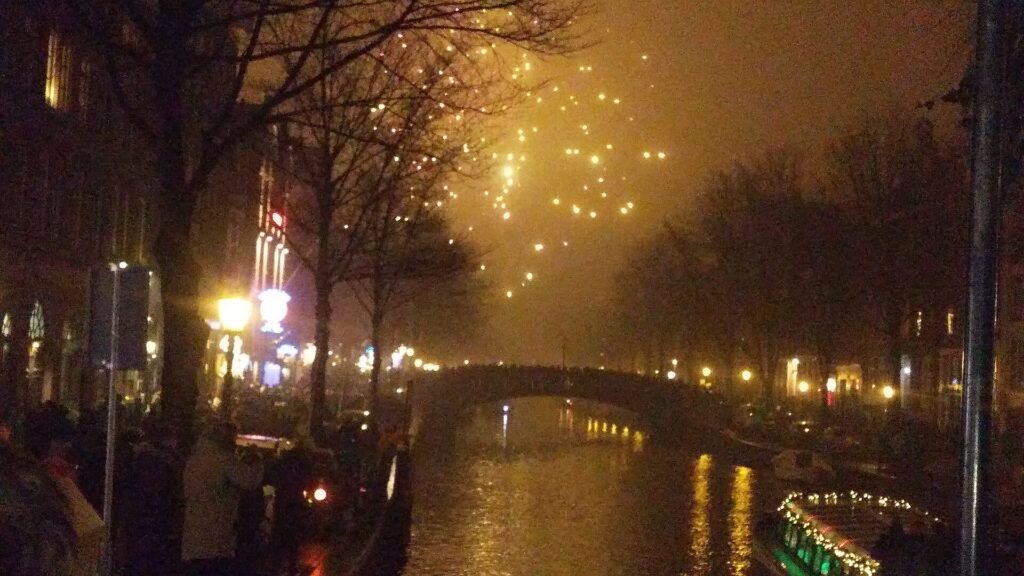
Few cities greet the new year quite as loudly as Amsterdam.
For one night the canals fill with smoke and colour, the smell of hot oil and powdered sugar drifts from street corners, and strangers wish each other a gelukkig nieuwjaar over the noise.
Then, a few hours later, comes the quieter ritual: the resolutions.
If the research is any guide, most of them will not survive the month.
Why the resolutions fade
A study from the UK and Australia found that about two-thirds of people abandon their New Year resolutions within a month.
The researchers followed roughly 180 adults, aged 18 to 77, who filled in the same survey four times over two months.
Most resolutions clustered around the same familiar territory - diet at about 29 per cent and exercise at about 24 per cent - and more than half of the participants had made the very same promise a year earlier.
The bigger problem, the authors concluded, was vagueness.
Nearly two-thirds of the resolutions were too woolly to act on: “get fit”, “eat better”, “be happier”.
Lead author Joanne M. Dickson, a psychology professor at Edith Cowan University, has argued that specificity is what makes a goal stick.
A resolution tied to a time, a place and a person - “a 45-minute walk around the park with a friend on Monday, Wednesday and Friday mornings” - gives the brain the cues it needs.
A vague intention, by contrast, quietly demands that you re-decide the details every single day, and most people simply stop.
The finding, the researchers noted, is “consistent with the folk wisdom that people are not particularly good at sticking to” their resolutions - even when they start out fully convinced they will.
How Amsterdam sees in the new year
Before any of that, though, there is the party.
New Year in the Netherlands, or Oud en Nieuw - “old and new” - is less a ticketed event than a citywide happening.
The essential food is the oliebol, a deep-fried dough ball, often studded with raisins or apple and buried under icing sugar, sold from seasonal stalls that appear across Amsterdam in the final weeks of December.
Alongside them come appelflappen, flaky apple turnovers, eaten hot on a cold pavement.
As midnight approaches, the city empties out of its living rooms and into its streets, bridges and squares.
Neighbours gather along the canals and the countdown ripples across the water.
For years the sky above the Jordaan, De Pijp and the centre erupted with an unruly, entirely amateur fireworks display set off by anyone with a lighter and a few euros to spare.
It was chaotic, occasionally beautiful, and every year it sent hundreds of people to hospital and left a fortune in damage behind.
Some Amsterdammers also keep the hardier tradition of the nieuwjaarsduik, the New Year’s dive, plunging into cold open water on 1 January.
The year the fireworks change
This coming turn of the year will look different.
After a long campaign by doctors, emergency services and city councils, the Dutch Senate passed the “Safe New Year’s Eve” law in 2025, and a nationwide ban on consumer fireworks takes effect in 2026.
That makes the 2026–2027 celebration the first in which setting off your own rockets is illegal across the country.
Only the small Category F1 novelties remain legal for private use; the big consumer categories are gone, and Amsterdam has said it will not hand out exemptions.
In their place, the city is leaning into organised spectacle.
Amsterdam has run professional displays at several points across town and stages an “Electric Fireworks” show on Museumplein, billed as a blend of light, audio and low-impact eco-fireworks.
It has also designated safety-risk areas to keep the night calmer than it once was.
The smoke will thin.
The crowds, the oliebollen and the midnight embraces will not.
A more Amsterdam kind of resolution
Which brings us back to the promises.
If the research is right, the trick is not to resolve to “get fit” but to make the goal concrete enough that the city itself does half the work.
Amsterdam is unusually well suited to this: a standing Saturday-morning ride along the Amstel, a weekly swim at a local bad, a walk that takes in a different canal each time, or a Tuesday-night language class you have already paid for.
Attach a time, a place and a person, and a resolution stops being a wish and becomes a plan.
Most people, the study reminds us, will still let their resolutions slide by February, and that is worth remembering before you judge yourself too harshly on 1 January.
The oliebollen will be gone, the fireworks quieter than ever, and the year stretched out ahead.
What you do with it, as always, comes down to the details.
Study: “Self-regulatory goal motivational processes in sustained New Year resolution pursuit and mental wellbeing,” Dickson, Moberly, Preece, Dodd & Huntley, International Journal of Environmental Research and Public Health (2021), DOI: 10.3390/ijerph18063084.
Featured image: Oudezijds Voorburgwal, Amsterdam, on New Year’s Eve - photo by Syd Storm (CC0).

![Top [count] Travel Blogs to Follow - OnToplist.com](https://www.ontoplist.com/images/ontoplist31.png?id=6a8dcf108f478)