
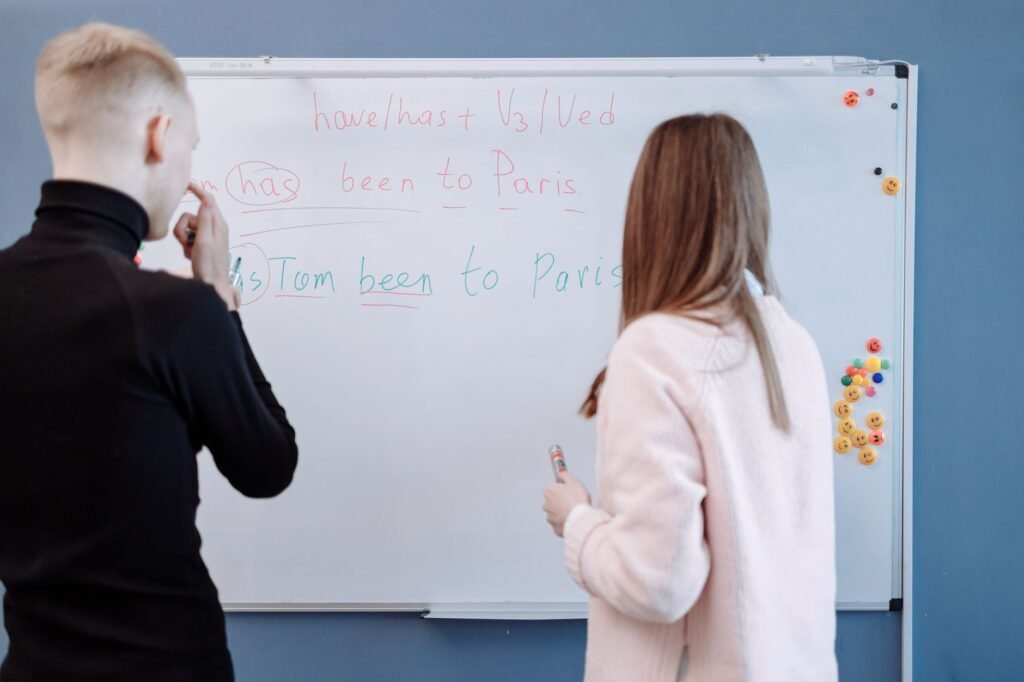
Four of the five schools below now publish their course fees, so a Dutch language course in Amsterdam can be compared on price before you phone anyone: a level costs roughly €340 to €975 depending on the school and how fast you go.
What still differs is hours, group size, level range and whether books are included, and those are set out for each school here, because a six-day intensive and a seven-week evening course are very different commitments even when they land you on the same rung of the ladder.
Fees, formats and start dates below were checked on each school’s own website on 28 September 2026.
Schools change them, so confirm on the linked page before you pay.
The Five Schools At A Glance
- Taalhuis Amsterdam, Gerard Doustraat 220, De Pijp. Levels A1 to C2. Once or twice a week, Saturday, fast tracks, online, conversation courses and a book club. Fees published, for example €340 to €380 for A1.1 depending on the schedule; books are extra. Suits someone who wants rolling start dates and a course at almost any level.
- Koentact, Elandsgracht 70, centre. Levels A1 to B2. Evening, morning, one-week intensive, conversation and online evening courses, with Saturday field trips. Fees published: €525 for the evening or morning course, €975 for the intensive week, €420 online; the course book is bought separately. Suits someone who wants to use Dutch outside the classroom early.
- UvA Talen, Roetersstraat 25, Roeterseiland. General courses at eight levels, from beginner to advanced, plus NT2 state exam preparation. Group courses on site or online, with new courses starting every month. Fees published, from €485 for Dutch Beginners 1 and from €710 from intermediate level. Suits students and anyone heading for the Staatsexamen NT2.
- Dutch Courses Amsterdam, Admiraal de Ruijterweg 175, West. Levels A0 to C1. Two-week intensive, seven-week evening course, afternoon semi-intensive and online evening course, maximum eight students. Fees published: €675 per level in the classroom, €600 online, materials included. Suits someone who wants a small group and one all-in price.
- Talencoach, Keizersgracht 8, centre. One seven-day live course, the Dutch Brainwash, in groups of up to eight. Levels and fee not published: ask the school. Suits someone who has stalled with conventional lessons and can clear a full week.
How To Choose A Dutch Course In Amsterdam
Work through five questions in this order and the list usually narrows to one or two schools.
Which level do you need, and for what? Daily life and neighbours, a job or study place, or a civic integration requirement are three different goals.
If a formal level is required, the qualification that counts is usually the Staatsexamen NT2 or an integration exam, not a school’s own certificate, so ask the school whether its course prepares for that exam.
Our Dutch lessons guide explains the difference between NT2 and inburgering.
Which hours can you actually keep? Evening courses run alongside full-time work; intensives suit the gap before a job starts.
Where will you travel from? The five are spread across De Pijp, the centre, Roeterseiland and West, and all but Talencoach also teach online.
What is the total cost? Add the book where it is not included (Taalhuis and Koentact), and multiply by the number of levels you need, since the cost of getting from nothing to B1 is what matters.
How big is the group? Dutch Courses Amsterdam and Talencoach cap groups at eight, Koentact’s intensive at six, and its regular courses run with 5 to 12 students.
1) Taalhuis Amsterdam
Taalhuis is at Gerard Doustraat 220 in De Pijp, a few minutes from the Albert Cuyp market, and covers the full ladder from A1 to C2.
It runs the widest set of formats of any school here: courses once or twice a week, a Saturday course, fast tracks, deepening and conversation courses, online groups, private lessons and in-company teaching.
There is also a B1+ book club, which is where you go once grammar has stopped being the problem and confidence has become it.
Fees are published per course.
An A1.1 beginners course costs €340 for twelve lessons of an hour and a half, and €370 to €380 for the longer or once-a-week versions.
Its terms say fees exclude books unless stated otherwise.
New courses start throughout the year rather than in fixed terms, but popular groups fill: when we checked, several of the September A1.1 groups were full and taking a waiting list.
The school reserves about five free places each course period for undocumented refugees through a partnership with ASKV.
Enquiries go to info@taalhuisamsterdam.nl or 06 14 30 31 31.
2) Koentact
Koentact teaches from the Claverhuis community centre at Elandsgracht 70 in the centre and runs courses from A1 up to B2.
Its evening course is ten lessons plus two Saturday field trips, 31 hours over five weeks, and the morning course is eight lessons plus two field trips, 32 hours over four weeks; both cost €525.
The intensive option is six days from 09:30 to 15:45, 33 hours of teaching plus a field trip, in a group of at most six, for €975.
It is the fastest route on this list to a working level.
There is also a conversation course, five lessons plus two field trips over five weeks for €320, for people who already have some Dutch and have stopped using it.
An online evening course (25 hours over five weeks, €420), private lessons and in-company teaching complete the range.
You buy one course book separately.
3) UvA Talen
UvA Talen is the University of Amsterdam’s language centre, at Roetersstraat 25 on the Roeterseiland campus, and it lists 26 Dutch courses.
Its general courses run at eight levels from complete beginner to advanced, each finished with an exam in reading, listening, speaking and writing, and it also runs courses that prepare you for the NT2 state exam.
Group courses run in Amsterdam or online, at daytime, afternoon, evening and Saturday times, and new courses start every month.
Fees are published: Dutch Beginners 1 starts from €485, and the intermediate, advanced and proficiency courses from €710.
It is reachable on 020 214 1234 or trainers@uvatalen.nl.
4) Dutch Courses Amsterdam
Dutch Courses Amsterdam is at Admiraal de Ruijterweg 175 in West and caps every class at eight students.
It covers A0 to C1 and splits grammar and conversation between specialist teachers rather than having one person do both.
The formats are a two-week intensive of 35 hours on weekdays from 10:15 to 14:15, an evening course of seven weeks meeting twice a week from 19:00 to 21:15, an afternoon semi-intensive over four and a half weeks on Mondays, Wednesdays and Fridays, and the evening course online.
Each classroom level costs €675 and the online evening level €600, with study materials included, and courses start once or twice a month.
5) Talencoach
Talencoach, at Keizersgracht 8, runs one main thing: a seven-day live course called Dutch Brainwash, built by Albert Both around pattern recognition rather than grammar drills.
It always starts on a Saturday and ends the following Friday afternoon, from 10:00 to 16:45 each day, in a group of at most eight.
The next dates listed are 17 October, 21 November and 12 December 2026.
It is the outlier here: a single week rather than a term, aimed at people who have already failed to get going by conventional means.
The school does not publish levels or a price, so ask both before booking, particularly if you need a level for a formal purpose.
Which Course Type Fits Your Schedule
An intensive course means most of a working week for one or two weeks, and it suits the gap between arriving and starting a job.
Koentact’s six-day intensive and Talencoach’s seven-day course are the compressed end of that, and Dutch Courses Amsterdam’s two-week day course is the more conventional version.
Evening courses meeting once or twice a week are the realistic option alongside full-time work, and all four of the conventional schools run one.
Private lessons cost more per hour but let you set the focus, which is worth it if your Dutch is uneven rather than absent.
Online groups exist at Taalhuis, Koentact, UvA Talen and Dutch Courses Amsterdam, and are the answer if you travel for work.
Frequently Asked Questions
Which Dutch schools in Amsterdam are best for absolute beginners?
Dutch Courses Amsterdam starts at A0 and caps classes at eight, and Taalhuis Amsterdam starts at A1.1 with rolling start dates so you do not wait for a term.
Koentact also starts at A1 and builds field trips into its group courses, which gets you using the language outside a classroom early.
How much do Dutch courses in Amsterdam cost?
At the four schools that publish fees, one course costs from about €340 (a Taalhuis A1.1 course) to €975 (Koentact’s intensive week), with most regular levels between €485 and €710.
Talencoach gives its price on request.
Check whether the book is included, and price the whole ladder rather than one level.
What is the difference between intensive and part-time courses?
Intensive courses run most days for a short block, from Koentact’s 33 hours in six days to a two-week day course, and move you up a level fast.
Part-time evening courses meet once or twice a week over five to seven weeks and take longer to cover the same ground, but survive contact with a job.
Are there free or low-cost Dutch classes in Amsterdam?
Taalhuis Amsterdam reserves around five free places each course period for undocumented refugees through ASKV.
Beyond that, subsidised lessons exist under the integration programme for those who qualify, and libraries and volunteer language cafés offer informal practice rather than structured teaching.
How long does it take to reach A2, B1 or B2?
That depends on hours rather than months.
The schools here publish roughly 31 to 35 hours of teaching per course, and a CEFR level is often split across more than one course.
Any school quoting you a timeline should be asked how many contact hours it involves, because that is the comparable number.
Which school suits international students and working professionals?
UvA Talen suits students: it is on the Roeterseiland campus and runs NT2 exam preparation.
For people in full-time work, the evening courses at Taalhuis, Koentact, UvA Talen and Dutch Courses Amsterdam are built around that schedule.

![Top [count] Travel Blogs to Follow - OnToplist.com](https://www.ontoplist.com/images/ontoplist31.png?id=6a8dcf108f478)