Origins and Historical Development
The history of India Pale Ale (IPA) is closely tied to British colonial trade, long-distance shipping and the development of modern brewing.
But the familiar story that IPA was suddenly “invented” because ordinary British beer could not survive the voyage to India is too simple.
Pale ales had already been shipped to India, and strong, heavily hopped English stock ales existed long before the name India Pale Ale appeared.
What brewers did understand was that beer intended to remain drinkable for a long period benefited from substantial hopping and sufficient alcohol.
Hops were valued not only for bitterness and aroma but also because their antimicrobial properties helped beer keep.
In beers destined for distant markets, the higher hop content acted as a natural preservative, helping suppress spoilage during months in wooden casks at sea.
Alcohol and careful fermentation provided additional protection.
The result was not one sudden invention but the gradual evolution of an existing family of pale, strong and well-hopped ales into the beer eventually known as IPA.
Birth of India Pale Ale
Beer exports to India expanded alongside the British Empire and the activities of the East India Company.
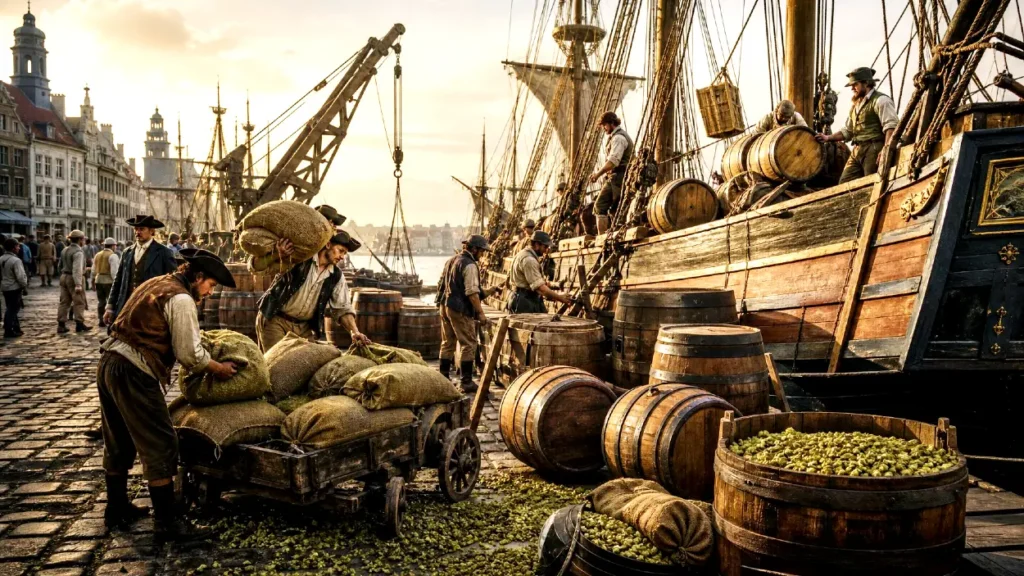
The voyage from Britain to India could take around six months, crossing the equator and rounding the Cape of Good Hope while barrels experienced heat, constant movement and major temperature changes.
English brewers already produced strong “October beers” or stock ales that were designed to mature for long periods.
These beers were commonly brewed with generous quantities of hops.
Both alcohol and hopping improved their ability to withstand extended storage, making them logical candidates for export.
Rather than inventing a completely new type of beer, brewers gradually adapted these existing beers to the Indian trade.
The term “India Pale Ale” itself came later.
Pale ale had reached India decades before the expression became established, and the style developed progressively as brewers, merchants and drinkers discovered which beers travelled and matured particularly well.
George Hodgson and Bow Brewery
One of the most important figures in this development was George Hodgson, whose Bow Brewery stood in East London close to the docks used by East India Company ships.
Hodgson is sometimes described as the inventor of IPA, but that overstates his role.
Other pale ales had already been shipped to India.
His importance lay instead in successfully developing the market.
Bow Brewery supplied strongly hopped pale and October-style ales and offered favorable credit terms to ship captains, allowing payment to be delayed until ships returned from India.
These commercial arrangements helped Hodgson’s beer establish a dominant position in the Indian market.
By the early 19th century, Hodgson’s pale ale had become well known in India.
However, conflicts over prices and trading terms eventually encouraged the East India Company to look for competing suppliers.
Burton-on-Trent Takes Over
The next major chapter took place in Burton-on-Trent.
Brewers there, including Samuel Allsopp and later Bass, began producing pale ales for India during the 1820s.
Burton had an important natural advantage: its brewing water contained relatively high levels of sulfates and other minerals that enhanced the dry, crisp impression of hop bitterness.
Burton-brewed pale ales proved extremely successful.
The combination of pale malt, vigorous hopping, highly attenuated beer and the town’s distinctive water helped establish the flavor profile associated with classic British IPA.
Burton eventually displaced Hodgson’s brewery as the leading source of pale ale for the Indian market.
Global Trade and Expansion
The East India Company and Britain’s expanding commercial networks helped take pale ales far beyond their original brewing regions.
Long-distance trade exposed British beer to markets throughout India and elsewhere in the empire.
By the middle of the 19th century, Burton pale ales had also become fashionable in Britain itself.
IPA was therefore no longer simply an export beer.
It had become an important domestic style and part of Britain’s rapidly industrializing brewing industry.
Evolution of IPA and Its Variations
India Pale Ale has changed dramatically since the 19th century.
The English export ales associated with Burton-on-Trent were relatively dry, bitter and highly drinkable.
Modern IPA now encompasses everything from intensely bitter West Coast IPAs to soft, hazy New England versions and low-alcohol Session IPAs.
Innovations in IPA Brewing
The original export beers relied heavily on hops for both flavor and keeping quality.
Burton upon Trent’s mineral-rich water helped produce particularly crisp and expressive pale ales, but the next major transformation of IPA took place across the Atlantic.
American brewers embraced aromatic American hop varieties during the late 20th-century craft beer revival.
The introduction of Cascade hops in the 1970s was especially influential.
Cascade delivered grapefruit, citrus and floral aromas dramatically different from the more restrained character associated with many traditional English hops.
Later brewers increasingly used dry hopping - adding hops during or after fermentation rather than relying solely on hops boiled in the wort.
This technique emphasizes volatile hop aromas without necessarily increasing bitterness, helping create the intensely aromatic IPAs common today.
Modern IPA Styles and Classification
The original English IPA eventually gave rise to numerous interpretations.
An American IPA typically emphasizes citrus, pine, resin or tropical-fruit characteristics from American and other New World hops.
West Coast examples are commonly relatively clear, dry and assertively bitter.
Double or Imperial IPAs increase both hop intensity and alcohol content.
At the opposite end of the scale, a Session IPA aims to retain a pronounced hop character while keeping the alcohol level relatively low.
New England IPAs, often abbreviated NEIPA, moved the style in another direction.
They tend to emphasize hop aroma and fruit character rather than sharp bitterness.
Oats and wheat are frequently included, while brewing methods involving yeast, proteins and hop compounds help produce the characteristic haze and soft mouthfeel.
Tropical-fruit, citrus and stone-fruit aromas are common.
The Craft Beer Revolution
The modern craft beer movement made IPA one of the world’s most experimental beer categories.
West Coast IPAs established a recognizable combination of dryness, firm bitterness and pine, citrus and resinous hop aromas.
Brewers then pushed in almost every possible direction.
The Hazy IPA, closely associated with the New England IPA, puts greater emphasis on aroma, fruitiness and a soft mouthfeel.
Double, Triple, Black, White, Cold and alcohol-free IPAs demonstrate how far the category has moved from a single historical model.
Some brewers deliberately test the limits.
Dogfish Head 120 Minute IPA, for example, became famous for continuously adding hops during a two-hour boil and producing an unusually powerful interpretation of the style.
Modern IPA is therefore less a single recipe than a broad family of hop-focused beers.
Amsterdam’s Long History With Hops and Beer
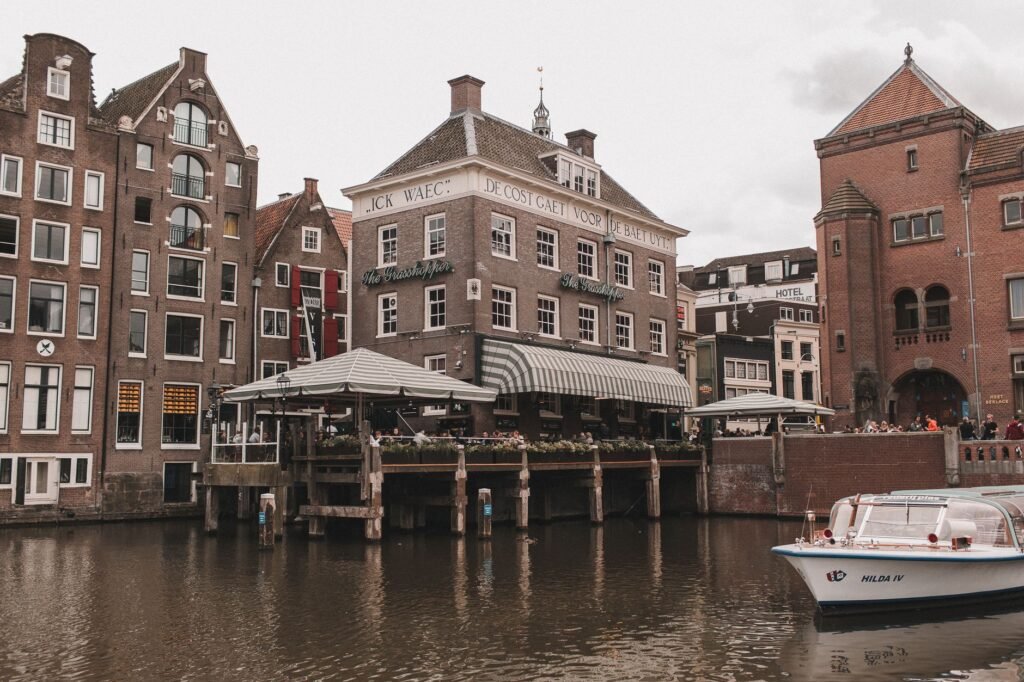
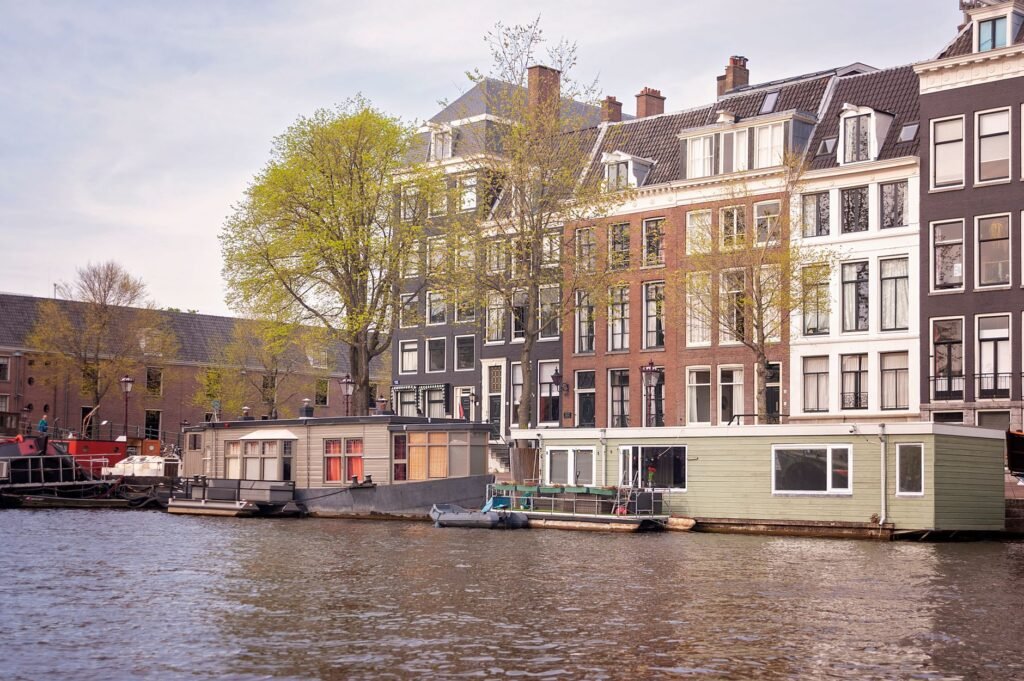
IPA itself is a British beer style, but Amsterdam provides an interesting historical parallel.
The city’s relationship with hopped beer and maritime trade stretches back centuries before India Pale Ale existed.
According to the Amsterdam City Archives, a beer toll introduced in 1323 required ships carrying hopped beer from Germany and Denmark into Holland to travel through Amsterdam or Medemblik.
Barrels were unloaded in Amsterdam and redistributed by local skippers to markets farther south.
The trade helped Amsterdam develop from a small settlement into an important European trading port.
The Amsterdam Museum consequently traces Amsterdam’s history as a beer city back to its role as a major market for German hopped beer.
The connection is particularly interesting because hops were valuable for more than taste: their contribution to beer’s keeping quality mattered in an age when storage and transport could take weeks or months.
Beer on Amsterdam’s Voyages to Asia
Amsterdam also had its own experience with the problem of transporting drink over enormous distances.
The city became the dominant center of the Dutch East India Company, or VOC, whose ships sailed from the Netherlands to Asia on voyages lasting many months.
Beer from nearby Weesp was among the provisions carried aboard VOC ships.
Amsterdam’s municipal history records that Weesp beer travelled on these ships because beer kept longer than water during the journey.
This beer was not India Pale Ale, and there is no direct line from Amsterdam’s VOC beer to the British IPA tradition.
But the parallel is striking.
Dutch and British maritime traders faced the same practical question: how do you transport beer through changing temperatures and tropical climates for months without it becoming undrinkable?
The eventual British answer included strongly hopped pale ales that evolved into IPA.
IPA in Amsterdam Today
Amsterdam’s modern craft breweries have taken the IPA in almost every direction imaginable.
Traditional bitterness, American West Coast hops, hazy New England styles, Double IPAs and alcohol-free versions can all be found among beers brewed in the city.
Brouwerij ‘t IJ IPA
One of Amsterdam’s best-known breweries, Brouwerij ‘t IJ, started brewing in the city in 1985.
Its IPA is a 6.5% dark-blond beer made with Amsterdam tap water and dry hopped with Cascade, Citra and Mosaic.
The brewery describes grapefruit, floral aromas and a lingering fruity bitterness.
‘t IJ also demonstrates how far IPA has diversified.
Its NIJPA is a 6.2% New England-style interpretation built around tropical flavors such as pineapple, peach and guava, while Free IPA offers a very low-alcohol alternative.
Oedipus Gaia
Amsterdam-Noord brewery Oedipus takes a distinctly American direction with Gaia, a 7% West Coast IPA.
American hops produce grapefruit and yellow stone-fruit flavors backed by the piney, resinous character traditionally associated with the West Coast style.
The brewery also makes other hop-forward beers, illustrating how American IPA traditions have been absorbed into Amsterdam’s own brewing culture rather than simply copied from abroad.
Walhalla’s Family of IPAs
Few Amsterdam breweries explore the IPA family as broadly as Walhalla.
Its permanent range includes Loki Golden IPA at 5.5%, Elixer New England IPA at 6%, Nisaba West Coast IPA at 6.5% and Zeus Double IPA at 8%, alongside rotating and seasonal hop-focused beers.
Together they offer a useful demonstration of how the word IPA now encompasses very different beers: Loki is relatively light and citrusy, Elixer emphasizes a softer New England profile, Nisaba returns to piney and bitter West Coast territory, and Zeus increases both strength and hop intensity.
Two Chefs Green Bullet
Another established Amsterdam example is Green Bullet from Two Chefs Brewing.
The 6.5% IPA combines Citra, Chinook and Columbus hops, giving it floral, citrus, grapefruit and peach notes together with a pronounced bitterness.
Two Chefs also brews New England, Session and experimental IPAs, making it another good example of the way Amsterdam brewers have moved from the traditional idea of one IPA style toward a much broader spectrum of hop-focused beers.
Where to Drink IPA in Amsterdam
For anyone who wants to explore the style rather than simply buy a bottle, Amsterdam has several particularly useful places to start.
Brouwerij ‘t IJ – Proeflokaal de Molen: The brewery’s original tasting room at Funenkade 7 sits beside the De Gooyer windmill in Amsterdam-Oost.
It is the obvious place to compare ‘t IJ’s own IPA with its other beers and rotating specials.
Brouwerij ‘t IJ tasting rooms.
Walhalla Taproom: Walhalla’s brewery and tasting room at Asterweg 2 in Amsterdam-Noord is particularly suitable for comparing different IPA substyles because several form part of the brewery’s core range.
Oedipus Craft Space: At Schaafstraat 21 in Amsterdam-Noord, Oedipus serves beer at the brewery itself, including its hop-forward beers such as Gaia.
BeerTemple: For the American side of IPA history, BeerTemple at Nieuwezijds Voorburgwal 250 is particularly relevant.
The Amsterdam bar specializes in American beer and lists around 50 taps, including roughly 30 American and Canadian beers.
It opened in 2009, when intensely hopped American craft beer was becoming increasingly influential in Europe.
Proeflokaal Arendsnest: For the Dutch interpretation of the same revolution, Arendsnest at Herengracht 90 serves only Dutch products and offers 52 beers on tap.
Its regular brewery selection includes Amsterdam names such as Two Chefs and Walhalla, making it a useful place to compare locally brewed IPAs with versions from elsewhere in the Netherlands.
From Preservation to Hop Aroma
The history of IPA therefore comes full circle in an interesting way.
Hops were once prized partly because a heavily hopped beer could remain in better condition during long storage and transport.
Today’s brewers still use enormous quantities of hops, but usually for a very different reason: aroma and flavor.
A modern Amsterdam IPA filled with Citra, Mosaic or Simcoe hops is expected to be consumed fresh because the volatile aromas that brewers work so hard to create gradually fade.
The ingredient that once helped beer survive a six-month voyage is now often responsible for making freshness one of the most important qualities of the finished beer.
That transformation - from a durable export pale ale associated with Britain’s trade with India to hazy, citrus-heavy and intensely aromatic beers brewed beside Amsterdam’s canals and former shipyards - explains why IPA remains one of brewing’s most adaptable and enduring styles.