Amsterdam’s public transport divides neatly by job: trams for the historic centre, the metro for anything longer than a couple of kilometres, free ferries to Noord, and NS trains for the airport and day trips.
The only decision that costs you money is which ticket you buy, so this guide leads with the fares.
What It Costs In 2026
Tapping a contactless bank card or phone through OVpay charges a €1.16 boarding fee plus €0.217 per kilometre travelled on GVB trams, buses and metro.
A typical centre-to-Museumplein hop therefore comes in under €2.
A paper or app single valid for one hour costs €3.40, which only makes sense if you are changing lines within the hour.
GVB day tickets cover unlimited travel on GVB trams, buses, metro and night buses, and they run €10 for 24 hours, €16 for 48, €21.50 for 72, €27.50 for 96, €34 for 120, €39 for 144 and €43 for a full week.
Children aged four to eleven pay €5 for the 24-hour version, and under-fours travel free.
The break-even point against OVpay sits at roughly five or six rides a day, so a 24-hour ticket pays for itself on a museum-hopping day and loses money on a walking day.
Two tickets extend beyond the GVB network.
The Amsterdam Travel Ticket adds the train and bus link to Schiphol and costs €20, €27 or €34 for one, two or three days.
The Amsterdam & Region Travel Ticket stretches to Haarlem, Zaandam, Zandvoort and the Waterland villages at €23, €34 or €44.
The I amsterdam City Card bundles GVB travel with free entry to most major museums, starting at €67 for 24 hours and rising to €140 for five days.
It only repays you at a rate of roughly two paid attractions a day, which is a harder pace than most people actually keep.
Paying: What Changed This Year
OVpay is now the default and works with Mastercard and Visa contactless cards, Apple Pay and Google Pay.
Tap in on boarding and tap out on leaving with the same card or device every time, or you are charged the maximum fare for the line.
The anonymous blue OV-chipkaart is no longer sold - sales stopped on 1 July 2026 - although cards already in circulation keep working until the system is retired at the end of 2027.
If you were planning to buy one on arrival, buy a GVB day ticket or use contactless instead.
One warning that catches people out: a single bank card counts as one traveller.
Two people cannot tap the same card, so a couple needs two cards, two phones, or a paper ticket each.
Which Service For Which Trip
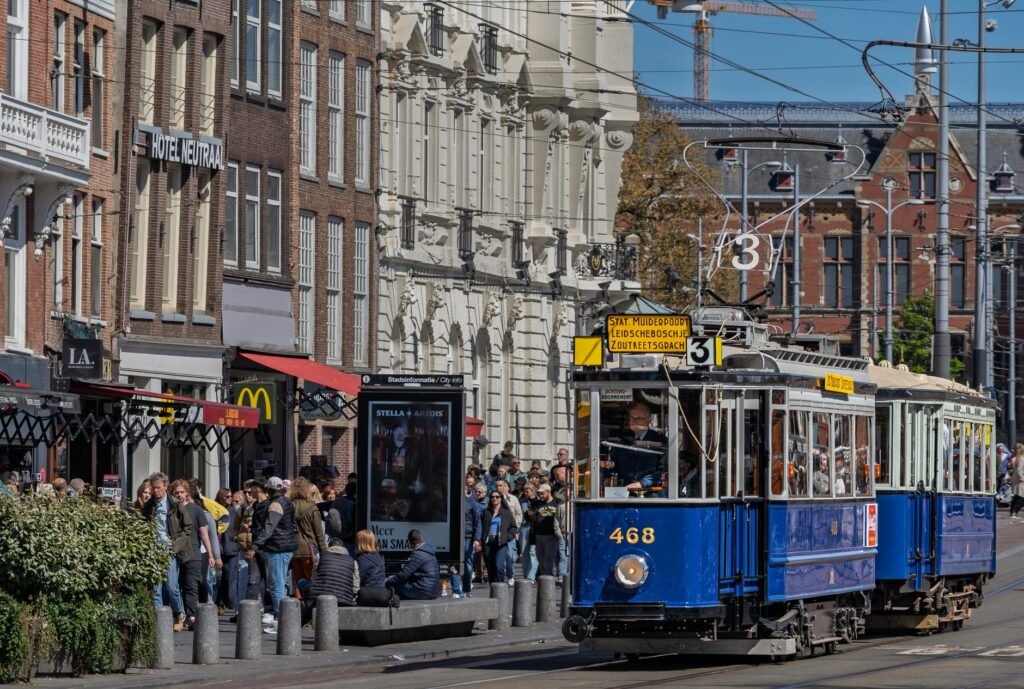
Trams handle the centre and are the reason most visitors never look at a metro map.
Lines converge on Centraal Station and fan out through Dam Square, Leidseplein, Museumplein and De Pijp, and you are rarely more than a few minutes’ walk from a stop inside the canal ring.
The Noord/Zuidlijn, metro line 52, is the fastest thing in the city and runs from Noord under the IJ to Centraal, Rokin, Vijzelgracht, De Pijp and Zuid in a few minutes end to end.
Use it whenever you are crossing the city rather than moving within the centre.
The GVB ferries behind Centraal Station are free and need no ticket at all.
The Buiksloterweg boat is the two-minute crossing to the Eye Filmmuseum and the A’DAM Tower; the NDSM ferry takes about fifteen minutes and lands at the old shipyard.
For anything outside the city, NS trains are faster than the bus and reach Haarlem in about fifteen minutes, Utrecht in around half an hour and Rotterdam in about forty on the direct service.
Schiphol And Journey Planning
Trains to Schiphol leave Amsterdam Centraal several times an hour from a platform that runs directly beneath the terminal, taking fifteen to twenty minutes.
OVpay works on NS as well, so the same card covers the whole journey.
The Airport Express bus 397 runs to Museumplein and Leidseplein and is the better choice if you are staying in the south or west of the centre rather than near a station.
Night buses cover the hours after the trams stop, around half past midnight, and are included in GVB day tickets.
For planning, 9292 covers every Dutch operator door to door, the GVB app carries live departures and disruption notices for the city network, and Google Maps is adequate for a quick check.
Track works are common in summer and are announced in the GVB app before they appear anywhere else.
Frequently Asked Questions
Fares, passes and the airport account for most of what visitors need to sort out before arriving.
How much is a day ticket for Amsterdam public transport?
A GVB 24-hour ticket is €10 for an adult and €5 for a child aged four to eleven, covering trams, buses, metro and night buses inside the city.
Longer versions run up to €43 for seven days.
How do I pay for a tram in Amsterdam?
Tap a contactless bank card or phone on the pink OVpay reader when you board and again when you get off, which charges €1.16 plus €0.217 per kilometre.
Use the same card both ways, and one card per person.
Can I still buy an OV-chipkaart as a visitor?
No - anonymous OV-chipkaarten stopped being sold on 1 July 2026, and the card is being retired entirely by the end of 2027.
Contactless payment or a GVB day ticket replaces it.
Is the I amsterdam City Card worth it?
It costs €67 for a day and includes GVB travel plus entry to most major museums, so it repays you only if you visit at least two paid attractions daily.
For a slower itinerary, a GVB day ticket plus individual museum tickets works out cheaper.
What is the easiest way from Schiphol to central Amsterdam?
The train from beneath the terminal to Amsterdam Centraal takes fifteen to twenty minutes and accepts the same contactless card you use in the city.
Bus 397 is more direct if your hotel is near Museumplein or Leidseplein.
Are the ferries free?
The GVB ferries across the IJ from behind Centraal Station are free and require no ticket or tap.
They also take bicycles at no charge.
Which app should I use?
9292 for door-to-door routes across the whole country, and the GVB app for live city departures and disruptions.
Both are free and neither requires an account.
Related reading
In the news
- No trains at Amsterdam Centraal on Saturday 3 October 2 October 2026
- Zuidoost residents push back against metro renumbering 25 September 2026
- No trains at Centraal Station on Saturday 24 September 2026
- Amsterdam metro lines to rebrand as M1 through M4 21 September 2026
- Anouk plans Ziggo Dome afternoon concert 5 September 2026