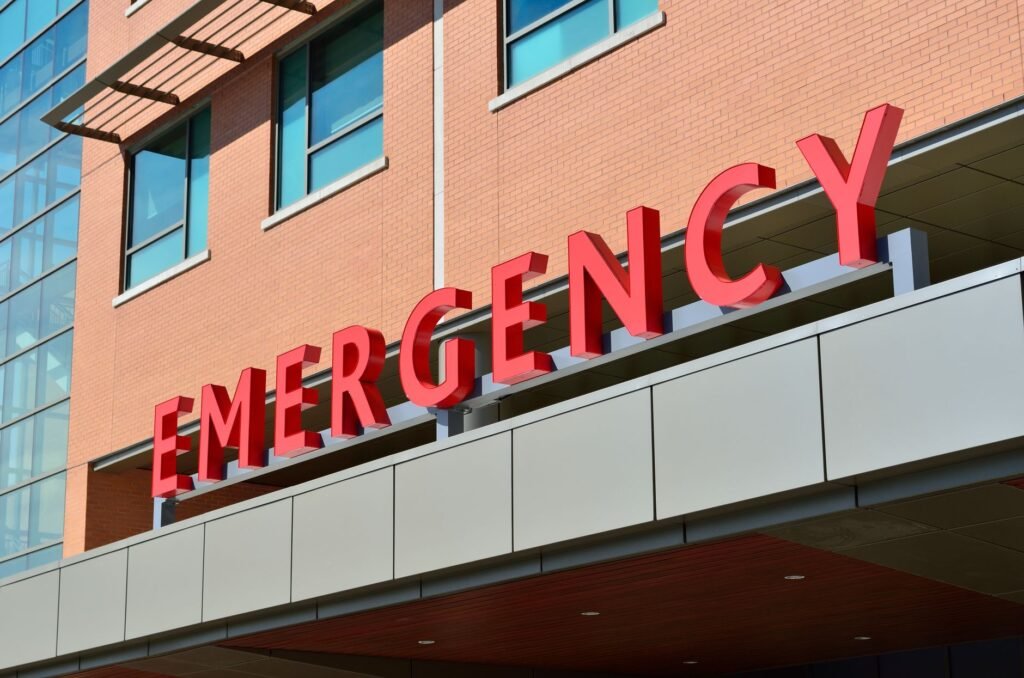
You cannot walk into an Amsterdam emergency department and be seen, and that single rule causes more confusion for arrivals than anything else in Dutch healthcare.
Unless an ambulance brings you, the route to a hospital runs through a doctor first: your huisarts in working hours, or the out-of-hours GP service on 088 00 30 600.
The out-of-hours service covers weekday evenings and nights from five until eight, and runs around the clock at weekends and on national holidays.
You telephone, you are given an appointment, and you attend at the time you are given, because there is no waiting room to sit in unannounced.
112, The Huisartsenpost, Or The Emergency Department
Call 112 for anything that looks life-threatening: chest pain, difficulty breathing, heavy bleeding, a serious fall, a suspected stroke.
The ambulance service decides where you go, and that decision overrides everything below.
For the enormous middle ground - a wound that may need stitches, a child with a fever at midnight, a fracture you can still walk on - the huisartsenpost is the correct door.
Amsterdam runs four of them, deliberately placed inside the hospitals: CentrumOost at Oosterpark 9, West at Jan Tooropstraat 164, Noord at Statenjachtstraat 1 and Zuidoost at Meibergdreef 9.
If the GP there decides you need hospital care, you are walked or sent a few metres to the emergency department with a referral, which is faster than arriving without one.
The site moetiknaardedokter.nl exists precisely for this judgment and will tell you whether to call at all.
The Hospitals, And What Each One Is For
OLVG is the city’s general hospital and runs emergency departments at two sites, both open around the clock.
OLVG Oost sits at Oosterpark 9 with the emergency entrance on Ruyschstraat and answers on 020 599 30 16, while OLVG West is at Jan Tooropstraat 164 on 020 510 81 61.
OLVG also runs an outpatient location at Spuistraat 239a in the centre, open weekdays from seven in the morning until seven in the evening, which handles appointments rather than emergencies.
BovenIJ covers Amsterdam Noord from Statenjachtstraat 1 on 020 634 6346, with emergency care seven days a week around the clock and the entrance at the rear of the building.
Beyond the emergency room it runs an acute admissions ward, a cardiac emergency unit, intensive care and a trauma clinic, so a north-side injury does not need to cross the IJ.
Amsterdam UMC is the university hospital and the place complex cases end up, split across two sites: AMC at Meibergdreef 9 in Zuidoost on 020 566 9111, and VUmc at De Boelelaan 1117 in Zuid on 020 444 4444.
This is where you go for specialist and rare conditions, usually on referral from another hospital rather than directly.
The Antoni van Leeuwenhoek on Plesmanlaan is a dedicated cancer hospital and research institute, entered by referral and not by arriving at a door.
What It Costs, And What To Bring
Dutch hospital treatment is billed as a care pathway rather than per item, so the invoice covers a whole episode - consultation, imaging, procedure and follow-up - and arrives long after the treatment.
Residents pay through their insurer, and the compulsory excess of €385 for 2026 applies to hospital care in full before the policy starts paying.
That excess does not apply to visits to your own huisarts, which is why the GP route is cheaper as well as faster.
Visitors without Dutch cover are billed directly and should expect to settle it themselves and reclaim from a travel insurer afterwards.
Bring photo identification, your insurance details or European Health Insurance Card, a list of your medication with generic names and doses, and the name of your GP if you have registered with one.
Dutch hospitals hold records digitally under your citizen service number, so having your BSN to hand saves a slow start.
English is spoken throughout, and you do not need to arrange an interpreter for ordinary treatment.
For more of the practical detail of living here, you can sign up to the Essentially Amsterdam newsletter.
Frequently Asked Questions
These are the questions that come up in the moment, when the decision is which number to ring.
Can I just go to the emergency department?
Not usually, since in principle you always call the huisartsenpost first and are referred on from there.
An ambulance arriving with you is the exception, and so is a genuinely life-threatening emergency, for which you call 112.
What number do I call at night?
088 00 30 600 reaches the Amsterdam out-of-hours GP service, staffed from five in the evening until eight in the morning on weekdays and continuously at weekends and on national holidays.
You cannot attend without an appointment, so the call comes first.
Which Amsterdam hospitals have a 24-hour emergency department?
OLVG Oost at Oosterpark 9 and OLVG West at Jan Tooropstraat 164, and BovenIJ at Statenjachtstraat 1 in Noord.
Amsterdam UMC’s AMC and VUmc sites handle complex and specialist acute care, generally on referral.
Will I be charged?
Residents are billed through their insurer, with the €385 compulsory excess applying to hospital care before cover starts.
Visitors are billed directly and should keep everything for a travel insurance claim.
What should I take with me?
Photo identification, your insurance card or EHIC, your BSN if you have one, and a written list of your medication with generic names and doses.
Take the packaging too, since a brand name from home often means nothing to a Dutch clinician.
Is treatment available in English?
Yes, throughout, and there is no need to arrange an interpreter for standard hospital care in Amsterdam.
Written correspondence and appointment letters, however, will usually arrive in Dutch.