Amsterdam shopping is organised by street, not by shop, and the streets are close enough together to do three of them in an afternoon.
Pick the area that matches what you want and the rest follows.
One practical thing first: many small independent shops open late or not at all on Monday morning, and Sunday trading in the centre generally runs from around noon to six.
The Canal Ring And The Jordaan
De Negen Straatjes - the Nine Streets - is the block of nine short cross-streets linking the main canals between Leidsegracht and Raadhuisstraat.
Wolvenstraat and Runstraat are the two to start on, with vintage, denim, jewellery and Dutch design within a few doors of each other.
Go before midday, because the area fills up from early afternoon and the streets are narrow enough that it matters.
The Jordaan, immediately west, is less curated and more local, with the concentration around Elandsgracht.
Laura Dols on Wolvenstraat is the vintage shop people remember, stocked with theatrical and formal wear rather than everyday secondhand.
Haarlemmerstraat and its continuation Haarlemmerdijk run north of the Jordaan and mix independent fashion with specialist food shops.
Utrechtsestraat, running south from the Amstel, is the quieter equivalent on the east side of the canal ring.
Gerard Doustraat in De Pijp is scruffier and cheaper, and it runs off the Albert Cuyp market.
Luxury, Department Stores And High Street
Pieter Cornelisz Hooftstraat in Oud-Zuid, known to everyone as PC Hooftstraat, is the luxury street, running from the Museumplein towards the Vondelpark.
Van Baerlestraat crosses it and Cornelis Schuytstraat sits just beyond, both quieter and both worth the extra five minutes’ walk.
Beethovenstraat, further south again, is where the same kind of shops serve people who live there rather than visitors.
De Bijenkorf on Dam square is the main department store and the simplest single stop if you are short of time.
Magna Plaza, in the old post office building directly behind the Royal Palace, is worth entering for the building whether or not you buy anything.
Kalverstraat is the high-street chain run between Dam square and Muntplein, and it is heaving from late morning until closing.
Leidsestraat and Nieuwendijk carry the same kind of shops with slightly fewer people on them.
Markets, And When They Are Actually On
Albert Cuypmarkt in De Pijp runs Monday to Saturday, roughly 09:00 to 17:00, and is closed on Sunday.
It is the largest daily market in the country and mixes food, fabric, flowers and cheap household goods.
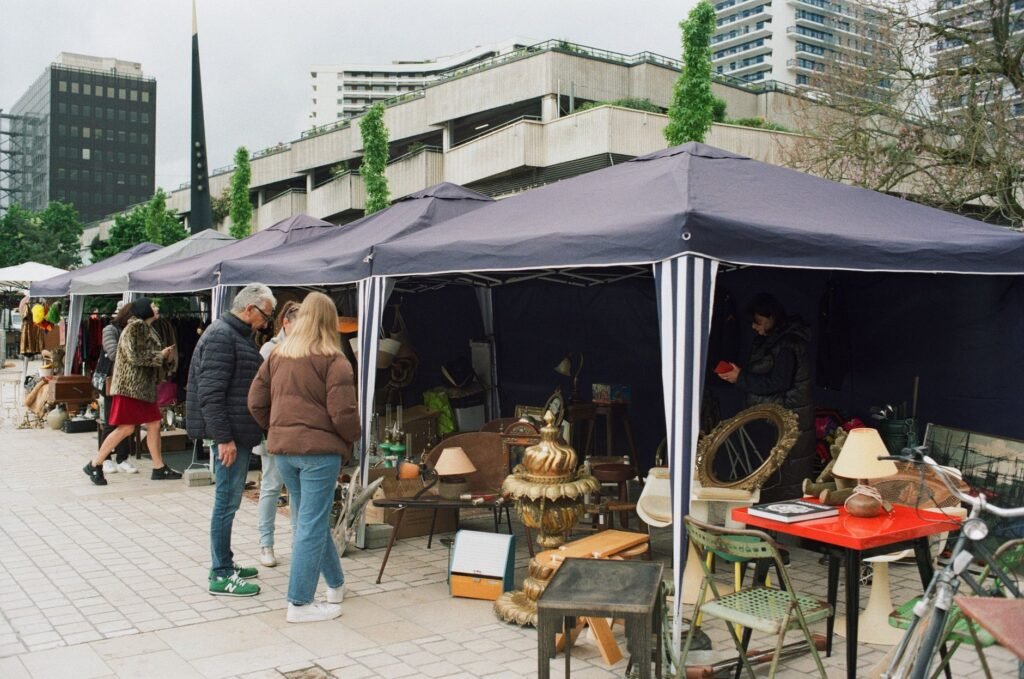
Waterlooplein, the secondhand and flea market beside the Stopera, also runs Monday to Saturday.
Dappermarkt in Oost and Ten Katemarkt in West both run Monday to Saturday and are ordinary neighbourhood markets rather than attractions, which is exactly their appeal.
Noordermarkt in the Jordaan is two different markets: an organic farmers’ market on Saturday morning, and a flea market on Monday morning spilling into Westerstraat.
The Lindengracht market, a few streets away, is on Saturday.
The Bloemenmarkt on the Singel is open daily and sells bulbs and souvenirs rather than cut flowers worth carrying home.
IJ-Hallen at the NDSM wharf in Noord is Europe’s largest flea market and runs on one weekend a month, reached by the free ferry from behind Centraal.
Antiques, And What Is Worth Taking Home
The Spiegelkwartier, on Nieuwe Spiegelstraat between the Rijksmuseum and the Herengracht, is the antiques district: prints, maps, ceramics and small furniture.
Delft Blue is worth buying from a dealer there or from a proper shop rather than from a souvenir strip, where nearly all of it is transfer-printed elsewhere.
Cheese, stroopwafels and jenever travel well and cost a fraction of the airport price when bought at a market.
Old maps and canal-house prints from the Spiegelkwartier pack flat and are the one genuinely local souvenir that does not look like one.
Outlets Outside The City
Amsterdam The Style Outlets is at Halfweg, between Amsterdam and Haarlem, about fifteen minutes out by car and reachable by train to Halfweg-Zwanenburg.
Batavia Stad Fashion Outlet is at Lelystad, roughly an hour east, and is the larger of the two.
Designer Outlet Roermond, in Limburg, is the biggest in the country and a two-hour drive, which makes it a day out rather than an errand.
Amsterdam itself has no outlet centre, which is why the shopping in town is either full price or secondhand.
Frequently Asked Questions
Which shopping areas should I actually visit?
De Negen Straatjes for independents, PC Hooftstraat for luxury, and Kalverstraat for chains.
Haarlemmerstraat and Utrechtsestraat are the two that most reward wandering.
Where do I go for clothes?
PC Hooftstraat and Cornelis Schuytstraat for designer labels, Kalverstraat and Nieuwendijk for high street, and the Nine Streets for independent and vintage.
Gerard Doustraat and Haarlemmerdijk are cheaper and less predictable.
When are the markets open?
Albert Cuyp, Waterlooplein, Dappermarkt and Ten Kate all run Monday to Saturday.
Noordermarkt is a farmers’ market on Saturday and a flea market on Monday, Lindengracht is Saturday, and IJ-Hallen is one weekend a month.
Are there outlets near Amsterdam?
Amsterdam The Style Outlets at Halfweg is the closest, Batavia Stad at Lelystad is about an hour away, and Designer Outlet Roermond is the largest but a two-hour drive.
There is no outlet centre inside Amsterdam itself.
Where do I find bargains in the city?
Waterlooplein and IJ-Hallen for secondhand, Dappermarkt and Ten Kate for everyday goods.
Prices drop noticeably one street back from any main shopping route.
What is worth buying as a souvenir?
Cheese, stroopwafels and jenever from a market, and antique prints or maps from the Spiegelkwartier.
Buy Delft Blue from a dealer rather than a souvenir shop if you want the real thing.
Are shops open on Sundays?
In the centre and on the main streets, generally from around noon until six.
Small independents often stay shut on Sunday and open late on Monday, so save those for a weekday.
Hunting for something old rather than new?
Try our guide to vintage and kringloop shops in Amsterdam.
In the news
- Ben G skateshop faces toughest times in 21 years 29 September 2026
- Extra fee on non-EU parcels from November 23 September 2026
- Dutch shoppers order less from Chinese online stores following EU import tariffs 11 August 2026