
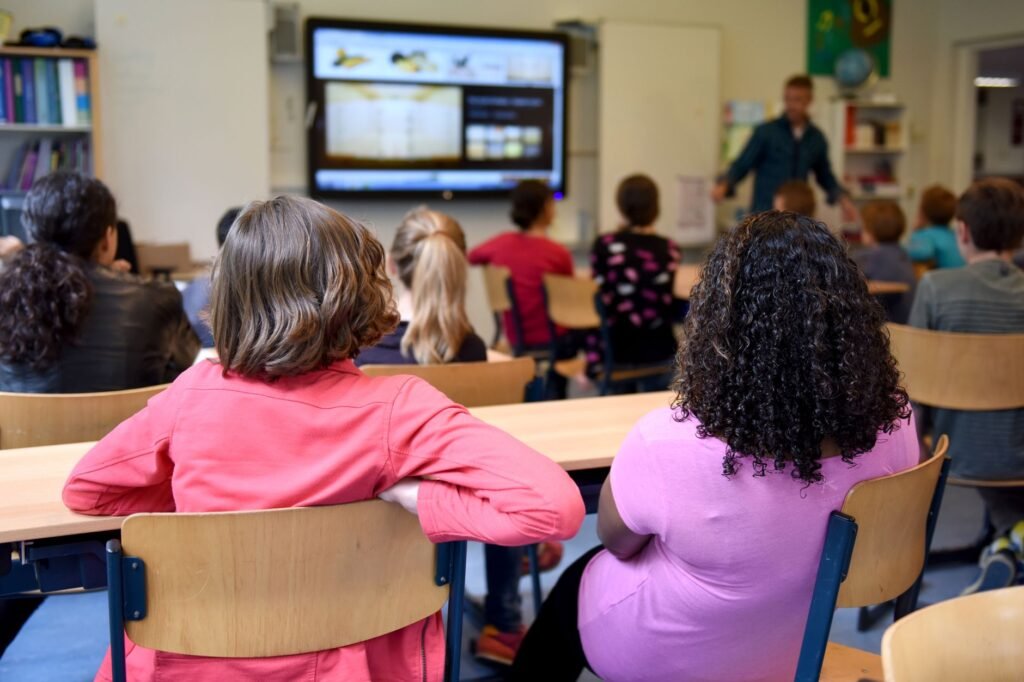
Most newcomers find the Dutch education system baffling for one reason: it sorts children into academic and vocational routes at about the age of twelve.
To anyone from a system where that decision comes at sixteen or eighteen, this feels alarmingly early.
It is also less final than it looks, and understanding why is the key to the whole thing.
This guide covers the national system, published in outline by the Dutch government, and then how school choice, admission and international education actually work in Amsterdam - which is where most of the practical difficulty lies.
The system at a glance
The path runs from childcare and preschool, into primary school at four, into secondary school at around twelve, and from there into vocational or higher education.
The terms you will meet immediately: basisschool is primary school, middelbare school is secondary.
Within secondary there are three routes - vmbo, havo and vwo.
Beyond school, mbo is vocational education, hbo is higher professional education, and wo is university.
I amsterdam publishes a good overview of the structure.
The important thing is that these are connected routes rather than a single ladder with winners and losers.
Students move between them, and many arrive at a university degree by a longer path.
Preschool and childcare
Three different things get called “preschool” in English, and they are not the same.
Daycare (kinderopvang) is childcare for working parents, generally from a few months old and paid for privately with a means-tested government allowance.
Preschool (peuterspeelzaal) is a few mornings a week for two- and three-year-olds, focused on play and socialising.
Early childhood education, Amsterdam’s voorschool programme, is a targeted version aimed at language and general development before primary school begins.
Voorschool places are free or heavily subsidised for children who qualify, usually on the basis of parental education or language background.
If your child may benefit, ask the consultatiebureau - the child health clinic - rather than waiting to be offered it.
For the practicalities of finding a place, see our guide to daycare and childcare in Amsterdam.
Primary education
Children may start primary school the day after their fourth birthday, and attendance becomes compulsory at five.
They stay until about twelve.
The eight years are called groep 1 to groep 8.
The first two are effectively kindergarten - play-based, with reading and writing beginning properly in groep 3.
Schools divide into public (openbaar), religious (bijzonder, most often Catholic or Protestant but also Islamic and Jewish), and alternative pedagogies.
All are state-funded and free, including the religious ones, which is a surprise to many newcomers.
The alternative approaches are genuinely different rather than branding.
Montessori schools let children work at their own pace on self-chosen tasks; Dalton emphasises independence and responsibility; Jenaplan groups children of different ages together and organises learning around themes.
The national rules on primary education apply to all of them equally.
Choosing a primary school in Amsterdam
Amsterdam runs a centralised admission system, and this is where families most often go wrong by assuming they can simply apply to the school they like.
You submit a ranked preference list.
Children get priority at schools near their registered home address, and when a school is oversubscribed - which the popular ones always are - places are allocated by lottery weighted by that priority.
Two consequences follow.
Your address materially affects which schools you can realistically get into, and listing only one school is a poor strategy.
The Amsterdam School Finder is the official tool, covering more than 200 primary schools along with childcare and special education.
It shows catchment priority for a given address, which is the single most useful thing you can check before signing a lease.
Secondary education and the school recommendation
At the end of groep 8, the primary school issues a schooladvies - a recommendation for which secondary route the child should take.
This carries more weight than any exam.
Children also sit the doorstroomtoets, a national test taken in the final year.
If the test result is higher than the recommendation, the school must reconsider and may revise it upward; it cannot be revised downward.
So placement is not decided by one test on one morning.
It rests on eight years of teacher observation, with the test acting as a check on it.
Many schools also offer a brugklas - a bridge class combining two levels, such as havo/vwo, for the first year or two.
This postpones the final decision for children who are genuinely borderline, and it is worth asking about specifically.
The government sets out how secondary education works in more detail.
The three main secondary routes
Vmbo takes four years and is mainly vocational, leading into mbo.
It is the route about half of Dutch children take, and it carries none of the stigma a newcomer might expect.
Havo takes five years and prepares students for hbo.
Vwo takes six and prepares them for university, and includes the gymnasium variant with Latin and Greek.
The crucial point is that these are permeable.
A student can finish vmbo, go to mbo, then move to hbo, and from hbo to a university master’s degree.
That path takes longer than going straight through vwo, but it arrives at the same place.
The official comparison of the routes sets out the transfers between them.
Applying to secondary school in Amsterdam
Amsterdam again uses a citywide matching system with ranked preferences, run once a year with firm deadlines.
Schools hold information evenings in the autumn and winter, and these are worth attending in person - the difference between a school that suits your child and one that does not is rarely visible on a website.
Research several schools at the recommended level rather than fixing on one.
The matching algorithm gives you your highest-ranked school with a place available, so a longer honest list improves your outcome rather than diluting it.
Details are on the city’s secondary school pages and in the School Finder’s secondary section.
Vocational education and MBO
Mbo runs at four levels, from assistant training at level 1 to middle-management and specialist qualifications at level 4.
Level 4 gives access to hbo.
There are two study modes.
Bol is school-based with placements; bbl is work-based, where students are employed and study part-time - effectively a paid apprenticeship.
Bbl deserves more attention from newcomers than it gets.
It is a real job with a real salary while qualifying, and in trades with shortages it leads directly to steady work.
ROC van Amsterdam is the city’s main provider, with campuses across the region and courses in most fields.
Higher education: HBO and WO
Dutch higher education is split into two types rather than ranked into a hierarchy.
Hbo is professionally oriented, taught at universities of applied sciences, with placements built into the degree.
Wo is academic, taught at research universities, and more theoretical.
Both award bachelor’s and master’s degrees, and both are recognised qualifications.
Amsterdam has three major institutions.
The University of Amsterdam and the Vrije Universiteit are research universities; the Amsterdam University of Applied Sciences is the hbo institution.
International and bilingual education
Families arriving from abroad face a genuine choice rather than an obvious answer.
Dutch schools are free, integrate children into local life, and produce fluent Dutch speakers within a couple of years at primary age.
Subsidised international schools charge modest fees and teach in English.
Private international schools charge substantially more and offer continuity for families who expect to move again.
The honest rule of thumb: the younger the child and the longer you expect to stay, the stronger the case for a Dutch school.
The older the child and the more likely another move, the stronger the case for international.
The city sets out the international school options, and I amsterdam publishes both a list of schools in the area and a useful piece weighing international against Dutch education.
For the schools themselves - who they suit, what they cost and how long the waiting lists run - see our guide to international schools in Amsterdam.
Education for children who do not yet speak Dutch
Children arriving without Dutch do not go straight into a mainstream classroom.
They spend roughly a year in a dedicated newcomer class first.
At primary level these are nieuwkomersklassen; at secondary level they are international transition classes, ISK.
Both provide intensive Dutch before the child moves into normal schooling.
This system works well and is one of the strongest arguments for choosing a Dutch school.
The city also lists further language support.
Parents learning alongside their children can compare options in our guide to language schools in Amsterdam.
Special educational needs and additional support
The governing principle is passend onderwijs - appropriate education - which obliges schools to find a suitable place for every child, in mainstream education where possible.
Every school publishes a support profile (schoolondersteuningsprofiel) setting out what it can and cannot provide.
Read it, and then discuss your child’s needs with the school directly before applying rather than after.
Where mainstream schooling is not appropriate, special education (speciaal onderwijs) exists as a separate system.
The government explains how appropriate education works.
School quality and inspections
Every school is inspected and the reports are public.
The Education Inspectorate publishes its findings, and Scholen op de Kaart shows results, class sizes, methods and parent satisfaction for each school.
Read these carefully rather than competitively.
A school’s average results reflect its intake as much as its teaching, and a school serving a mixed neighbourhood can be doing markedly better work than its scores suggest.
What to look for instead: the inspection judgement itself, staff turnover, how the school describes its approach to children who are struggling, and whether the atmosphere on a visit matches the prospectus.
Fees and other expenses
Dutch primary and secondary schools charge no tuition.
They are free, including the religious and alternative ones.
Schools do request a voluntary parental contribution (ouderbijdrage), typically tens to a few hundred euros a year, covering trips and extras.
It is genuinely voluntary and a school may not exclude a child for non-payment.
Real costs sit elsewhere: after-school care, lunch supervision, a laptop or tablet at secondary level, and school camps.
Budget for these rather than for tuition.
International schools are the exception, with fees from a few thousand euros at subsidised schools to tens of thousands at private ones.
Higher education has its own statutory tuition fees, considerably lower for EU students.
School hours, holidays and leave
Primary schools typically run from about 8:30 to 15:00, and many still finish early on Wednesdays.
After-school care (buitenschoolse opvang) covers the gap for working parents and is booked separately.
Holidays are set regionally, with the Netherlands divided into three regions to stagger the summer break.
The dates are published nationally - see also our guide to Amsterdam school holiday dates.
Term-time holidays are not permitted.
Compulsory attendance is enforced by a municipal officer, and taking a child out for a cheap flight can result in a fine.
Practical advice for families moving to Amsterdam
Start the school search before you move, not after you arrive.
Admission rounds have fixed deadlines and missing one costs you a year of preference.
Check catchment priority in the School Finder before you commit to an address.
Housing and schooling are the same decision in Amsterdam, whether or not anyone tells you so.
Visit several schools, and ask specifically about language support, current waiting lists, the school’s educational philosophy and whether after-school care is available on site.
I amsterdam has a practical page on finding the right school.
If the move itself is still ahead of you, see our guides to movers and storage and the Dutch healthcare system, both of which have their own deadlines.
The thing to hold on to
The Dutch system looks like an early, irreversible sorting of children.
It is better understood as several connected routes that all lead somewhere, with more movement between them than the vocabulary suggests.
Learn the national structure first, then learn Amsterdam’s admission procedures, because the second is what will actually determine where your child sits in September.
Frequently Asked Questions
When does school become compulsory in the Netherlands?
Leerplicht begins on the first school day of the month after a child’s fifth birthday and runs to sixteen.
From sixteen to eighteen the kwalificatieplicht applies, requiring continued study until the young person holds a havo, vwo or mbo level 2 diploma.
Is the cito-toets still used?
No - the end-of-primary test is the doorstroomtoets, sat between late January and mid-February, and it now follows the teacher’s provisional advice instead of preceding it.
Cito is one of several providers of that test, which is why the old name refuses to die.
How do children get a secondary school place in Amsterdam?
Through one central lottery: parents submit a single ranked preference list in the last week of March and every child in the city is matched in one round, with results in early April.
You are not applying to schools individually, and visiting open days in November and December is how families build the list.
Can a child move between vmbo, havo and vwo later?
Yes, and it happens routinely, both through the brugklas and by stacking diplomas afterwards.
A vmbo-t diploma can lead into havo, mbo level 4 into hbo, and hbo into a university master’s, so an early track is a starting point rather than a ceiling.
What documents does an international family need to enrol?
Proof of your Amsterdam address, the child’s passport, previous school reports and BSN registration cover most cases at a local school.
International and bilingual schools add their own forms, language assessments and waiting lists, so start those enquiries six to twelve months before you move.
How does this compare with the UK or US?
The decisive difference is age twelve, when Dutch children are sorted into tracks that American and British systems leave open for several more years.
The compensation is that the Dutch system is unusually permeable afterwards, with formal routes from every level to the one above it.
Related reading
In the news
- Amsterdam teacher reaches millions on TikTok 12 September 2026
- Amsterdam school lottery encourages strategic lying by parents 11 September 2026
- Schools told to accommodate pupils’ home languages 8 September 2026
- School trips disappear as parent funding falls short 28 August 2026
![Top [count] Travel Blogs to Follow - OnToplist.com](https://www.ontoplist.com/images/ontoplist31.png?id=6a8dcf108f478)