Dutch children are sorted into one of three secondary tracks at age twelve, and that decision shapes what they can study for the next decade.
Everything else about the system - the free tuition, the eight primary groups, the religious and Montessori schools funded on identical terms - matters less than understanding that split before your child reaches it.
Primary: Groep 1 To Groep 8
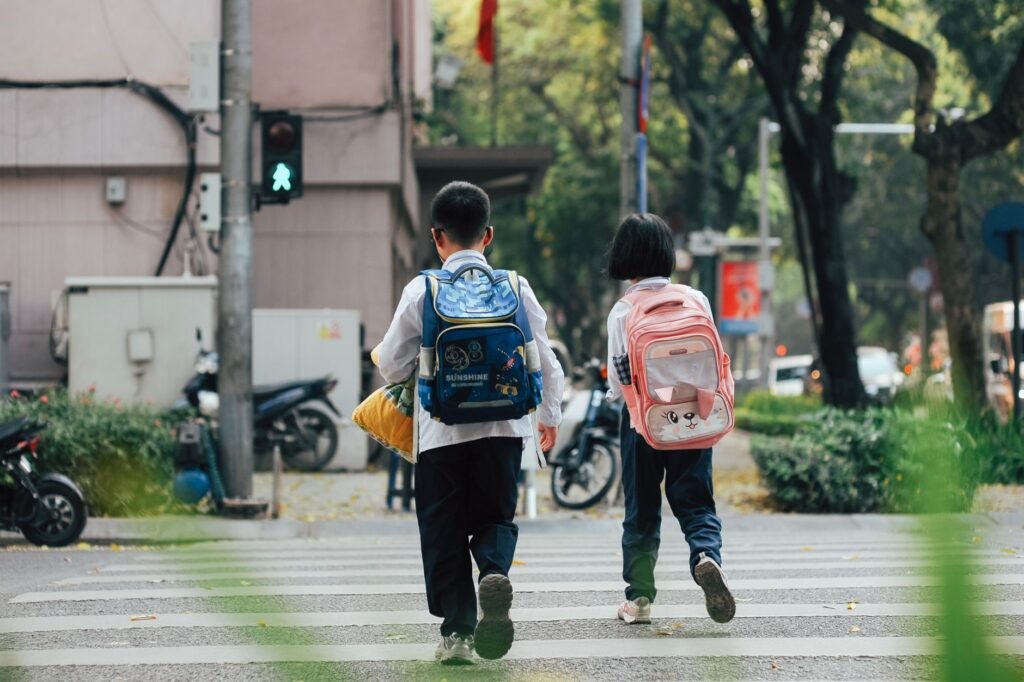
Children may start basisschool at four, and compulsory education (leerplicht) begins at five.
Almost everyone starts at four, so arriving mid-year with a four-year-old means joining a class already formed.
Groups 1 and 2 are kindergarten in all but name, taught through play rather than formal lessons.
Reading, writing and arithmetic begin in groep 3, and English usually appears in groep 7.
Before basisschool, families use a kinderdagverblijf from about ten weeks old, or a peuterspeelzaal playgroup from two - neither is part of the education system, and both attract the childcare allowance described in the childcare guide.
The Doorstroomtoets
In groep 8 every child sits the doorstroomtoets, the national test that was renamed from the cito-toets in 2023 and moved earlier in the school year.
It is taken in the first half of February, and the results arrive before the school’s own advice is finalised.
The school’s advice, not the test, is what determines placement - but a test result higher than the advice obliges the school to reconsider it upwards.
That reconsideration is the one lever parents actually have, so know it exists before the letter arrives.
The Three Secondary Tracks
Most schools begin with a brugklas, a bridge year that can be set at a single level or straddle two while the placement settles.
Ask which kind a school offers, because a dual-level brugklas keeps the decision open for another year.
VMBO - Pre-Vocational, 4 Years
Around half of Dutch pupils take this route, which leads on to vocational training rather than to a university.
It splits into four sub-tracks: basis and kader are workshop-based and practical, gemengd sits between, and vmbo-t (also called mavo) is the theoretical one that can lead upwards into HAVO.
Praktijkonderwijs is a separate route again, for pupils who need highly individualised practical teaching.
HAVO - General Secondary, 5 Years
Roughly a quarter of pupils take HAVO, which leads to a hogeschool rather than a research university.
From the fourth year pupils choose one of four profiles: culture and society, economics and society, nature and health, or nature and technology.
VWO - Pre-University, 6 Years
The academic track, and the only one giving direct entry to a Dutch research university.
It comes in two forms - atheneum, and gymnasium, which adds Latin and Ancient Greek - and uses the same four profiles as HAVO.
Movement between tracks is built in rather than exceptional, upward with a good year’s results and downward when a placement is not working.
A school-by-school description of the structure is worth reading alongside any individual school’s prospectus.
Where Each Track Leads
VMBO leads to MBO, HAVO to HBO, VWO to WO.
None of those is a dead end, which is the part that reassures parents used to a single-track system.
MBO is secondary vocational education, one to four years, in fields from healthcare to engineering to hospitality, with a work placement built into most programmes.
Finishing MBO level 4 opens the door to HBO, so the vocational start does not close off a degree.
HBO at a hogeschool is a four-year professional bachelor’s, entered with a HAVO diploma or MBO level 4.
WO at a research university needs a VWO diploma, or a completed first year of HBO, or the final two years of VWO.
Popular programmes at both levels use a numerus fixus, capping places and selecting among applicants.
Application for those runs through Studielink on a fixed January deadline, months earlier than the rest.
Dutch, Bilingual Or International
Regular Dutch schools are free apart from a voluntary parental contribution, and they put your child into Dutch from day one.
If you expect to stay more than a couple of years, this is the route that actually integrates a child, and taking a Dutch course yourself makes the homework survivable.
Newly arrived children who speak no Dutch usually spend a year first in a nieuwkomersklas or internationale schakelklas before joining a mainstream class.
Ask the municipality where the nearest one is, because they are not attached to every school.
Bilingual schools, tweetalig onderwijs or TTO, sit inside the public system and teach a substantial share of lessons in English in the early years.
Pupils still follow the Dutch curriculum, sit Dutch exams and leave with a standard Dutch diploma.
International schools teach the IB, British or American curricula in English, and split into two very different price brackets.
Government-subsidised international schools - the Amsterdam International Community School among them - charge a fraction of what fully private ones do, where fees can run past €25,000 a year.
Subsidised places usually require that at least one parent is in the Netherlands temporarily for work, so check eligibility before you plan around the fee.
The right answer depends mostly on how long you are staying, not on which school is better.