
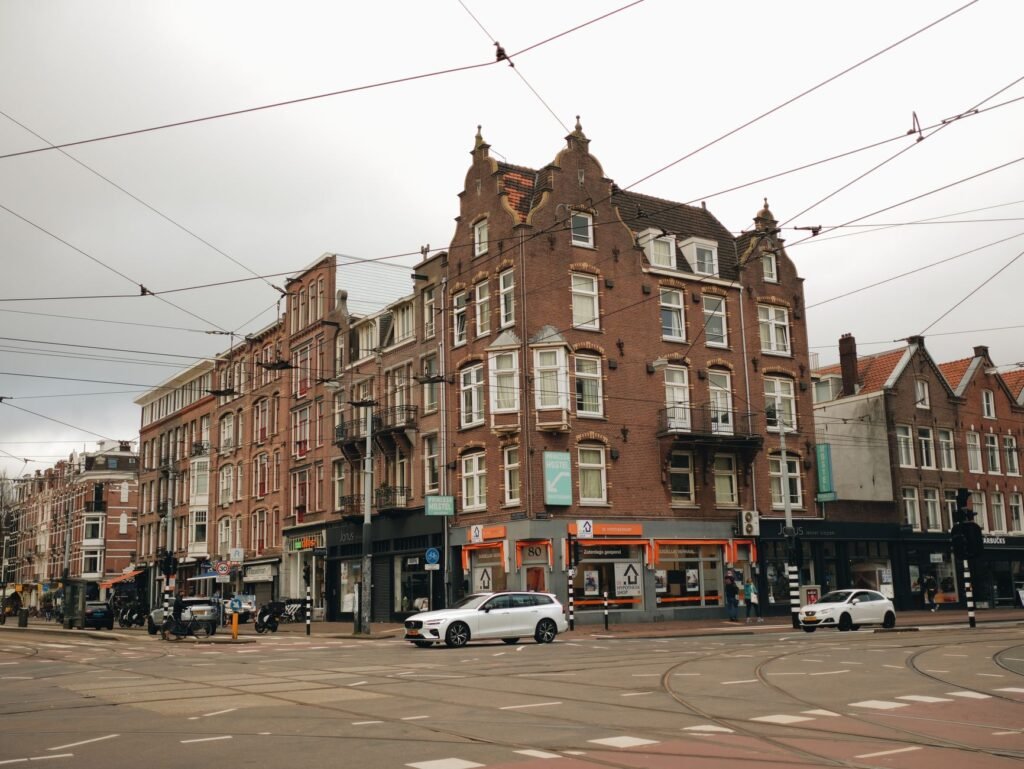
Amsterdam’s center folds around four main squares, and each one does a different job.
Once those four make sense, the Nine Streets shopping grid tucked between them makes sense too.
Dam Square
Dam Square marks where the city began: a 13th-century dam across the Amstel River gave Amsterdam its name.
It’s still the busiest square downtown, and most walking routes through the center pass through it - see Dam Square: What It Is and Why Everyone Ends Up There for the full picture.
The Royal Palace sits on the square’s west side, built in 1655 and still used for royal events; it opens to visitors when it’s not in use.
Next to it, the Gothic Nieuwe Kerk hosts exhibitions and has hosted the inauguration of Dutch monarchs, and the shopping street Nieuwendijk starts at its corner.
On the northeast side, the De Bijenkorf department store faces the square, with Damrak running from there to Centraal Station.
The east side holds Hotel Krasnapolsky along with restaurants, cafés and terraces, and the National Monument, which commemorates World War II, stands in front of it.
Behind Krasnapolsky is the Red Light District, known locally as De Wallen; it’s worth reading the rules before wandering in, covered in The Red Light District: What It Actually Is, and the Rules Every Visitor Should Know.
On sunny days, street performers - musicians, jugglers, living statues - work the open space in front of the palace.
The square’s south side leads into Madame Tussauds and the shopping streets Rokin and Kalverstraat, the city’s main pedestrian shopping strip; see Kalverstraat: Amsterdam’s Main Shopping Street, Explained for what’s actually on it.
Leidseplein
Leidseplein is Amsterdam’s nightlife square, busiest after dark and through the summer when the terraces fill.
Two of the city’s best-known music venues sit right on it: Melkweg, a former dairy factory, and Paradiso, a former church, both still hosting touring acts.
Several theaters cluster around the square, including the Stadsschouwburg - home to Internationaal Theater Amsterdam - plus De Balie, Bellevue and DeLaMar.
Later on, clubs including Jimmy Woo, Club Up and Club Maïa, plus the live-music room Bourbon Street, keep the square going past midnight.
The art nouveau American Hotel anchors the square’s southwest corner, and its Café Americain is known for an art deco interior.
In front of it stands the Hans Snoek fountain, named for the Dutch dancer who founded the Scapino Ballet.
Directly across is the 1912 Hirsch building, originally a department store and now home to an Apple Store.
In winter, part of Leidseplein turns into an outdoor ice rink.
Museumplein
Museumplein is the museum quarter’s front lawn; see Museumplein: What’s There and How to Plan a Visit for a full visit plan.
The Rijksmuseum sits on the square’s north side, holding major works by Rembrandt and Vermeer.
On the west side stand the Van Gogh Museum, home to the largest collection of Van Gogh’s work anywhere, and the Stedelijk Museum, which covers modern and contemporary art.
The upscale shopping street P.C.
Hooftstraat runs nearby, along with the House of Bols genever museum and Coster Diamonds.
The Concertgebouw closes the square’s south side, known for its acoustics and its classical music program.
The square’s open lawns get used for picnics, football and frisbee, with basketball courts and pétanque courts along the edges.
Museumplein also hosts major events, including King’s Day, and turns into an ice rink in winter like Leidseplein does.
Rembrandtplein
Rembrandtplein takes its name from the statue of Rembrandt that has stood at its center since the 19th century.
Like Leidseplein, it’s built around nightlife, with bars and clubs ringing the square that stay busy into the early hours.
It sits a short walk from both Museumplein and the Nine Streets, so it’s an easy stop to add onto a canal walk.
For opening times, current tenants and what’s actually worth stopping for, see Rembrandtplein: What’s Actually There and When to Go.
Where the Nine Streets Fit In
Between Leidseplein and Dam Square, a grid of nine short cross-streets links two of the canal ring’s main waterways.
Locals call it the Negen Straatjes - the Nine Streets - and it’s the city’s densest concentration of independent boutiques, vintage shops and small cafés; see The Nine Streets: Amsterdam’s Best Boutique Shopping Grid for the layout.
It works well as the walk between Dam Square and Leidseplein, or as a detour off either one.
For the wider picture of where to shop across the city, see Amsterdam Shopping Guide for Streets, Markets, And Finds, and for boutique picks specifically, 7 Boutique Shops In Amsterdam Perfect For A Solo Shopping Spree.
Getting Between Them
All four squares sit within about a 20-minute walk of each other, and each one connects to a different part of the center.
Dam Square leads to Centraal Station and the Red Light District, Leidseplein and Rembrandtplein anchor the nightlife side, and Museumplein anchors the museum quarter to the south.

![Top [count] Travel Blogs to Follow - OnToplist.com](https://www.ontoplist.com/images/ontoplist31.png?id=6a8dcf108f478)