Amsterdam has more than thirty parks, and choosing between them is easier if you start from what you want the afternoon to be rather than from a ranking.
A quiet bench, a full day in woodland, a playground with a café attached and a lake you can swim in are four different requirements, and they are four different parks.
This matches the green spaces to the visit, with what is inside each one and how to get there.
The Parks To See First
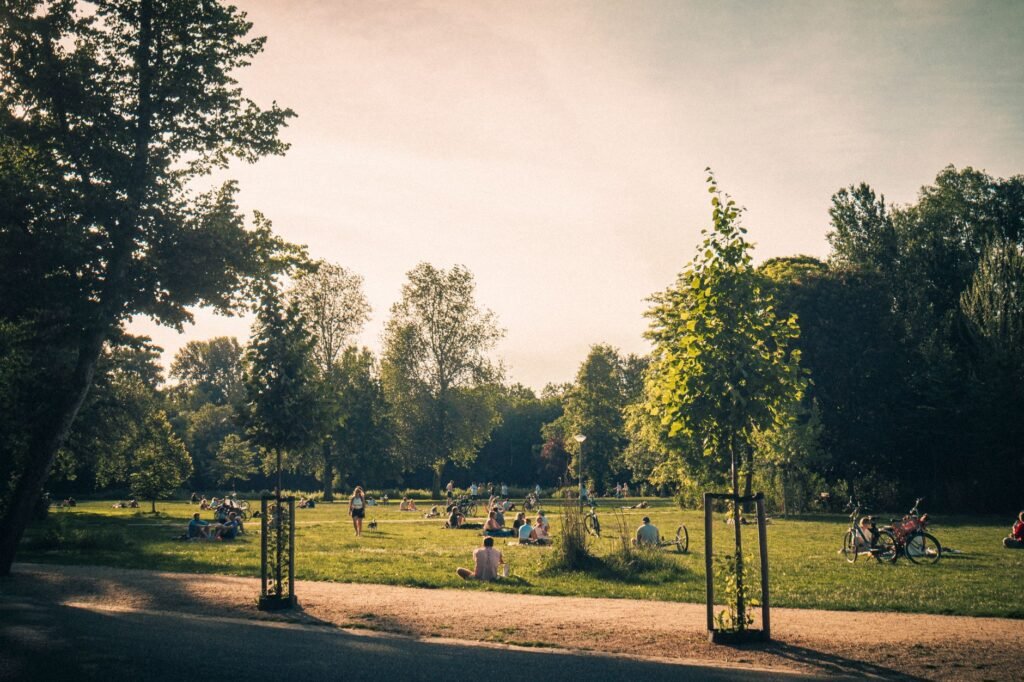
Vondelpark covers 47 hectares between Museumplein and Oud-West and functions as the city’s shared front garden, with joggers on the elm-lined paths early and every lawn under a blanket by four in the afternoon.
Its open-air theatre runs a free programme from May to September, funded by donation, with performances several times a week through the summer.
Westerpark sets lawns against the brick of a decommissioned gasworks, and the Westergas complex inside it holds galleries, cafés, markets and outdoor cinema.
Oosterpark, east of the centre, was reworked in 2016 and combines mature trees and a large pond with several memorials and a strong programme of neighbourhood events.
For a full day, Amsterdamse Bos on the southern edge is roughly three times the size of Central Park, an entirely man-made forest with rowing lanes, cycling loops and Highland cattle grazing in the open sections.
Amstelpark, built for the 1972 Floriade horticultural exhibition, keeps its formal gardens along with a miniature railway and a petting zoo.
Rembrandtpark in the west is the quieter big park, with wildlife planting, off-leash dog areas and marked barbecue zones.
Beatrixpark near the RAI is a designed landscape rather than a lawn, with water channels and structured planting, and it is close to empty on a weekday.
Choosing By Where You Are
In De Pijp, Sarphatipark is two streets from the Albert Cuyp market, small enough to cross in five minutes and surrounded by townhouses reflected in its pond.
It is a neighbourhood park rather than a destination, which is exactly the point of it.
In Oost you have two very different options: Flevopark, which is reeds, herons and winding trails and reads as countryside inside the ring road, and Park Frankendael, a seventeenth-century country estate with heritage gardens around the house.
In Noord, Noorderpark is four minutes from Centraal on the free Buiksloterweg ferry and has wide lawns with essentially no visitors on them.
In the southeast, Gaasperpark has a lake, open meadow and enough space for a large group, and it is on metro line 53.
Near Waterlooplein, Wertheimpark is the smallest green space in this guide and holds the Auschwitz memorial by Jan Wolkers, which gives it a weight the size does not suggest.
Hortus Botanicus is next door, so the two work as a single stop between museums.
What Is Inside The Parks
In Vondelpark, the Blauwe Theehuis is the 1930s modernist pavilion in the middle, now run by the Brouwerij ‘t IJ brewery, with a wraparound terrace that fills the moment the sun appears.
Groot Melkhuis at the eastern end opens daily from ten to five and has a large playground beside the terrace, which makes it the default with small children.
Vondeltuin at the southern entrance is the casual terrace at the Amstelveenseweg end, open daily from ten and useful if you are entering the park from Zuid.
At Westerpark, the Westergas buildings hold the food markets, the cinema and the club nights, and the Sunday markets are the busiest thing in the park by a distance.
South of Sarphatipark, the Albert Cuyp Market runs Monday to Saturday from half past nine to five, closed Sundays and public holidays, and is where to assemble a picnic before walking two streets north.
At Park Frankendael, the restored mansion houses Restaurant Merkelbach, open daily from nine to six with lunch served from midday, though it often closes Fridays and Saturdays for private events in summer.
The heritage garden around it is free and rarely has anyone in it.
Family Days And Outdoor Activity
In Amsterdamse Bos, the Ridammerhoeve goat farm is a working dairy where children can feed the animals, and it sells goat-milk ice cream made on site.
The same forest has a high-ropes climbing park, marked barbecue areas and cycling loops running up to about 21 kilometres.
Sloterpark in Nieuw-West wraps around the Sloterplas, a lake with supervised swimming areas in summer, a running loop of roughly six kilometres and barbecue zones.
Check the posted water-quality notice before swimming, since blue-green algae closes Dutch lakes at short notice in hot weather.
Amstelpark is the most child-focused of the large parks, with the miniature Amstel train, several playgrounds and a petting zoo, and it is at its best in late spring when the rhododendrons are out.
Gaasperpark has the open meadow for kites and frisbees and the room for a large group that the central parks do not have.
Flevopark has a public swimming pool and tennis courts alongside its wilder end.
Barbecues are permitted only in marked zones across the city, and the fines for lighting one elsewhere are real.
The Quieter Ones
Beatrixpark is the best of them, a mid-century designed landscape in Zuid where the benches are empty by the middle of the day.
Sarphatipark holds a neighbourhood crowd rather than a visiting one, and you can sit for an hour without anyone approaching you.
Wertheimpark is a pause rather than a visit, and the memorial at its centre is why people come.
Noorderpark across the IJ is wide, plain and almost entirely local, and the ferry over is free.
Flevopark in autumn, with mist coming off the water through the reeds, is the best photograph in any Amsterdam park and takes twenty minutes to reach from Centraal.
Park Frankendael is the one that stops feeling like a city at all, which is unexpected given it is inside the ring.
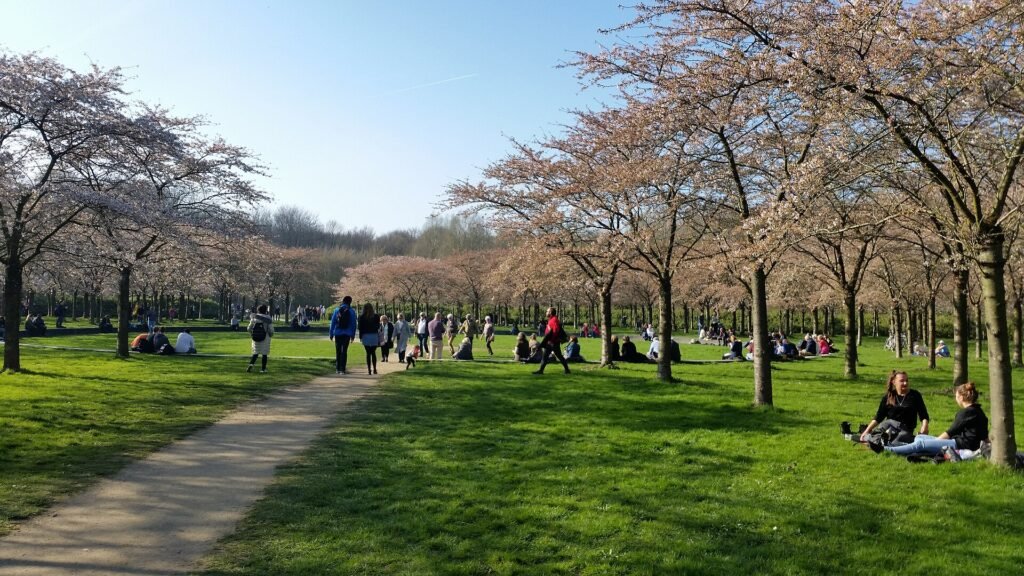
In spring, our guide to cherry blossom in Amsterdam explains when and where the Bloesempark trees flower.
Frequently Asked Questions
Which park should a first-time visitor go to?
Vondelpark, because it is central, flat and next to the museum quarter, and because it is genuinely the social centre of the city in good weather.
Westerpark and Amstelpark are the next two, offering the industrial-cultural version and the family version respectively.
How do I get to Vondelpark?
Trams 1, 3 and 12 all stop within a short walk of the main entrances, and the park is a ten-minute walk from Museumplein.
By bike it connects to every neighbourhood on dedicated paths, and the 9292 app plans any of it in real time.
When are the parks at their best?
Early morning at any of them, and specifically before nine at Vondelpark if you want it quiet.
Spring for the blossom and bulbs, summer for the lakes and the free open-air theatre, and autumn for light and low crowds.
Which parks have playgrounds?
Vondelpark has several, with Groot Melkhuis attaching a café to the largest of them.
Amstelpark adds the miniature train and the petting zoo, and Amsterdamse Bos has the goat farm and the climbing course for older children.
What are the rules on bikes, dogs and barbecues?
Cycle only on the marked paths and use your bell when passing pedestrians, which is expected rather than rude here.
Dogs must be leashed except in signed off-leash areas, and barbecues are allowed only in marked zones and nowhere else.
Where do I go for quiet and wildlife?
Flevopark for reeds, water and herons, and Beatrixpark for a designed landscape with nobody in it.
Park Frankendael and Wertheimpark are both small, both overlooked and both walkable from a tram stop.
In the news
- Nobody knows who removed Westerpark wildlife crossing 7 October 2026
- Butterfly highway needs residents’ gardens and balconies 1 October 2026
- Hortus Botanicus course explores urban plant survival 12 September 2026
- Where to forage in Amsterdam this September 11 September 2026
- Floating garden renamed to honour artist’s wife 5 September 2026