No Amsterdam framer publishes a price list, and there is a reason worth understanding before you ring around.
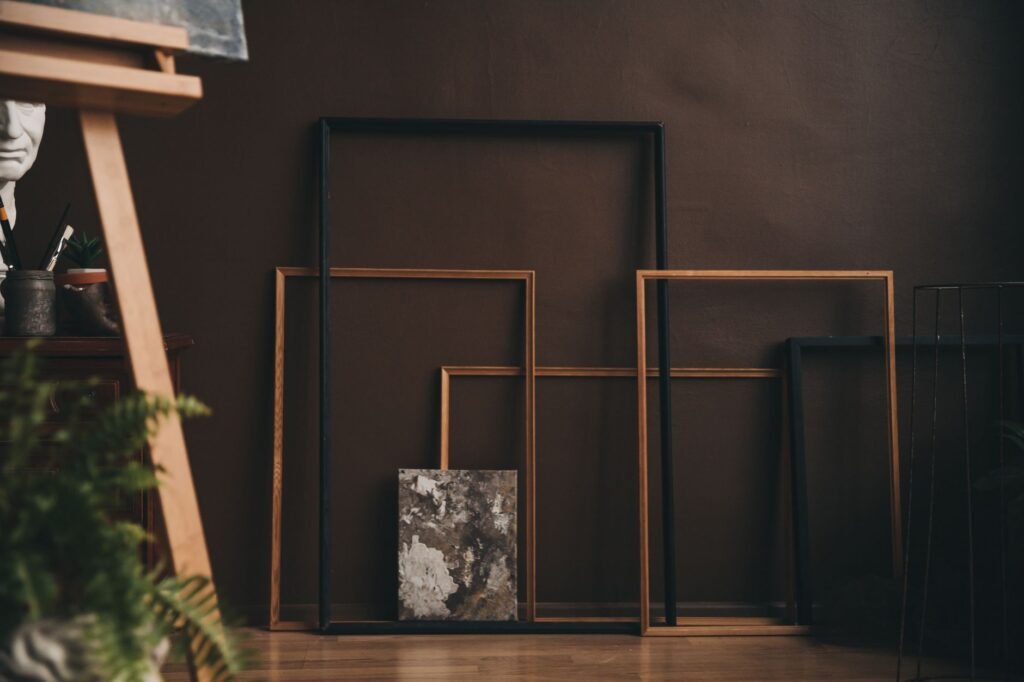
A frame is quoted from four variables - moulding, glazing, mount and size - and changing any one of them moves the total more than changing the shop does.
Which means the useful question is not who is cheapest.
It is how to get two quotes that describe the same job, so the comparison means something.
How To Find The Right Frame In Amsterdam
Bring the work itself rather than the measurements.
A framer holds mouldings against the actual paper in daylight, and the sample that looked obvious on a phone screen usually loses to something you would not have chosen.
Say up front what the piece is worth to you, in money or otherwise.
That single sentence determines whether the conversation is about a decorative frame or a conservation one, and it saves the framer guessing at your budget by showing you the middle of the range.
Ask what the shop actually keeps in stock.
Gelijk Inlijsten on Maasstraat has been framing since 1946 and carries over two hundred moulding types, from aluminium to olive wood and from modern profiles to baroque, which is a genuinely different browsing experience from a shop working off a catalogue.
Then ask what they do beyond flat work.
The same shop builds 3D box frames for objects - christening gowns, baby shoes, football shirts, medals - and stretches canvases, batiks and other fabrics, which are the jobs a general framer will quietly subcontract.
When Custom Framing Is Worth It
Custom framing is worth it whenever the work is irreplaceable or an odd size, and rarely otherwise.
A mass-produced poster in a standard format is better served by a ready-made frame; an original print, a document, a photograph you cannot reprint or anything that is not a catalogue size is not.
Conservation materials are the part worth paying for and the part most often skipped.
Acid-free mounts and backing stop the yellow line that appears where a cheap mount touches paper, and UV-filtering glazing slows the fading that turns a colour print grey over a decade on a bright wall.
Glazing is where the money hides.
Standard glass is cheapest, acrylic is lighter and safer in a stairwell or over a bed, and museum glass costs several times either but removes reflections almost entirely - worth it on a dark image opposite a window and wasted on a bright one in a corridor.
Ask whether the work is hinged or stuck down.
Anything of value should be hinged with reversible tape so it can be removed later, and a framer who proposes dry mounting an original is telling you something about the shop.
Comparing Local Frame Shop Options
Amsterdam’s framers cluster by neighbourhood and by temperament rather than by price band.
Quick Lijsten sits at Ceintuurbaan 200 in De Pijp and works across a wide range, from plain aluminium profiles up to the Garcia mouldings at the top of its collection, on etchings, canvases and photographs.
Gelijk Inlijsten on Maasstraat in Zuid is the larger operation and the more specialised one.
It works as a team, which is why turnaround there is shorter than at a single-bench atelier, and it has parking directly in front - relevant if what you are carrying is a metre across.
Consider location as a practical matter rather than a preference.
You will make the journey twice, once with an unframed work and once with a glazed one, and the second trip is the awkward one on a bike.
Ask each shop for the quote broken into its parts.
Moulding, glazing, mount and labour listed separately lets you compare two shops properly and lets you drop the glazing a grade without redoing the whole conversation.
What To Check Before You Place An Order
Get the quote in writing with the moulding reference on it.
Mouldings are identified by supplier codes, and a written code is the only thing that makes a re-order or a second matching frame possible in a year’s time.
Confirm the glazing type by name rather than by description.
“Non-reflective” covers both etched glass, which softens the image, and museum glass, which does not, and the difference is visible and expensive.
Agree the mount colour against the work in daylight and ask to keep the sample.
Shop lighting is warmer than domestic lighting, and a white that reads as neutral under a halogen lamp can read as cream on your wall.
Ask about hanging hardware and whether it is included.
A large frame needs a proper hanging system rather than a single hook, and in Amsterdam’s older buildings the wall you are fixing to is often not what you assume.
Frequently Asked Questions
Framers here quote per job rather than from a list, so the answers below cover what drives the number.
How much does custom framing usually cost in Amsterdam?
No shop in the city publishes a price list, because the total is driven by size, moulding, glazing and mount rather than by a standard rate.
Ask for the quote itemised into those four parts, which lets you compare two framers on the same job and drop one element a grade without starting again.
Where can I find a reputable custom picture framer nearby?
Quick Lijsten is at Ceintuurbaan 200 in De Pijp, and Gelijk Inlijsten is on Maasstraat in Zuid and has been framing there since 1946.
Both work to order rather than from stock sizes, and the second has parking in front, which matters for anything larger than you can carry on a tram.
How long does custom framing typically take from drop-off to pickup?
Turnaround depends on whether the shop works as a team or off a single bench, and on whether the moulding you chose is in stock or ordered in.
Ask both questions when you order rather than accepting a general answer, and expect a rush job to be possible at a premium at the larger shops.
Can you stretch a canvas and frame it at the same time?
Yes, and it is a specific skill rather than a standard service, so ask before you carry a rolled canvas across town.
Gelijk Inlijsten stretches canvases, batiks and other fabrics in-house, which is the kind of job a general framer will send elsewhere.
What frame styles and mat options work best for modern art prints?
A plain profile in aluminium or a narrow wood keeps the attention on the image, and a generous mount does more for a modern print than an elaborate frame does.
Choose the mount colour against the work in daylight rather than under shop lighting, and use acid-free board so the edge does not yellow against the paper.
Do you offer conservation-grade materials to protect artwork from fading and damage?
Ask for acid-free mounts and backing and UV-filtering glazing by name, and ask that the work be hinged with reversible tape rather than mounted down.
Any framer working on originals will have all three; a framer who suggests dry mounting an original is answering the question for you.