Few cuisines are as deeply woven into Dutch daily life as Indonesian, a legacy of the long and complicated history between the two countries.
In Amsterdam it has become comfort food, celebration food and everyday takeaway all at once, and learning to navigate it is one of the tastier rites of passage for anyone settling into the city.
Indonesian restaurants to book first
Indonesian food in this city splits between counters you collect from and dining rooms you sit down in, and the two are not interchangeable when the plan is to book a table.
Both appear below, along with the rijsttafel - the long shared rice table that is the point of Indonesian eating in the Netherlands.
Toko Bersama West
Toko Bersama West carries 11,555 reviews at 4.9, more than four times the count of any other Indonesian address in the city and a figure that is unusual in any category.
It is a counter and kitchen on Bilderdijkstraat in Oud-West rather than a dining room, open noon to half past nine seven days a week, with catering and delivery alongside.
Sama Sebo
The rijsttafel here is put together by Javanese chefs and is an extensive one, with gado-gado on the menu beside it, on the Pieter Cornelisz Hooftstraat in Oud-Zuid.
It works a split day, noon to four and five to ten, shuts entirely on Sundays, and its 1,283 reviews come in at 4.2.
Restaurant Blauw
Blauw sets Indonesian cooking in a modern room on Amstelveenseweg in Zuid, leaning on traditional dishes given an individual turn rather than on heritage alone.
Dinner only, five to ten, half past ten on Friday and Saturday, every day of the week, and 1,404 reviews put it at 4.4.
Restaurant MAX
A rijsttafel you assemble yourself is the pitch at MAX on Herenstraat, where ordering is built around combinations instead of a fixed set menu, with Dutch and wider Asian dishes on the same list.
It serves half past five to ten, Tuesday to Sunday, and 871 reviews come in at 4.6.
Sampurna
Twenty-five years on the Singel and explicitly set up for groups large and small, which matters because Indonesian food works best ordered across a table rather than per head.
Noon to half past ten, every day, on 2,558 reviews at 4.2.
Warung Barokah
Aalsmeerweg in Zuid, noon until eight, with Wednesday off - warung hours rather than restaurant hours, so it suits an early dinner or a walk-in lunch.
The cooking is billed as straightforwardly Indonesian rather than adapted, on 722 reviews at 4.7.
The rijsttafel experience
The centerpiece of Indonesian dining here is the rijsttafel, whose name means rice table – a spread of a dozen or more small dishes served together around a mound of rice.
It is a Dutch colonial invention rather than something you would find in Indonesia itself, but it remains the classic way to sample the range of a kitchen in one sitting.
Order one for the table and you will get a parade of satay, rendang, sambal-spiked vegetables and sweet-sour sides, each meant to be tried in small, contrasting bites.
It is generous, social and best shared, so bring an appetite and a couple of friends.
For a more formal night out, it holds its own against the city’s best restaurants, and it makes a memorable place to bring visitors who want a taste of something distinctly Dutch-Indonesian.
Reading the menu
A little vocabulary goes a long way.
Nasi goreng (fried rice) and bami goreng (fried noodles) are the familiar staples; saté arrives with peanut sauce; and rendang is the slow-cooked beef that rewards a slower meal.
Sides such as gado-gado, a salad in peanut dressing, and crisp kroepoek crackers round out most tables.
Watch for sambal, the chili paste that ranges from gently warm to genuinely fierce – ask the staff where a dish lands before you commit.
Spice levels are often adjustable, and a good kitchen will happily steer newcomers toward the milder end without any judgment.
Vegetarians are usually well looked after too, since many classic dishes are built around tempeh, tofu and vegetables.
Takeaway and the toko
Not every Indonesian meal is a sit-down affair.
The neighbourhood toko (a small Indonesian or Asian grocery and takeaway) is an Amsterdam institution, selling ready-made portions by weight alongside pantry staples for cooking at home.
It is where many locals grab a quick, satisfying dinner on the way back from work.
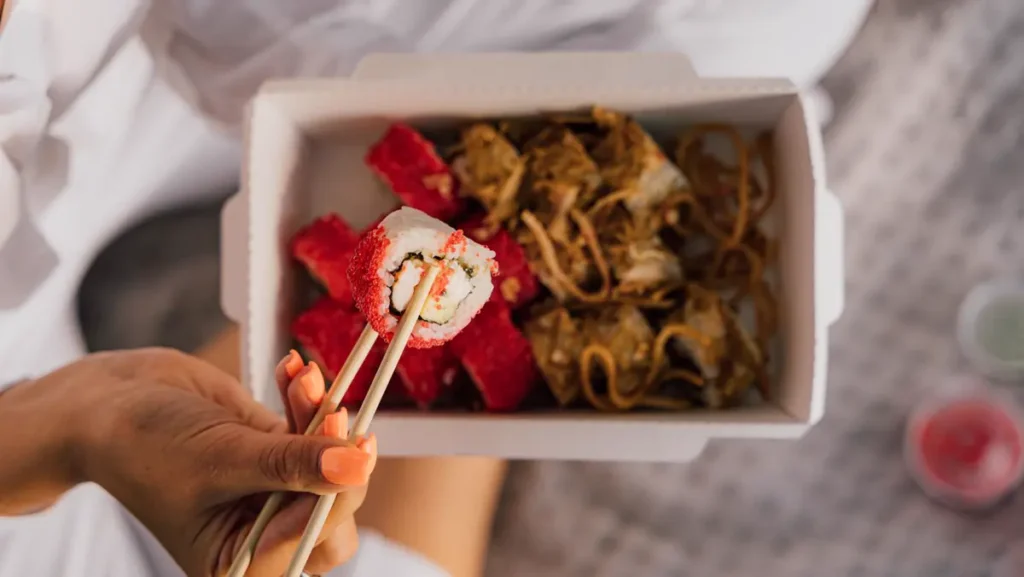
Toko Bersama West is a good example of the format that locals rely on for a quick, honest plate without the ceremony.
Grab a container of rendang and some kroepoek crackers and you have dinner sorted for a fraction of restaurant prices.
Many tokos also stock the spice pastes and coconut milk you need to try recreating these dishes in your own kitchen.
Where to find them
Indonesian spots are spread across the whole city, from grand old dining rooms near the canals to modest family kitchens in the outer neighbourhoods.
Kantjil & De Tijger in the centre is a long-running fixture that many newcomers try first, handy for its location and its approachable, well-priced rice tables.
De Pijp, Oud-West and the areas around the markets tend to have the highest concentration, often tucked between the city’s Chinese restaurants and other Asian kitchens.
Half the pleasure is finding the small place near your own front door, the kind of spot where the owner starts to recognise your usual order.
Making it a night
Indonesian food pairs naturally with a relaxed evening.
Many people start with drinks – a Dutch borrel (a casual drinks gathering) or a cold beer – before settling in for the long, grazing pace of a rice table.
It is unhurried food, meant to be lingered over rather than rushed.
If you are building a weekend around food, it slots easily alongside a lazy morning at one of the city’s cafés and brunch spots and, on other nights, something completely different like the burgers at Amsterdam’s American restaurants.
Variety is the point, and Indonesian cooking earns its place in the rotation.
Ready to book a table or track down your nearest toko?
Browse the full directory of Amsterdam Indonesian restaurants to find one near you.
Related guides
- Where to Eat Dutch Food in Amsterdam
- A Guide to Eating Out in Amsterdam
- Where to Eat Vietnamese Food in Amsterdam
Related reading
- Where to Eat Dutch Food in Amsterdam
- Amsterdam Food Guide For Newcomers: What To Eat First
- Where to Eat Thai Food in Amsterdam
Want something healthy to take home instead?
See our guide to healthy, affordable takeaway in Amsterdam, with more than 25 places for around 10 euros.
In the news
- Spicy Sumatran restaurant draws queues in De Baarsjes 10 October 2026
- Bakery Louf hosts Indonesian pop-up lunch 17 September 2026