The single most useful thing to learn in your first week here is that Dutch kitchens close early.
Last orders at an ordinary Amsterdam restaurant often fall around ten, and a nine-thirty arrival that would be normal in Madrid or Rome is late here.
The second is that the city’s most-loved food is not Dutch.
Indonesian, Surinamese and Javanese cooking are as native to Amsterdam as herring, and they are where the best value sits.
What To Try First In Amsterdam
Chips first, because Vlaams Friteshuis Vleminckx on Voetboogstraat holds 4.5 across more than five thousand reviews and settles the question of whether a queue can be worth it.
The decision is the sauce rather than the chips, and the standard local answer is mayonnaise or oorlog, which combines mayonnaise, satay sauce and raw onion.
Then bitterballen, which are the national bar snack and belong with a beer rather than a meal.
Crisp outside, molten beef ragout inside, always with mustard, and always ordered by the six or the eight.
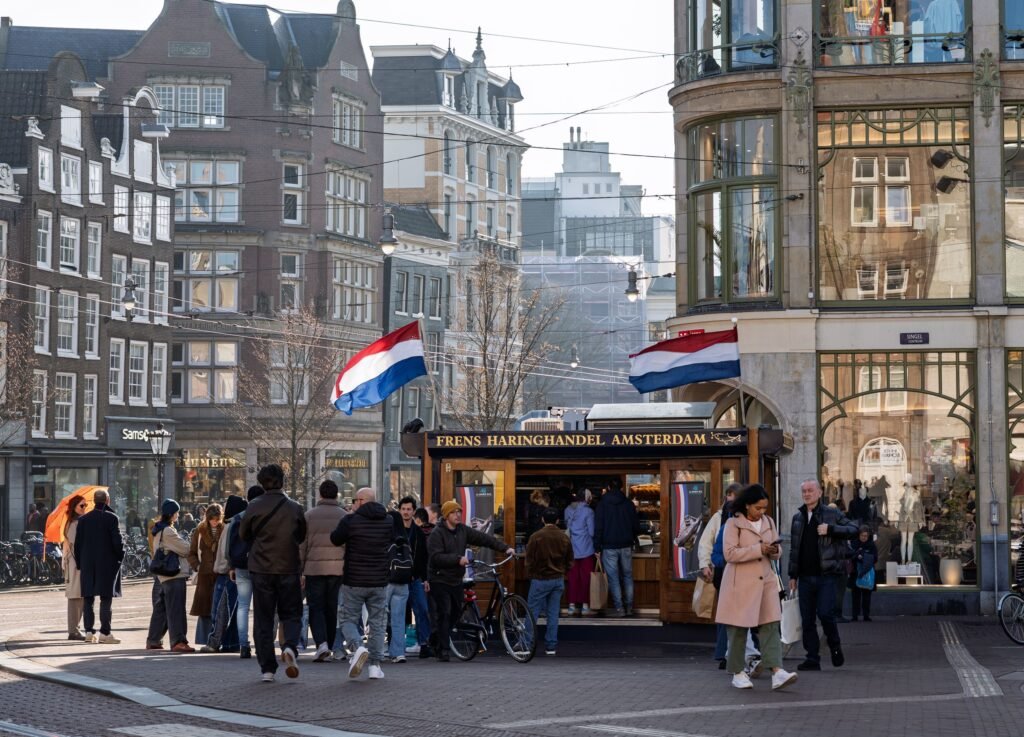
Raw herring is the rite of passage and the season matters.
From late May through July you get hollandse nieuwe, the first catch, which is fattier and milder than herring eaten later in the year.
Then apple pie, and the queue at Winkel 43 on the Noordermarkt is famous for a reason at 4.5 across nearly thirteen thousand reviews.
For pastry rather than cake, Patisserie Holtkamp is the address, and its croquettes are as celebrated as its cakes.
Stamppot is winter-only and worth waiting for.
Mashed potato with kale or sauerkraut under a smoked rookworst appears from about October to March and is the closest thing the Netherlands has to a national plate.
Where Newcomers Should Eat By Setting
The brown café is the setting to understand first, because it is where most Dutch eating and drinking actually happens.
Dark wood, sand on the floor in the old ones, a short menu of snacks, and no expectation that you order food at all.
For a proper sit-down Indonesian meal, Restaurant Blauw on Amstelveenseweg is the rijsttafel booking, on more than fourteen hundred reviews.
Tempo Doeloe is the long-established alternative in the centre, and at both places the rijsttafel is a shared table of a dozen or more small dishes rather than a menu you choose from.
For a restaurant that is an outing rather than a dinner, Vuurtoreneiland puts you on a boat to an island in the IJmeer.
Dinner is a seasonal multi-course menu in a greenhouse inside a nineteenth-century fortress, and it books out well ahead.
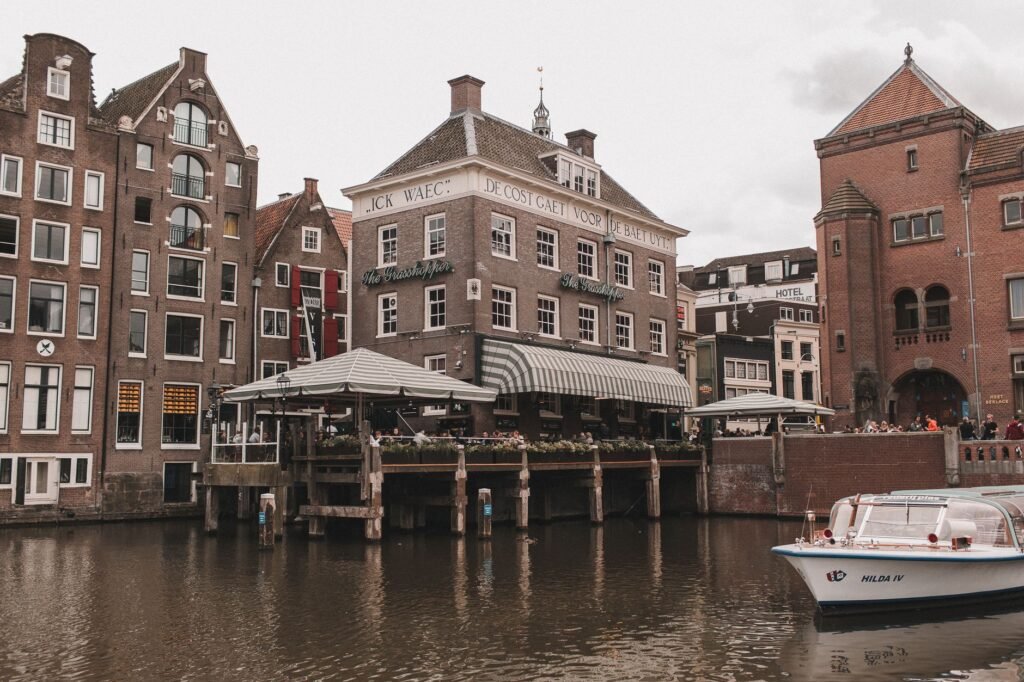
For a canal table in the centre, De Belhamel at Brouwersgracht 60 is the reliable answer.
For the opposite, Hotel de Goudfazant in Noord serves serious food in a warehouse with cars parked in it, and is a twenty-minute cycle and a free ferry away.
The Multicultural Side Of The City’s Food Scene
Surinamese food is the cuisine newcomers discover last and then eat weekly.
Roopram Roti on Van Woustraat does the roti - a flatbread with curried chicken, potato and a boiled egg - that people cross the city for, and it has more than six hundred reviews to show for it.
Warung Spang Makandra on Gerard Doustraat sits at the Surinamese-Javanese crossover and carries nearly two thousand reviews.
Its second branch on Tussen Meer in Nieuw-West serves the same food to a neighbourhood rather than a queue.
Markets are where the city’s mix is most obvious.
The Dappermarkt in Oost runs Moroccan, Turkish and Surinamese food side by side at prices below anything in the centre, and the Albert Cuyp Market in De Pijp does the same at a larger scale six days a week.
Indonesian cooking is not an import here so much as an inheritance.
Rijsttafel was invented in the colonial Dutch East Indies rather than in Indonesia, which is why it exists in Amsterdam in a form you will not find in Jakarta.
Drinks, Snacks, And Easy Food Stops Between Sights
Jenever is the Dutch spirit and the way it is served is the point.
Wynand Fockink, in an alley behind Dam Square, fills the tulip glass to the brim so that the first sip is taken with your hands behind your back and your mouth at the bar.
Coffee comes with a biscuit and nobody will rush you.
A koffie verkeerd is the local milky coffee, literally “wrong coffee”, and ordering one is a small signal that you have been here more than a week.
For eating between museums, the market stalls beat the café terraces on both price and quality.
Herring, kibbeling, a fresh stroopwafel or a portion of chips will each keep you going for under €10 and take five minutes rather than an hour.
Foodhallen in West is the wet-weather version of the same idea.
More than twenty vendors in a converted tram depot, €10 to €15 a dish, and a table where four people can eat four cuisines without agreeing on anything.
Frequently Asked Questions
Practical answers for a first month, with current review counts where they help.
What are the must-try local foods and drinks in Amsterdam?
Bitterballen, raw herring with pickled onion, chips with mayonnaise or oorlog sauce, appeltaart with whipped cream, and stamppot between October and March.
To drink, a Dutch pilsner with a proper head on it, a jenever at Wynand Fockink, and a koffie verkeerd in the afternoon.
Where are the best areas to eat near Amsterdam Central Station?
Walk ten minutes rather than eating on the Damrak, which is the single most reliable food advice in the city.
The Haarlemmerstraat and Haarlemmerdijk run west from behind the station into the Jordaan, and De Belhamel sits at the far end of that walk on the Brouwersgracht.
What are the best street food options to try in Amsterdam?
Chips from Vleminckx, herring and kibbeling from a market stall, a fresh stroopwafel made while you wait, and Surinamese roti from De Pijp.
All four come in under €10 and none of them needs a reservation or a table.
Which restaurants in Amsterdam are worth booking ahead for first-time visitors?
Vuurtoreneiland, because it involves a boat and sells out weeks ahead, and Restaurant Blauw or Tempo Doeloe for rijsttafel, which is a set-piece meal rather than a walk-in.
De Belhamel is worth booking for a specific table rather than for availability, since the canal-side windows go first.
What are the tipping customs in Amsterdam restaurants and cafes?
Service is included in the price by law, so tipping is a gesture rather than an obligation.
Rounding up the bill is normal, and around five to ten percent is generous for a full meal you enjoyed.
What do people in the Netherlands typically eat for breakfast?
Bread, and a lot of it: sliced bread with cheese, ham, peanut butter, or hagelslag, which are chocolate sprinkles eaten by adults without embarrassment.
Yoghurt with muesli and a strong filter coffee is the other standard, and the hot cooked breakfast most arrivals expect is not part of the routine here.
Related reading
- Where to Eat Dutch Food in Amsterdam
- Where to Eat Indonesian Food in Amsterdam
- Where to Eat Thai Food in Amsterdam
See also: Where to Eat Spanish Food and Tapas in Amsterdam.
See also: Where to Eat Indian Food in Amsterdam.
See also: Where to Eat Surinamese Food in Amsterdam.
See also: Where to Eat Vegetarian and Vegan Food in Amsterdam.
See also: Where to Eat Chinese Food in Amsterdam.
See also: Where to Eat Middle Eastern Food in Amsterdam.
See also: Amsterdam Supermarkets: A Guide for Newcomers.
See also: Where to Eat Vietnamese Food in Amsterdam.
See also: Where to Eat Italian Food in Amsterdam.
See also: Where to Eat Turkish Food in Amsterdam.
See also: The Best Food Tours in Amsterdam, Compared.