Three rules cover most of what a visitor can get wrong in Amsterdam: stay out of the bike lane, keep your voice down, and carry a debit card rather than cash.
Everything else is detail, and almost all of it follows from the same idea - that the centre is a working residential city rather than an attraction with people living in it.
Dutch social behaviour is direct, quiet and unfussy, which reads as cold for about a week and then as restful.
Nobody here is being short with you.
The Street Rules
The red asphalt is a bike lane and it is the most dangerous surface in the city for a visitor, because bikes are silent, fast and legally in the right.
Do not stand on it to check a map, do not step onto it while looking the other way, and treat a ringing bell as an instruction to move rather than a greeting.
Trams take priority over almost everything and stop where the tracks are, not where the pavement is.
Let passengers off before boarding, and check in and out with your card at the reader every single time, since the fare only calculates on checkout.
Doe normaal - act normal - is the governing social instruction, and it means keeping your volume, drama and self-presentation at a level that does not require anyone else’s attention.
Public drinking is banned in much of the centre with signposted alcohol-free zones, and the fines are issued rather than threatened.
Photographing sex workers in De Wallen is forbidden, taken seriously, and enforced by people who are not police.
Put the phone away entirely on those streets.
Greetings, Directness And Language
Say hello when you enter a small shop, a bakery or a doctor’s waiting room, because walking in and launching straight into a question reads as rude here in a way it does not elsewhere.
Hallo covers almost everything, goedemorgen and goedemiddag are the safe formal versions, and doei is the casual goodbye.
Dank je wel is thank you among peers and dank u wel is the formal version, with alsjeblieft and alstublieft doing the same split for please and here-you-are.
Almost everyone in Amsterdam speaks fluent English, so these are courtesies rather than necessities, and short and sincere beats a rehearsed sentence.
Dutch directness is a genuine cultural difference rather than a stereotype.
You will be told plainly that something is not possible, that your idea will not work, or that you are standing in the way, and none of it carries the hostility the same words would carry in London or New York.
The corollary is that indirect English politeness does not translate.
“That might be a bit difficult” will be understood as a mild concern rather than a refusal, so say what you mean.
Money, Eating And Tipping
Carry a debit card, because a great many Amsterdam cafés, bakeries and shops take cards only and some refuse cash entirely.
Foreign credit cards are also less useful than you expect, as plenty of smaller places accept Maestro and V Pay debit but not Visa or Mastercard credit.
Tipping is modest and optional, with service included in the listed price by law.
Rounding up or leaving five to ten per cent for good service is normal, and twenty per cent marks you out rather than pleasing anyone.
Kitchens close earlier than most visitors plan for, often between nine and half past nine, and popular restaurants expect a reservation.
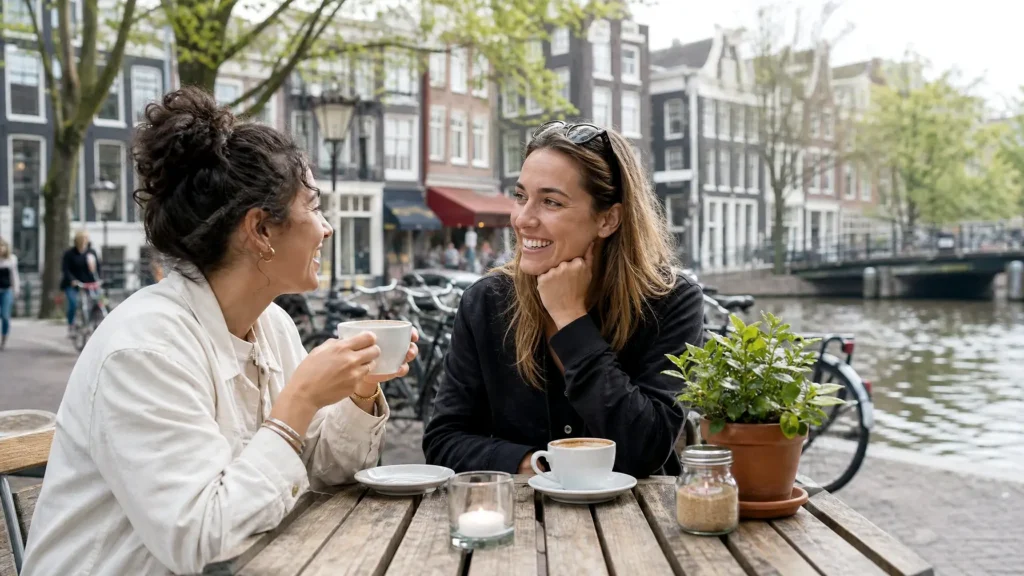
Terrace service is at the table, unhurried by design, and a waiter leaving you alone is politeness rather than neglect.
Splitting the bill exactly is standard and carries no awkwardness, usually settled with a Tikkie payment link sent afterwards.
If you want the local version of Dutch food, bitterballen with a beer at five o’clock is the ritual worth copying, and raw herring from a street stall is the test everyone photographs.
Museums, Markets And Coffeeshops
The Anne Frank House is a memorial before it is a museum, and it requires timed tickets bought online well in advance, with no walk-up entry.
The Rijksmuseum and Van Gogh Museum also sell timed slots online and are visibly calmer in the first hour after opening.
At the Albert Cuyp Market and the Dappermarkt, prices are fixed and haggling is not part of the culture.
Greet the stallholder, step aside before stopping, and expect to be served in strict order.
Coffeeshops sell cannabis, not coffee, and they operate under rules a visitor is expected to know.
You must be eighteen and carry ID, you may buy no more than five grams a day, and no alcohol is sold on the premises.
Smoking cannabis on the street is banned in the Red Light District and the surrounding old centre, and the ban is enforced with on-the-spot fines.
Photographing other customers is not done, and staff will ask you to leave for it.
Frequently Asked Questions
What are the main do’s and don’ts?
Stay out of bike lanes, greet staff when you enter a shop, keep your voice down in residential streets, and carry a debit card.
Do not photograph sex workers, do not drink alcohol in the street in the centre, and do not treat a residential canal at midnight as a venue.
Is Dutch directness really that blunt?
Yes, and it is not aimed at you.
Answers come without cushioning, disagreement is expressed openly and immediately, and the same person will be entirely friendly two sentences later.
How much should I tip?
Round up the bill or leave five to ten per cent for good service, since service charges are already included in the listed price.
Tipping in cash is appreciated where the card terminal has no tip option, which is common.
Can I pay with cash or a credit card?
Assume you cannot - a large share of Amsterdam venues are card-only, and some accept only Maestro and V Pay debit rather than Visa or Mastercard credit.
A debit card that works on those networks, or a card in a phone wallet, is the safest thing to arrive with.
What are the rules in coffeeshops?
Eighteen and over with photographic ID, a maximum of five grams a day, no alcohol on the premises, and no photographs of other customers.
Smoking cannabis outdoors is banned in the old centre and the Red Light District, so consume it where you bought it or at your accommodation if they allow it.
Are visitors from the US welcome?
Entirely, and the adjustments that help are small ones: a lower speaking volume, smaller tips, and reading bluntness as efficiency rather than rudeness.
For more of the practical side of the city, the Essentially Amsterdam newsletter arrives daily.