You can get from nothing to holding a conversation in Dutch in Amsterdam for well under a hundred euros, and most people spend ten times that because they buy the class first.
The cheap version works in the opposite order: free input and free speaking practice for three months, then one paid course aimed at whatever is still broken.
A classroom level at an Amsterdam language school runs around €600 to €675, so every month you delay that purchase without stalling is real money saved.
What follows is the free tier, the speaking practice that replaces early tutoring, and the weekly routine that makes both worth doing.
Do The Free Tier First
The OBA Taalcafé is the single best free thing in the city for a learner, running at library branches for anyone between A1 and B1.
There is no fee, no registration and no library membership required, and you are talking to Dutch volunteers rather than to an app.
Neighbourhood Taalhuis desks and buurthuis language programmes run subsidised classes for residents, with eligibility usually turning on your registration and income rather than your passport.
Your local OBA branch is where these are indexed, and asking there in person gets a better answer than any website.
For the grammar you will not get from conversation, DutchGrammar.com explains the rules properly and Learndutch.org runs guided beginner lessons, both free.
Give each free tool one job - app for vocabulary drilling, website for grammar, video for pronunciation, radio for listening - because the failure mode of free learning is six apps all teaching the same first two hundred words.
Free Listening That Is Actually At Your Level
Jeugdjournaal, the children’s news bulletin, is the most useful free listening in Dutch because it is spoken slowly with a small vocabulary and covers the same stories the adults are discussing.
NU.nl does the same job in writing, with short headline-led pieces you can read at A2 long before you could manage a newspaper.
On video, Easy Dutch puts subtitles on unscripted street interviews, which is the closest free approximation of how people actually speak here.
Dutchies To Be and DutchPod101 cover the structured end for beginners.
The rule that turns passive watching into progress is copying aloud.
Repeat one sentence back after each clip rather than watching another, because the mouth learns nothing from listening.
Speak Before You Pay
Most people who book a tutor early are paying to solve fear rather than ignorance, and fear is cheaper to fix.
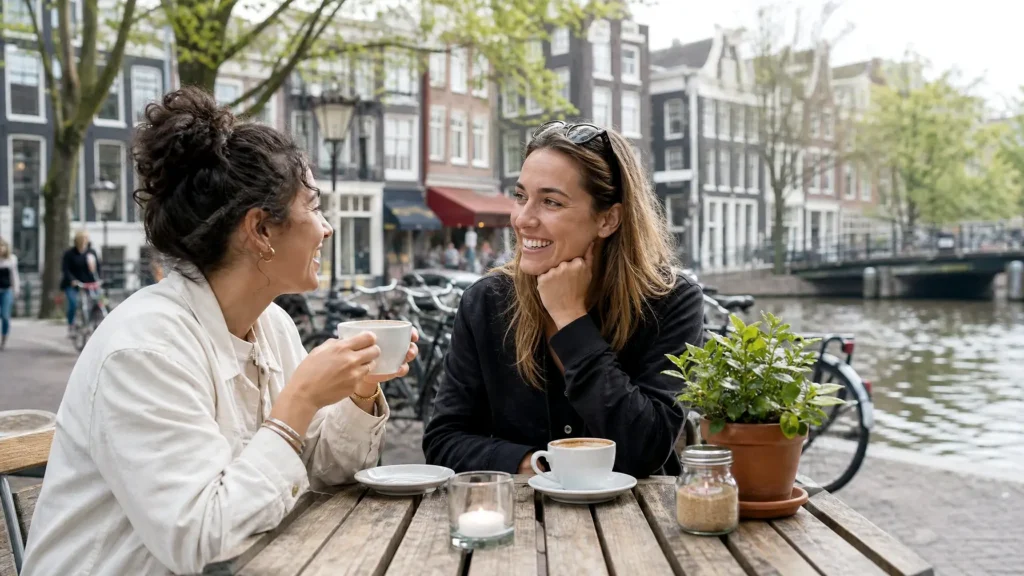
Language exchange evenings, the Taalcafé and ordinary shop transactions all supply the same corrective at no cost.
Set one rule at a language exchange or the practice collapses into English within ten minutes: half the time in Dutch, enforced by the clock rather than by mood.
Your partner speaks better English than you speak Dutch, and without the rule that fact wins every time.
In daily life, pick three sentences and use them until they are automatic.
“Mag ik pinnen?”, “Ik ben Nederlands aan het leren” and “Kunt u dat langzamer zeggen?” cover the shop, the excuse and the repair, and between them they get you through most early conversations.
The Weekly Routine
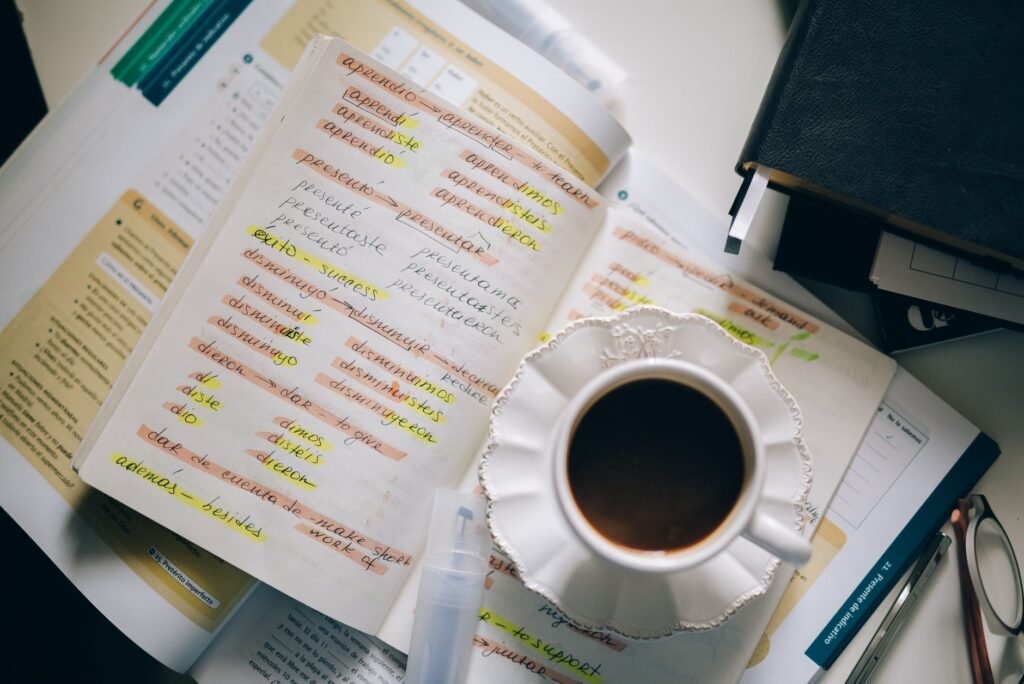
Fifteen minutes of vocabulary five days a week, fifteen minutes of grammar three days a week, two short listening sessions and one real conversation is enough to move a level in about three months.
It is roughly two and a half hours a week and it beats a three-hour Sunday session, because spacing is what fixes vocabulary and a single long block does not.
Keep one running note on your phone of phrases you actually want to reuse, harvested from that week rather than from a list.
Ten phrases a week that you have genuinely heard someone say will serve you better than a thousand-word frequency list.
Buy a course when the free tier stops working, which usually shows up as one of two symptoms: you can understand but not build sentences, or you have plateaued at the same level for six weeks.
At that point one group level of around €600 to €675 does more than another year of apps, and you will get more from it than a beginner would.
For the rest of practical life in the city, the Essentially Amsterdam newsletter arrives daily.
Frequently Asked Questions
What does the cheapest realistic path cost?
Nothing for the first three months if you use the Taalcafé, free grammar sites and free listening, then around €600 to €675 for one classroom level when you hit the ceiling.
Compared with buying three consecutive levels from the start, that is roughly €1,300 saved for a slower but not worse result.
Are there genuinely free Dutch courses in Amsterdam?
Free conversation practice is easy to find, and free structured teaching is limited to subsidised neighbourhood programmes with eligibility conditions.
The OBA Taalcafé is free to everyone with no conditions at all, which makes it the dependable answer.
Which free apps and sites are worth using?
DutchGrammar.com for the rules, Learndutch.org for guided beginner lessons, and a spaced-repetition app of your choice for vocabulary drilling.
Add Easy Dutch for real speech and Jeugdjournaal for slow news, and that stack covers everything a paid beginner course would.
How do I practise speaking without paying a tutor?
Language exchanges, the Taalcafé and short daily transactions in shops and at markets, with a hard rule about how much of the time is spent in Dutch.
Frequent short conversations do more than one weekly hour with a teacher, particularly below B1.
How do I learn grammar without buying textbooks?
Take one topic at a time from a free grammar site - word order, then de and het, then separable verbs - and do nothing else until it is solid.
Buying a textbook early usually means owning several half-read books, which is a more expensive way to reach the same page.
What slows people down most?
Living entirely in English, which Amsterdam makes extremely easy, and treating app streaks as progress.
The fix for both is the same: one fixed weekly appointment where you have to speak Dutch to someone who is waiting for you to.