Two rules do most of the work in Amsterdam: ride predictably, and never stop where you are not expected to stop.
Everything a visiting cyclist gets wrong here comes from hesitating in traffic that assumes you will not.
The Rules That Are Actually Rules
Lights are compulsory in the dark and in poor visibility - white or yellow at the front, red at the rear - and they may be clipped to you rather than to the bike.
A red reflector at the back and reflective sides or pedals are required at all times, not just at night.
Holding a phone while cycling is prohibited and enforced, exactly as it is for drivers.
The drink-drive limit applies to cyclists at the same level it applies to cars.
You may ride two abreast, but no more, and you must not obstruct the lane while doing it.
Cycling on the pavement is not allowed anywhere in the city.
At an unmarked junction, traffic from the right has priority, and that includes cars giving way to you.
Turning traffic gives way to cyclists going straight on - which protects you, and equally binds you when you are the one turning.
Helmets are not required for bicycles and almost nobody wears one.
Riding In Amsterdam Traffic Without Causing Trouble
Signal turns with your whole arm, early, and hold it out long enough for the person behind you to react.
Keep right in the lane so faster riders can pass on the left, and do not drift while looking at your phone in a bracket.
A bell behind you is information, not aggression, and the correct response is to hold your line.
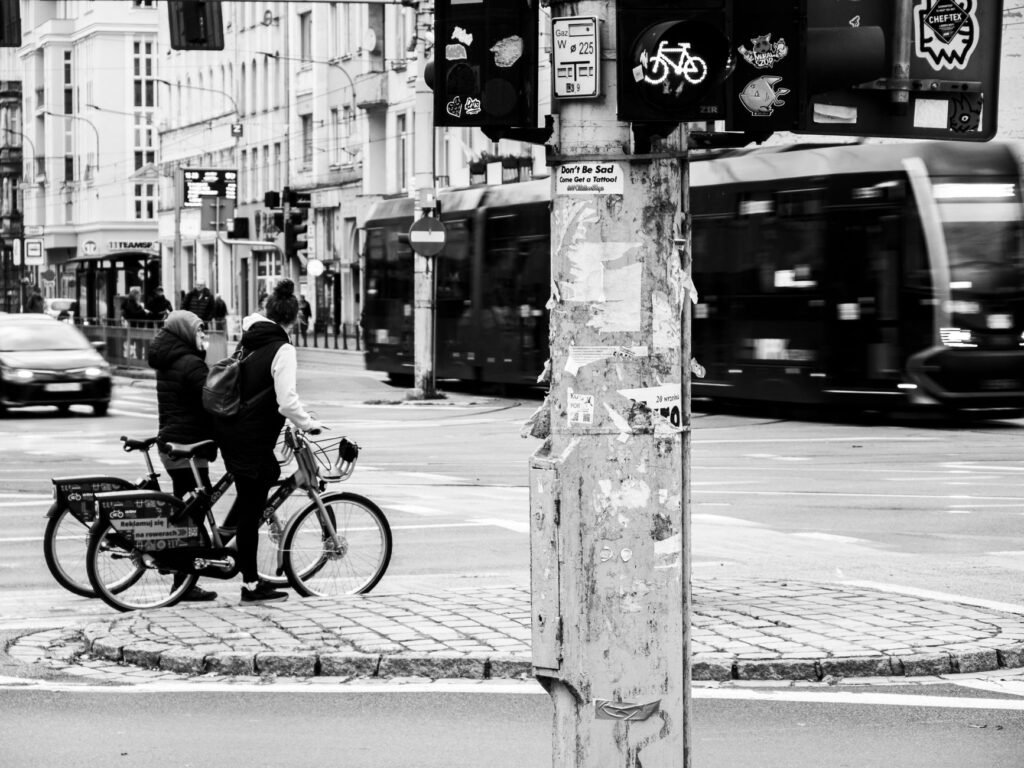
Cross tram tracks at as near a right angle as the street allows, because a wheel dropping into the groove is the classic Amsterdam fall.
Never stop in the middle of a bike lane to look at a map, take a photograph or wait for a friend - pull right out of the lane first.
Mopeds share many cycle paths and travel much faster, so check behind before moving left.
At red lights, cyclists stop, and a right turn on red is only allowed where a sign explicitly permits it.
Parking, And How To Not Lose The Bike
Lock the frame to something fixed, not just the wheel: the ring lock built into most Dutch bikes only stops it being ridden away, not carried away.
Use two locks of different types, because a thief carrying the tool for one rarely carries the tool for both.
Obstructive, abandoned or wrongly parked bikes are removed by the city and taken to the Fietsdepot at Bornhout 8 in the Westelijk Havengebied, where getting it back costs €26.
Our directory listing for the Bicycle Depot covers the opening hours, the fee and how long it keeps a bike.
Around Centraal, Leidseplein and De Wallen, use a guarded fietsenstalling rather than a rack on the street, particularly overnight.
Never lock a bike to a bridge railing or across a doorway, both of which are removal grounds.
Renting A Bike
MacBike rents from Nieuwe Nieuwstraat 19d near Centraal and from Tesselschadestraat 1E by the Vondelpark.
Yellow Bike is at Nieuwezijds Kolk 29 and at De Ruijterkade 34-b behind the station.
Black Bikes has counters at Nieuwezijds Voorburgwal 146 near Dam square, Lijnbaansgracht 283 at Leidseplein, and Eerste Constantijn Huygensstraat 88 by the Vondelpark.
Rental bikes are conspicuous, which makes them a target, so use the guarded parkings and take the insurance if it is offered.
Donkey Republic works by app if you want a bike for an hour rather than a day, with docks scattered across the city.
Check the brakes before you ride off: many Dutch bikes have a back-pedal brake and no rear hand lever at all, which is a surprise best had while stationary.
Where To Actually Ride
The Vondelpark loop is the gentlest place to get used to a Dutch bike, and it is closed to cars.
The free ferries behind Centraal take bikes to Noord in a few minutes and open up the quiet routes along the IJ.
Amsterdamse Bos, south of the city, is a long traffic-free run and reachable entirely on cycle paths.
Avoid Damrak, the Leidsestraat and the Wallen on a first outing: they combine trams, pedestrians, delivery vans and tourists in the smallest available space.
Frequently Asked Questions
Do I need lights on my bike?
Yes, white or yellow front and red rear, whenever it is dark or visibility is poor, and they can be worn rather than fixed to the bike.
Reflectors on the rear and on the sides or pedals are required at all times.
Can I use my phone while cycling?
Not in your hand - the ban is the same as for drivers and it is enforced.
A phone in a handlebar bracket is legal, though it is still the reason most people drift out of their lane.
Do I have to wear a helmet?
No, not on a bicycle, and hardly anyone here does.
Helmets are required on a snorfiets or bromfiets, which are a different vehicle class.
Who has priority at junctions?
Traffic from the right at unmarked junctions, cyclists included.
Turning vehicles must give way to cyclists continuing straight ahead.
Can I ride side by side with a friend?
Two abreast is allowed; three is not, and neither is blocking the lane.
Move to single file when a faster rider is behind you.
What happens if my bike is removed?
It goes to the Fietsdepot at Bornhout 8 and costs €26 to collect, with ID, your keys and a card.
It is held for two to four weeks depending on why it was taken.
Where can I rent a bike?
MacBike, Yellow Bike and Black Bikes all have counters within a few minutes of Centraal, and Donkey Republic rents by the hour through an app.
Test the brakes before leaving, because back-pedal braking is standard here.
For woodland, dunes, lakes and open countryside rather than city parks, see our guide to nature in and around Amsterdam.
Related reading
See also: Driving In Amsterdam: Rules, Parking, And Practical Tips.
In the news
- Cyclists on part of Amstelveenseweg path face 20 km/h limit in trial 5 October 2026
- Amsterdam street cleaners face growing impatience on city roads 27 September 2026
- Cyclists squeeze past barriers on narrowed Kabouterbrug 24 September 2026
- Most Dutch cyclists feel less safe on bike paths 20 September 2026
- Amsterdam completes seven kilometre Binnenring cycling route 18 September 2026