
Amsterdam packs an unusual amount of culture into a city you can cross on foot in an hour.
The problem for a first visit is not finding things worth seeing but deciding which of them to give a whole morning to.
This guide sorts the city into the layers that actually reward the time: the museums, the historic centre, the canal ring, the neighbourhoods, the music and the markets.
Two practical notes before you start.
The I amsterdam site carries the official events calendar and is the thing to check in the week before you travel.
You can also sign up for the Essentially Amsterdam newsletter for what is on while you are here.
Start With The Museums That Define The City
Museumplein puts three major collections within five minutes of each other, which is the single strongest argument for basing a first day there.
Do not try to do all three in one day; two is the realistic limit before the paintings stop registering.
The Rijksmuseum is the anchor, with roughly 8,000 objects on display tracing Dutch art and history from the medieval period onwards.
Rembrandt’s The Night Watch hangs at the end of the Gallery of Honour, with Vermeer, Frans Hals and Jan Steen along the way.
Pierre Cuypers designed the building itself in 1885 and it is worth ten minutes on its own, particularly the passage that cuts straight through the middle of it at ground level.
The Van Gogh Museum holds the largest collection of his work anywhere, hung chronologically so you walk from the dark Nuenen peasant studies through Paris and Arles to Almond Blossom in about ninety minutes.
Across the square, the Stedelijk covers modern and contemporary art and is the obvious antidote if the Golden Age starts to blur.
The Moco Museum, on the same square, shows Banksy, Kusama and other contemporary names in a converted townhouse, and is small enough to fit into a gap.
Away from Museumplein, FOAM runs photography exhibitions across four floors of a Keizersgracht canal house and changes its programme several times a year.
The Rembrandt House on Jodenbreestraat is the house he actually lived and worked in, reconstructed from the inventory taken when he went bankrupt.
Het Scheepvaartmuseum, the maritime museum on the eastern docks, has a full-size replica East Indiaman moored alongside that children can board.
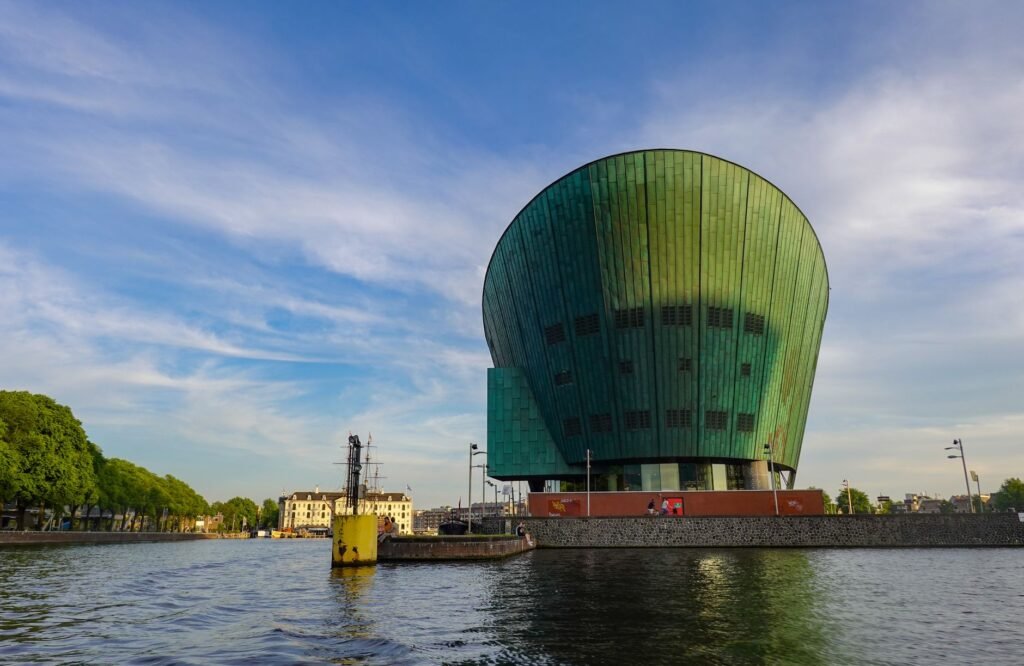
NEMO, the science museum, is the green sloping building next to it, and its roof terrace is free to walk up even if you skip the museum.
The EYE Filmmuseum sits across the IJ, two minutes on the free ferry behind Centraal Station, and screens from its own archive as well as running exhibitions.
Book the Rijksmuseum, the Van Gogh Museum and the Anne Frank House online before you travel, because all three routinely sell out and none of them has a useful walk-up queue.
Trace History Through Anne Frank And The Old Centre
The Anne Frank House on Prinsengracht is the building where the Frank family hid in the annex behind Otto Frank’s business premises for just over two years.
The rooms are kept unfurnished, at Otto Frank’s own insistence, which is a large part of why the visit lands the way it does.
Tickets are released online on a rolling schedule and sell out within hours, so set a reminder rather than hoping.
The house stands beside the Westerkerk, whose bells Anne wrote about hearing from the annex, and the tower is the tallest in the city.
Five minutes further into the centre, the Begijnhof is reached through a plain door off the Spui and opens into a 14th-century courtyard built for a lay religious community of women.
It is still residential, so it is kept quiet and closes in the evening.
Dam Square has the Nieuwe Kerk, now an exhibition space rather than a working church, and a short walk east brings you to the Oude Kerk, consecrated in 1306 and the oldest building in Amsterdam.
The Zuiderkerk, near Waterlooplein, was the first church in the city built for Protestant worship rather than converted to it.
The Jewish Cultural Quarter around Waterlooplein takes in the Portuguese Synagogue, still lit by candles and unheated, and the National Holocaust Museum that opened opposite the Hollandsche Schouwburg deportation site.
Our Lord in the Attic, on Oudezijds Voorburgwal, is a complete Catholic church built into the top three floors of a canal house during the period when Catholic worship was banned but quietly tolerated.
It is the clearest single illustration of how Amsterdam’s famous tolerance actually worked, which was by looking away rather than by permitting.
Read The City Through Canals, Architecture, And Water
The canal ring is a single 17th-century engineering project, not an accumulation, and it is on the UNESCO World Heritage list as one.
The three main rings - Herengracht, Keizersgracht and Prinsengracht - were dug outwards from the older Singel in a planned sequence, with the wealthiest plots on the Herengracht.
The house fronts explain themselves once you know that property tax was levied on frontage width.
Merchants built narrow and deep, which is why the staircases are near-vertical and why almost every gable still carries a hoisting beam for getting furniture in through the windows.
Many facades lean deliberately forward so that a hoisted load clears the wall below rather than scraping it.
A cruise is the only way to see the water-level detail, including the surviving VOC-era warehouses along the eastern stretches, and an hour is enough.
The Amstel gives wider, more open views than the inner canals and is where the rowing crews train in the early morning.
The Bloemenmarkt on the Singel is built on barges moored against the quay, and although it trades on being a floating flower market it now sells mostly bulbs and souvenirs.
Go for the bulbs if you want them and check the export label if you are flying outside the EU.
For the Amsterdam School - the expressive brick movement of the 1910s and 1920s - the place to go is Het Schip in the Spaarndammerbuurt, a housing block with a small museum inside it.
The Eastern Docklands, on the other side of the centre, show the same city solving the same problem a century later, with old harbour buildings converted into flats and cultural spaces.
Explore Creative Neighbourhoods Beyond The Postcards
The Jordaan was built as working-class housing outside the canal ring and is now one of the most expensive districts in the city.
What survives from before is the scale: narrow streets, small galleries, independent shops, brown cafés, and the hofjes - almshouse courtyards, several still open to visitors during the day if you push the door.
Go on a weekday morning, when it is a residential neighbourhood rather than a walking-tour route.
De Pijp is younger, denser and far more mixed, built as cheap tenements in the 1870s and now the busiest food neighbourhood in Amsterdam.
The Albert Cuypmarkt runs down the middle of it for several blocks, six days a week, with stalls selling stroopwafels made in front of you alongside Surinamese roti and Turkish bread.
Amsterdam-Noord across the IJ reads as a separate town, because until the tunnel and the metro it effectively was one.
NDSM Wharf is the old shipyard, now full of artist studios, large-scale murals, music venues and food in converted industrial sheds.
The ferry from behind Centraal Station is free, takes about fifteen minutes and carries bikes, which is the way most locals arrive.
Vondelpark is where the city goes to sit down, and in summer the open-air theatre programmes free concerts and performances.
Further west, Mercatorplein is a working residential square with a market and terraces and almost no visitors at all.
Hear Amsterdam In Its Music, Nightlife, And Festivals
Het Concertgebouw opened in 1888 and its main hall is one of the handful of concert rooms internationally regarded as acoustically outstanding.
Free lunchtime concerts run on Wednesdays through the season, roughly September to June, and the queue starts well before the doors open.
The Nationale Opera & Ballet on the Amstel is the home of the national opera and ballet companies and sells returns cheaply on the day.
Paradiso, a former church on the Weteringschans, and Melkweg, a former dairy behind Leidseplein, are the two mid-size music venues that between them cover most of what tours through Amsterdam.
Bitterzoet on Spuistraat is smaller and books across genres, which makes it the place to go on a night when you have no fixed plan.
Bimhuis, in the black box projecting from the Muziekgebouw on the IJ, is where the jazz and improvised music actually happens in this city.
Boom Chicago performs improvised and sketch comedy in English at the Rozentheater in the Jordaan and has been doing so since the 1990s.
The festival calendar has three fixed points: the Holland Festival for international performing arts in June, Pride in late July and early August, and Amsterdam Dance Event across five days in October.
ADE is the largest of them by a distance, taking over most of the city’s venues at once, and accommodation prices rise accordingly.
In 2026, Pride is unusually large because Amsterdam is hosting WorldPride from 25 July to 8 August, with the Canal Parade as its centrepiece.
Taste Everyday Culture Through Markets And Dutch Classics
Dutch food is plain, filling and mostly built around potatoes, dairy and things fried in batter.
The pleasure is in a handful of specific items rather than in restaurant cooking, and nearly all of them are cheap.
A stroopwafel is worth eating once from a market stall where it is pressed and syruped in front of you, and is a completely different object from the packaged version.
Bitterballen are the standard bar snack: breadcrumbed balls of beef ragout, served with mustard, and ordered by the plate for a table.
Stamppot is potato mashed with kale, endive or sauerkraut and served with sausage, and it is winter food that makes no sense in July.
Poffertjes are small yeasted pancakes with butter and icing sugar, sold at markets and at the standing stalls that appear in winter.
Raw herring, taken by the tail or in a soft roll with onion and pickle, is the one to try from a fish stall rather than a restaurant.
The Albert Cuypmarkt in De Pijp is the best single walk for all of this, with fish, cheese and Dutch snacks alongside Surinamese, Turkish and Indonesian stalls in the same stretch.
If you plan on several paid attractions, the I amsterdam City Card bundles museum entry with public transport for a fixed number of days.
Check the current list of included museums against your own shortlist before buying, since the inclusions change.
Frequently Asked Questions
What are the best cultural things to do in Amsterdam for first-time visitors?
Book the Rijksmuseum, the Van Gogh Museum and the Anne Frank House first, because those are the three that sell out.
Around them, an hour on a canal boat, a morning walking the Jordaan, and one evening at the Concertgebouw or Paradiso covers the city’s range.
Which museums and galleries in Amsterdam are most worth visiting?
The Rijksmuseum and the Van Gogh Museum are the two nobody regrets, and the Stedelijk covers the modern side of the same square.
For smaller and quieter, FOAM for photography, the Rembrandt House for the working studio, and Our Lord in the Attic for the hidden church.
What major festivals and cultural events are happening in Amsterdam in 2026?
The big one this year is WorldPride Amsterdam, running 25 July to 8 August 2026, with the Canal Parade and a programme spread across the city.
The Holland Festival ran in June, Amsterdam Dance Event follows in October, and the Amsterdam Light Festival runs through the winter along the canals.
Check the I amsterdam events calendar close to your trip for dates, since most of these move by a week or two each year.
Where can I find free cultural events and activities in Amsterdam today?
The Concertgebouw’s Wednesday lunchtime concerts are free through the season, and the Vondelpark open-air theatre programmes free performances in summer.
The ferries to Noord are free, the Begijnhof courtyard costs nothing, and NEMO’s roof terrace is open without a museum ticket.
What are the best places to visit in Amsterdam for free?
The Begijnhof, Vondelpark, NDSM Wharf and the whole of the canal ring cost nothing and account for a good deal of what people remember.
Add the outdoor markets, Dam Square and the square outside the Oude Kerk, and you have a full day without a ticket.
What are the most important do’s and don’ts for visitors in Amsterdam?
Book museum tickets before you travel, and treat the Anne Frank House and the National Holocaust Museum as places where photography and conversation are kept down.
Stay out of the red-painted cycle lanes, which are roads rather than pavement, and look both ways before stepping off a kerb because bikes come from directions cars do not.
Tipping is not expected and rounding the bill up by a euro or two is what locals do.