Amsterdam’s weather is mild, wet and windy, and the number that should actually drive your planning is daylight, not temperature.
Mid-June gives you about seventeen hours of it; late December gives you under eight.
Nothing else about the climate changes a trip as much as that.
What The Year Actually Feels Like
The coldest months are January and February, averaging around 3 to 4°C, which is 37 to 39°F.
Frost is common at night, deep cold is not, and the wind off the water makes it feel several degrees worse than the number suggests.
July and August average around 18°C, about 64°F, with daytime highs usually in the low twenties.
Genuine heat happens, but it is a handful of days rather than a season, and very little housing here has air conditioning.
Spring warms slowly and lags the calendar: April can still be cold, and May is the month the city reliably turns.
Autumn is the wettest stretch, with October and November bringing the longest spells of grey.
Rainfall totals around 800 to 850 mm a year and falls on roughly a third of all days, but it arrives as short showers far more often than as all-day rain.
Snow appears most winters and settles rarely; the country’s great skating race, the Elfstedentocht, has not been held since 1997.
Daylight, Which Matters More Than Degrees
In mid-June the sun is up before 05:30 and sets after 22:00, and the sky never goes fully dark.
In late December it rises around 08:45 and sets around 16:30, so a winter afternoon ends while you are still out.
Plan winter sightseeing for the morning and accept that anything after four o’clock is a lit-window city rather than a daylight one.
In June the reverse applies: dinner at nine still happens in full sun, and the canals stay busy until midnight.
The clocks change on the last Sunday of March and the last Sunday of October, which moves the evening by a full hour overnight.
Wind And Rain, Practically
Wind is the real weather here, not rain: it is a flat coastal country with nothing to break it.
A headwind on a bicycle across the Westerpark or along the IJ will do more to your day than a shower will.
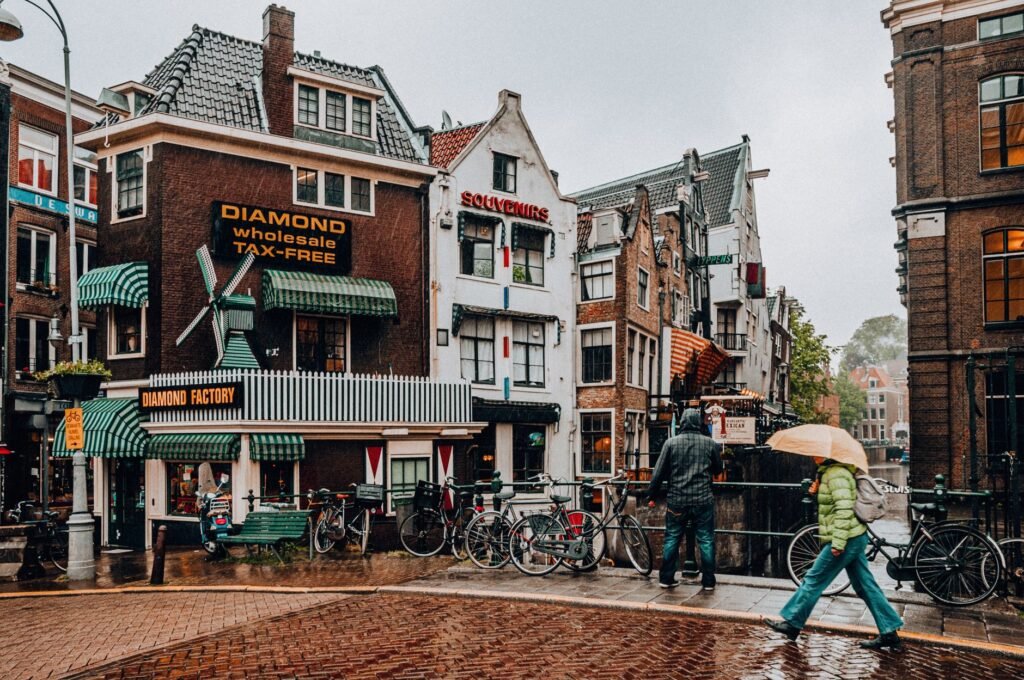
Nobody uses an umbrella on a bike, and in a strong gust an umbrella is useless on foot too - a hooded waterproof is the local answer.
Showers here typically pass in twenty minutes, so ducking into a café is usually a better strategy than walking through it.
The Dutch rain radar apps show the next two hours to the minute and are accurate enough that people genuinely time their departures by them.
Packing, By Season
All year: a waterproof jacket with a hood, and shoes you do not mind getting wet on cobbles.
Winter: a proper coat, gloves, and something for your ears, because the wind is the problem rather than the temperature.
Spring and autumn: layers, since a bright morning at 8°C and a wet afternoon at 14°C is one ordinary day.
Summer: a jumper for the evening regardless of the forecast, and a swimsuit if you plan to be near the coast - the North Sea at Zandvoort rarely gets above the high teens.
Any season: sunglasses, because low sun off wet streets and water is genuinely blinding here.
Choosing When To Come
Late April to early June gives the best combination of long days, tolerable crowds and reliable-enough weather.
September is the quiet equivalent, with warm water at the coast and the summer crowds gone.
July and August are the warmest and the busiest, and hotel prices reflect it.
November to February is cheap, dark and often lovely, provided your plans are indoors and you have accepted the four o’clock sunset.
27 April is King’s Day and the whole city stops, which is either the reason to come or the reason not to.
Frequently Asked Questions
What is the weather like month by month?
Cold and grey from November to February, averaging 3 to 4°C in the depth of winter; slowly warming from March, with May the first reliably pleasant month.
July and August average around 18°C, and October and November are the wettest.
How much does it rain?
Around 800 to 850 mm a year, on roughly a third of all days, mostly as short showers rather than sustained rain.
Autumn is the wettest season and spring the driest.
How cold does it get in winter?
Averages of 3 to 4°C with frost at night, and hard freezes that last more than a few days are unusual.
Pack for wind rather than for extreme cold.
When is the best time to visit?
Late April to early June, or September.
Both give long days without the peak crowds and prices of high summer.
How long are the days?
About seventeen hours around midsummer, with the sky never fully dark.
Under eight hours around the shortest day, with sunset before half past four.
Do I need an umbrella?
A hooded waterproof is more use, since the wind makes umbrellas awkward and nobody carries one on a bike.
The Dutch rain radar apps predict showers to the minute two hours ahead and are worth installing on arrival.
Can you swim at the coast?
Yes, from June to September at Zandvoort and Bloemendaal, both under half an hour by train from Centraal.
The North Sea rarely warms past the high teens, so it is bracing rather than balmy.
For woodland, dunes, lakes and open countryside rather than city parks, see our guide to nature in and around Amsterdam.