
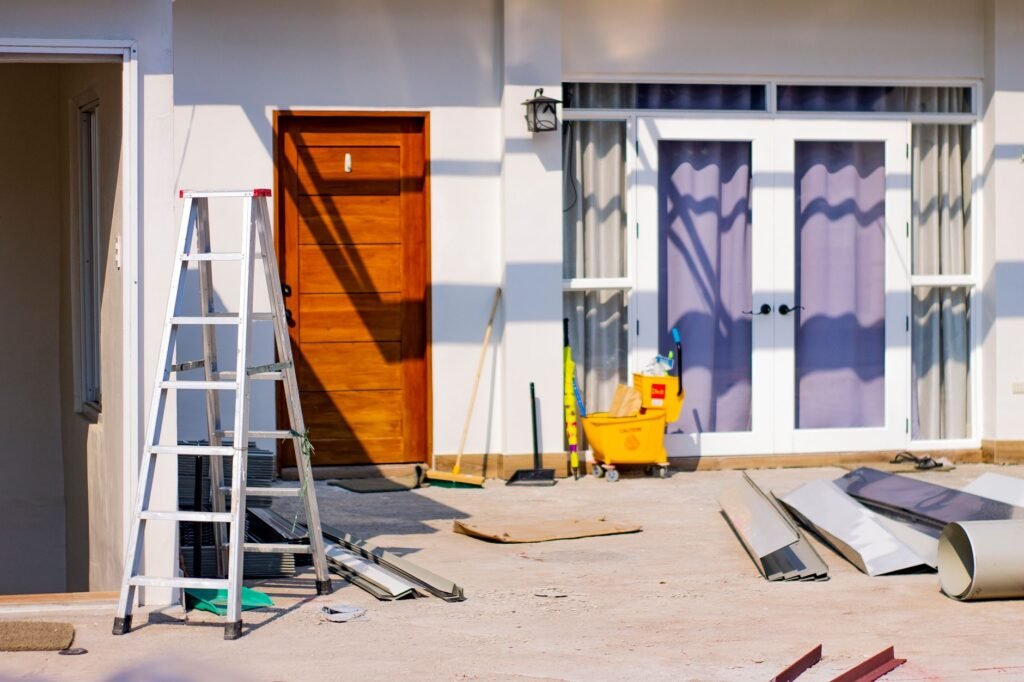
Before you commission anything, check two things: whether the work needs an omgevingsvergunning, and whether your building is a monument or has a VvE.
Those three answers decide the timeline and a good part of the budget, and finding them out after the builders start is what turns a renovation into a dispute.
Check the permit question yourself at Omgevingsloket - enter the address and the work, and it tells you what is required.
It takes ten minutes and it is free.
Scope And Budget
A kitchen runs €8,000 to €30,000 and a bathroom €7,000 to €25,000, and in both cases the spread is finish, not size.
Price each element separately - units, appliances, tiling, plumbing, electrics - because a single lump-sum figure is impossible to compare between contractors.
Budget separately for permit fees, architect or adviser costs and inspections, none of which appear in a builder’s quote.
Hold a contingency of 10 to 15 per cent, because older Dutch houses reliably produce damp, rotten beam ends or pre-war wiring once a wall comes down.
If you have a mortgage, ask your lender about a bouwdepot.
It is a renovation account attached to your Dutch mortgage that releases funds against completed stages, at mortgage rates rather than personal-loan rates.
Permits And Approvals
Most structural or exterior work needs an omgevingsvergunning from your municipality.
Building without one risks a fine, an order to undo the work, and a problem at the notary when you eventually sell.
All work must meet the Bouwbesluit, the national building code, and the permitting framework now sits under the Omgevingswet.
Rules are applied locally, so read your own gemeente’s page rather than a general one.
Monuments
A listed building needs a monumentenvergunning on top, and it constrains the facade, the windows and the structure.
Interior work can need approval too where it touches anything of historic value, which in an Amsterdam canal house can mean the staircase or the ceiling beams.
Apartments And The VvE
Anything affecting shared walls, the facade, the roof, the stack or communal systems needs your VvE’s approval, usually by a vote at a meeting.
Skip it and the other owners can require you to reverse the work at your own cost, however good it is.
Cosmetic work inside your own walls - paint, floors, light fittings - normally needs neither permit nor VvE consent.
Floor replacement is the exception in apartments, because most VvE rules set a minimum sound-insulation standard.
Energy Upgrades, In Payback Order
A large share of the Dutch housing stock predates modern insulation standards, so this is usually the work that pays for itself.
It also raises the energy label, which now affects both resale value and what a lender will advance.
Roof insulation first: an uninsulated roof loses more heat than anything else in the building.
Floor and cavity-wall insulation next, both of which are quick jobs with a visible effect in the first heating season.
Glazing after that.
Triple glazing costs more than double and earns it back fastest where you are replacing single panes, and it takes the street noise out of a canal-side room as a side effect.
The ISDE subsidy reimburses part of the cost of insulation, heat pumps and solar water heaters.
The eligible measures and the amounts change annually, so confirm on the RVO site before ordering - the subsidy is generally claimed after the work, against invoices.
Plan insulation and underfloor heating before floors and walls are closed up.
Retrofitting either afterwards costs several times more in labour than doing it in sequence.
Quotes And Contractors
Get at least three quotes for anything over €5,000, and require each to be itemised by materials, labour, permits, demolition and waste removal.
A quote you cannot compare line by line is a quote designed not to be compared.
Treat vague scope lines as the warning they are - “finishing as required”, “electrical work as needed” - and send them back for quantities and unit prices.
Those phrases are where the extra invoices come from.
Check whether BTW is included and at which rate.
The headline rate is 21 per cent, but labour on homes more than two years old attracts the reduced 9 per cent rate for certain work including painting, plastering and insulation - a real difference on a large job, and worth asking about explicitly.
Ask what happens if material prices move during the project, and get the answer in the contract rather than in an email.
Ask for references and go and look at a finished job before signing.
Look the company up in the KvK register and confirm it carries liability insurance.
A trader who is not registered, or whose registration does not cover the trade, is one you have no route against under Dutch consumer law.
Pay against milestones, never up front: something like 10 to 20 per cent at signing, staged payments as work completes, and a final 10 per cent held back until the snagging list is cleared.
For specialist trades, use a certified firm - for electrics, the Amsterdam electricians guide covers what to check.
Related reading
- Amsterdam Climate And Weather Guide For Trip Planning
- Amsterdam Children’s Party Guide For Easy Planning
In the news
- Private swimming pools surge across affluent Amsterdam neighbourhoods 30 August 2026
- Amsterdam real estate agent urges client to gut interior before landmark status applies 23 July 2026
- Rental homes must reach energy label D by 2029 22 July 2026
- Realtor advised buyer to strip interior before possible monument listing 21 July 2026
- Energy coaches in Zuidoost now help residents keep homes cooler 20 July 2026


![Top [count] Travel Blogs to Follow - OnToplist.com](https://www.ontoplist.com/images/ontoplist31.png?id=6a8dcf108f478)