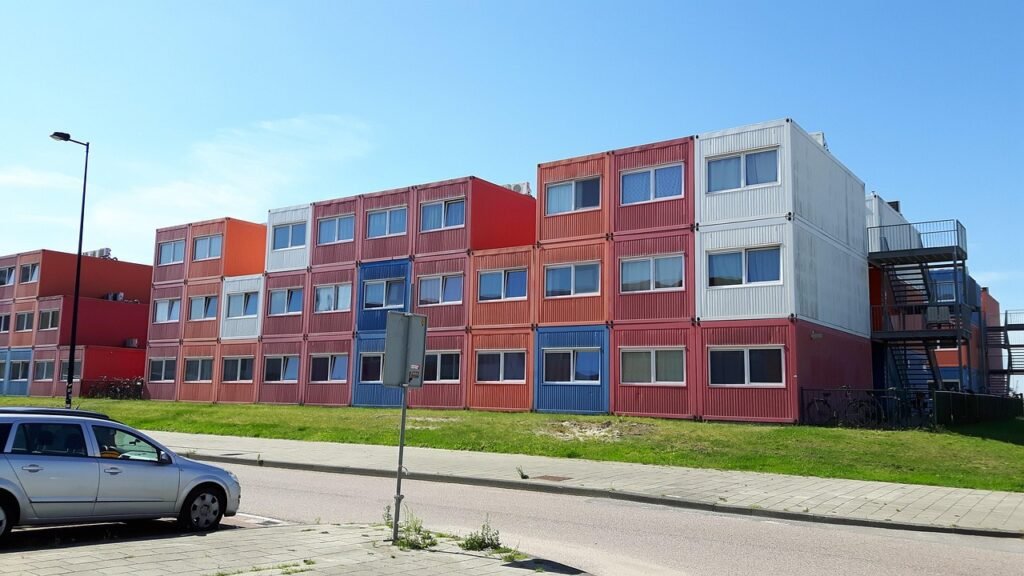

Amsterdam pays well and charges you for it in housing, and that single trade is the whole economic story for people moving here.
Everything below is about the mechanisms - how you are taxed, what your employer is obliged to give you, and where the money actually goes - rather than figures that go stale within a budget cycle.
What The City Runs On
The Zuidas is the financial and legal district, built around the banks, the big law firms and the international arbitration business, and it is a twenty-minute metro ride from the centre.
Schiphol and the Port of Amsterdam anchor a large logistics economy that does not appear in the tourist version of the city at all.
Technology is the growth story: Booking.com is headquartered on the Oosterdok, Adyen was founded and remains here, and a long list of American companies run their European operations out of Amsterdam because of the English-language workforce and the tax treaty network.
Tourism, creative industries and higher education fill in the rest.
The practical consequence is that a great many good jobs here are conducted entirely in English, and that competition for them is international rather than local.
How You Get Taxed
Income tax and social contributions come out of your salary before you see it, and your employer files the return of them, not you.
Everyone still files an annual income tax return, and for most employees it is largely prefilled by the Belastingdienst.
Savings and investments are taxed separately from income, under a regime that has been repeatedly rewritten by the courts and by parliament, so the rules that applied when a colleague arrived may not be the rules that apply to you.
Mortgage interest on your own home is deductible, which is the main reason buying is treated so differently from renting in Dutch financial advice.
The 30% ruling is a payroll facility for employees recruited from abroad who meet an annually-set minimum salary, letting part of the salary be paid as a tax-free allowance for a maximum of five years.
Both the percentage and the salary ceiling have been changed by successive budgets, and the rate that applies depends on the year your ruling started - get it in writing from payroll rather than from a colleague.
Applications for the ruling are made jointly by you and your employer within four months of starting, and applying later shortens the benefit rather than delaying it.
What Your Employer Owes You
Holiday allowance is a statutory 8% of gross annual salary, normally paid as a lump sum in May, and it is separate from your holiday days.
Most employees are covered by a CAO, a sector-wide collective agreement, which sets the pay scale, the notice period and often the pension - ask which one applies to you and read it.
Dutch dismissal law is restrictive and requires either the employee’s agreement, permission from UWV, or a court decision, which makes Dutch employment considerably more secure than the American equivalent.
A transition payment is owed on most dismissals, calculated from length of service.
Pension is usually arranged through the employer or a sector fund, and it is worth checking whether yours is defined contribution or a fund with accrued rights, because that determines what happens when you leave the country.
Where The Money Goes
Housing is the dominant cost and the dominant constraint.
The rental market is split between a regulated segment, where a points system caps what may legally be charged, and a free sector above it, and the Wet betaalbare huur extended that regulation upward from July 2024.
If you rent, get the rent checked against the points system, because charging above the cap is common and is recoverable through the Huurcommissie.
Health insurance is compulsory and privately bought: everyone over 18 pays a monthly premium to an insurer of their choice, plus an annual eigen risico deductible on most non-GP care.
Lower earners can claim zorgtoeslag and huurtoeslag, income-dependent allowances paid monthly by the Belastingdienst, which a surprising number of new arrivals never apply for.
A car in Amsterdam is a luxury purchase because of parking rather than because of the car - street rates run from €1.72 an hour in Zuidoost to €8.05 in the Centrum.
Public transport, a bicycle and a supermarket within cycling distance are what actually make the local cost of living work.
Working Here As A Non-EU National
The highly skilled migrant route requires a recognised sponsoring employer and a gross salary above a threshold that the IND publishes and revises annually, with a lower band for under-30s and a lower one again for recent graduates.
The orientation year permit lets graduates of Dutch universities and certain foreign ones work freely for a year without a sponsor, and it is the most useful permit most people have never heard of.
EU Blue Card and intra-company transfer routes exist alongside the national scheme with their own thresholds.
Self-employment as a ZZP’er is straightforward for EU nationals and considerably harder for others, requiring a separate permit assessed on the business plan.
Check the current thresholds with the IND directly, because they move every January and an out-of-date figure in a contract negotiation costs you real money.
Frequently Asked Questions
Is Amsterdam expensive?
Housing is, sharply, and almost everything else is unremarkable by Western European standards.
Salaries are high by Dutch standards and lower than London or the US for equivalent roles, with much stronger job security.
How does the 30% ruling work now?
It lets a portion of salary be paid tax-free for up to five years, for employees recruited from abroad who meet a minimum salary set each year.
The percentage and the salary ceiling have been changed repeatedly, so the rate depends on when your ruling started - confirm it with payroll.
What is holiday allowance?
A statutory 8% of gross annual salary, usually paid in May, on top of your normal pay and separate from your holiday days.
Do I need to file a tax return?
Yes, annually, though for most employees the Belastingdienst prefills most of it.
Filing is also how you recover overpaid tax in a year you arrived or left mid-year.
Is my rent legal?
Possibly not - the regulated segment caps rent by a points system, and the cap was extended upward in July 2024.
Have it checked by !WOON, and take an overcharge to the Huurcommissie.
What salary do I need for a highly skilled migrant permit?
A gross figure set by the IND and revised every January, with lower bands for under-30s and recent graduates.
Use the IND’s current published figure rather than one quoted in an older article or by a colleague.
What am I entitled to claim?
Zorgtoeslag towards health insurance and huurtoeslag towards rent, both income-dependent and paid monthly by the Belastingdienst.
Both are claimed by you, not granted automatically, and can be backdated only to a limited extent.