Walking in Amsterdam goes wrong in one specific way: people treat the red asphalt as pavement.
It is a traffic lane, it carries bikes, mopeds and delivery riders at speed, and nobody on it expects you to be standing there.
Below is what the Dutch traffic code actually says about where you may walk and who must yield to whom, rather than general advice about being careful.
Where You Are Allowed To Walk
The rule is a sequence: use the pavement or footpath, and only if there is none may you use the cycle path.
Only if there is no cycle path either may you walk on the verge or the road itself.
That is why walking in a bike lane while a pavement exists is not a matter of manners - it puts you in the wrong.
Amsterdam has no jaywalking offence, so you may cross away from a marked crossing, but you must not obstruct traffic while doing it.
Crossing against a red pedestrian signal is an offence, and it is enforced more often than visitors assume, particularly on the big junctions around Centraal and Weesperplein.
Bike lanes are one-way unless marked otherwise, which is exactly why looking only left before stepping out will eventually get you hit by something coming from the right.
Who Has To Give Way
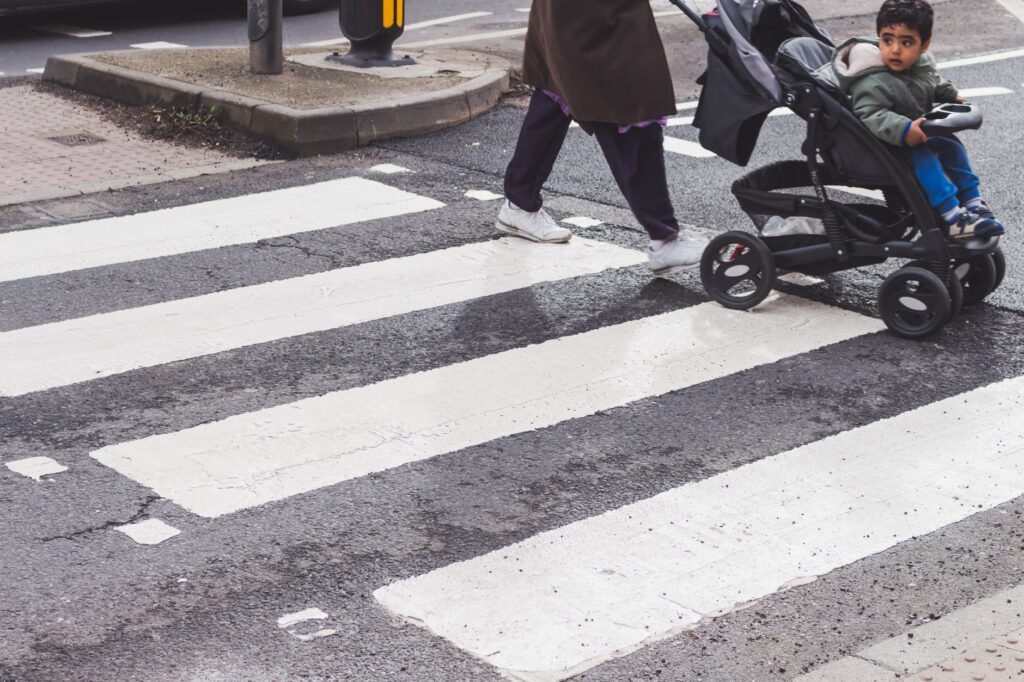
At a zebra crossing, every driver must give way to pedestrians who are on it or clearly about to step onto it.
Cyclists count as drivers under that rule, so a cyclist is legally obliged to stop at a zebra too, even though a good many will not.
Traffic that is turning must give way to pedestrians and cyclists crossing the road it is turning into.
That single rule covers most junction conflicts in the city, and it is the one to remember when a car is indicating across your path.
Shark’s teeth - the row of white triangles painted across a lane - mean the traffic on that lane gives way to traffic on the road it is joining.
They govern priority between vehicles, so they do not by themselves give you priority as a pedestrian, and stepping out on the strength of them is a mistake.
Trams have priority over other traffic at almost every crossing, and a tram cannot steer around you or stop quickly.
Where passengers get off a tram or bus and there is no raised island, other traffic must stop to let them cross to the pavement.
Trams, Tracks And Stops
Cross tram tracks at as close to a right angle as you can manage, because a shoe or a wheel catching in the groove is the common way people fall.
Never stand on the tracks to take a photograph, and never wait for a gap while standing between the rails.
Many Amsterdam tram stops are islands in the middle of the road, so getting to one means crossing a live lane, sometimes a bike lane as well.
Trams run silently on approach and arrive from behind you at stops, so listen for the bell rather than the engine.
Practical Habits That Prevent The Usual Collisions
Step off a pavement into a bike lane the way you would step into a road: look both ways, then go without stopping in the middle.
A bell behind you means keep going in a straight line, not turn round to look.
Groups should walk in twos on narrow canal streets, because a line of five across blocks both the pavement and the lane.
Stop to check your phone against a wall or a railing, not in the middle of a bridge approach, which is where cycle traffic funnels.
At night, cyclists are lit but often dimly, and delivery riders on fatbikes travel considerably faster than the rest of the traffic.
Watch for mopeds on the cycle path, which sound and move nothing like bicycles and are legal there on many streets.
Where The Bikes Themselves Are Parked
Pavements around Centraal, Leidseplein and the Wallen are frequently half-blocked by parked bicycles, and stepping into the road to get past is how visitors end up in traffic.
The city removes bikes that obstruct, and takes them to the Fietsdepot at Bornhout 8 in the Westelijk Havengebied, where the owner pays €26 to collect.
That is worth knowing if you are cycling as well as walking, because “everyone else parked here” is not a defence.
Frequently Asked Questions
Do pedestrians have priority at zebra crossings?
Yes - every driver must give way to a pedestrian on or about to step onto a zebra.
Cyclists are drivers for that purpose and are legally required to stop, whatever they do in practice.
Do cyclists have to stop for me anywhere else?
Only where they would have to stop for a car: at a zebra, at a red light, and when turning across your path.
Outside those situations you are the one who must give way if you are in their lane.
May I walk in a bike lane?
Only if there is no pavement or footpath available.
Where a pavement exists, walking in the cycle lane puts you in breach of the traffic code.
What do the white triangles on the road mean?
Shark’s teeth mark which lane gives way at a junction, between vehicles.
They do not grant a pedestrian priority, so do not step out because you see them.
How should I cross a street with bike lanes on both sides?
Treat it as three separate crossings and clear each one before starting the next.
Look right first for the near-side lane, because bike lanes are one-way and the near-side traffic comes from that side.
What are the rules around trams?
Trams have priority at nearly every crossing and cannot stop quickly.
Where there is no raised island at a stop, other traffic must stop for passengers stepping down to the pavement.
Is crossing on a red light actually enforced?
Yes, and more often than visitors expect at the larger central junctions.
Crossing away from a signal altogether is not an offence, as long as you do not obstruct traffic.