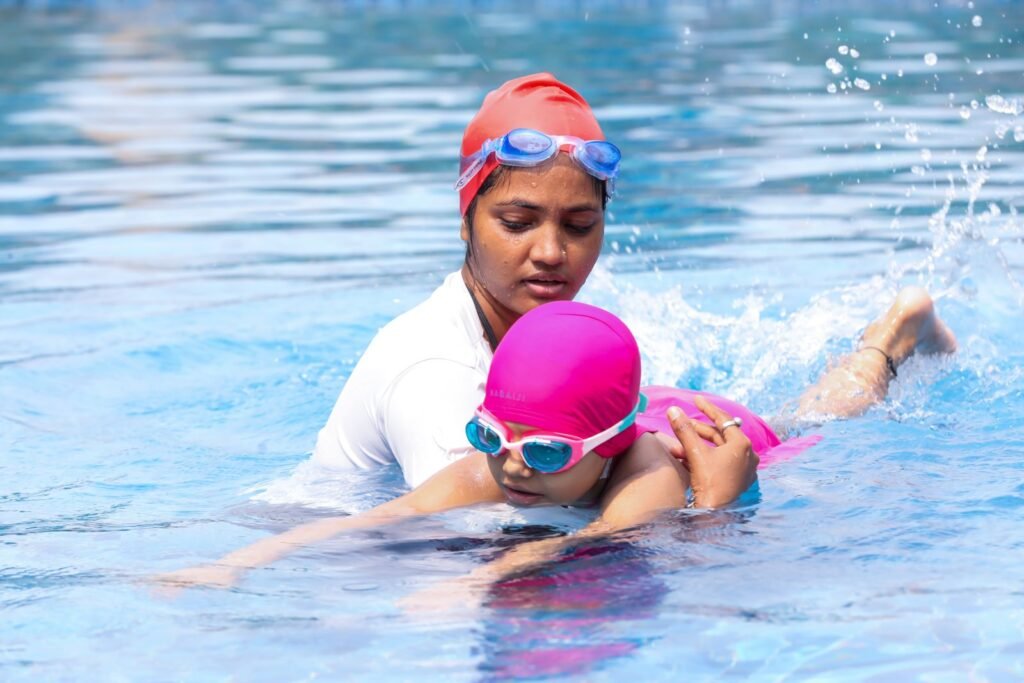
Almost none of Amsterdam’s baby swimming schools own a pool.
They book lane time at a handful of municipal baths, which is why several of them share one address, and why the address you are given is a pool rather than an office.
A handful of pools, a dozen schools
The Sloterparkbad on President Allendelaan in Nieuw-West carries the biggest cluster, with Swimming School "Druppel", De Zwemschool De Oceaan, DREAMSSS and De Natte Kikker all teaching there.
A second cluster works from the pool on De Mirandalaan in Zuid: Van der Wal Sport- & Zwemacademie, R&A Sports & Swimming and SWIM IN BALANCE.
East of the centre the lessons run at the Sportfondsenbad on the Land van Cocagneplein, and there is a further block at Het Marnix on the Marnixplein at the edge of the Jordaan.
Everything else is a single site - Children of the Water on the Amsteldijk, Aqua Hero at Reade on the Overtoom, Zwemschool de Reddertjes on the Anton de Komplein in Zuidoost, and Zwemschool Het Kikkertje on the Hobbemastraat.
The timetable is what actually decides it
Swimming School "Druppel" is the busiest name here by a wide margin, on 422 reviews at 4.9, and it teaches Monday, Tuesday and Friday afternoons plus both weekend mornings.
Wednesday and Thursday are shut, and its Sunday block - half past eight in the morning to one - is the longest single slot any of these schools runs.
De Zwemschool De Oceaan, at the same pool, is open all seven days from early afternoon into the evening, with a Sunday that runs from quarter past twelve until nine at night.
R&A Sports & Swimming on De Mirandalaan also covers the full week, and it opens at eight on Saturday and Sunday mornings, the earliest weekend start of the lot.
DREAMSSS teaches at the Sloterparkbad on Saturdays only, quarter past twelve to six.
Children of the Water on the Amsteldijk inverts the pattern completely, running seven to eleven in the morning from Monday to Friday and nothing at the weekend.
That works for a parent on leave and rules the school out entirely for anyone on office hours.
De Natte Kikker keeps the widest doors - nine to eight on weekdays, ten to six on Saturday - though at 3.2 across 25 reviews it is also the lowest-rated name in the category.
Aqua Hero at Reade on the Overtoom publishes one slot and one only, Monday evening from eight to ten.
Not everything filed here teaches babies
Your Personal Swim Coach is an adult programme, and its Marnixplein sessions are late-evening blocks starting at nine.
Topswim on the Christoffel Plantijnpad coaches open-water swimming and front crawl, and Well Cares Swimming works with adults, expats and children with special needs across several pools.
Van der Wal Sport- & Zwemacademie gives one-on-one lessons and prepares children for their A, B and C diplomas, which is the stage after the one you are looking for.
Where baby swimming leads
Dutch children work through a national diploma sequence, the Zwemdiploma A, B en C, and baby classes are the informal run-up to it rather than a part of it.
A school that teaches both will carry a child from the water-confidence stage to the first diploma without a change of pool, which saves finding a new slot at exactly the age it gets hardest.
If the diploma track is what you are really after, the city’s swimming schools are listed separately from the baby ones, and the public pools run their own lessons too.
Before you call
Several of these are one or two instructors with a mobile number rather than a reception desk, so a phone call gets you further than an enquiry form.
Zwemschool de Reddertjes in Zuidoost and Zwemschool Het Kikkertje on the Hobbemastraat publish no hours at all, which makes the phone the only way in.
Every entry in the full list of Amsterdam baby swimming schools carries the pool address, the phone number and the published timetable.
Related guides
- Finding a Coworking Space in Amsterdam
- How to Choose a Swimming School in Amsterdam
- How to Choose a Beauty Salon in Amsterdam
Related reading
- A Guide to Amsterdam's Swimming Pools
- Amsterdam International Schools Guide For Families
- Amsterdam School Registration Guide For Parents
See also: Having A Baby In Amsterdam: What To Expect.