The canal ring is a different place after the last tour boat has gone in.
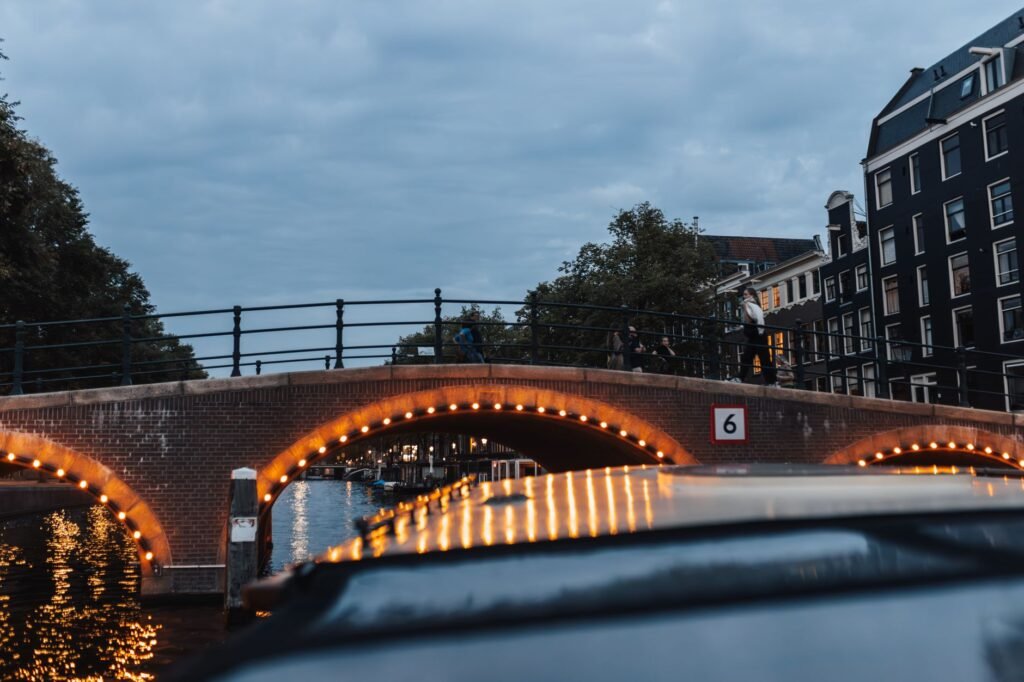
The bridge lamps come on, the water goes still enough to hold a reflection, and the streets that were impassable at four in the afternoon are empty.
What follows is a route that works, the bridges worth stopping at, and the timing that decides whether you get the reflections or not.
Where To Start For The Quietest Views
Do not start at Damrak, which stays busy long after dark and is a road rather than a canal walk.
Start instead on the Singel, the innermost of the ring canals, which is narrow enough that the lamps on both banks reach the middle of the water.
The Torensluis, the widest bridge in the city, is a good first stop, and walking south from there takes you past the Bloemenmarkt once its stalls have shut for the day.
The alternative opening is the Amstel, which is a river rather than a canal and gives you long open views and a wide sky.
From the Amstel you can pick up the southern ends of the Herengracht or the Prinsengracht and walk north into the ring, and the change of scale from river to canal is the best thing about doing it in that direction.
The Route Through The Canal Belt
Begin on the Herengracht at its northern end where it meets the Brouwersgracht, and head south.
This was the address of the merchant class and the facades say so, wider and taller than anything on the outer canals.
The stretch between Leidsestraat and Vijzelstraat is the Golden Bend, where the plots are double width and the interiors are lit from inside after dark, which is the closest thing Amsterdam has to a set piece.
From there cut one block west to the Keizersgracht, which mixes houses, small galleries and cafés and feels more lived-in.
Stand on the Berenstraat bridge and look north, where the Westerkerk tower closes the view down the canal.
West again brings you to the Prinsengracht, the outermost of the three, lined with houseboats whose lit windows sit at water level rather than above it.
Walking north along the Prinsengracht past the Jordaan you get the Westerkerk carillon on the quarter hour, which carries a long way over empty streets.
The detour worth taking is the Reguliersgracht, where seven stone bridges line up in a row and their arches double in the water into a run of illuminated circles.
The Bridges, The Reflections, And Where To Stand
The Magere Brug over the Amstel, near the Carré theatre, is the one everybody photographs, a white wooden drawbridge strung with hundreds of bulbs.
Come after nine on a weeknight and stand on the east bank shooting west to get the whole bridge and its reflection in one frame.
Reflections need still air more than they need darkness, so a windless evening matters more than the hour.
The narrow canals give the sharpest results because the lamps on both banks reach the centre of the water, which is why the Reguliersgracht and the Brouwersgracht work better than the wide Amstel for that particular shot.
The Staalmeestersbrug over the Groenburgwal frames the Zuiderkerk tower dead centre and is the best composition in the city that does not involve a drawbridge.
From the bridge on Nieuwe Spiegelstraat you get a long straight view down the canal with the Rijksmuseum closing it at the far end.
Rest the phone on the railing rather than holding it, since anything over a quarter of a second handheld will smear the reflection you came for.
Detours Worth Taking After Dark
The Rijksmuseum is closed in the evening, but the building is floodlit and the pool in front of it mirrors the whole facade when the water is calm.
It is about fifteen minutes south along the Singelgracht from the canal belt, and it is the one detour that is better without going inside.
Coming back north, the Nine Streets cross the three main canals between the Prinsengracht and the Singel in a grid of short blocks.
The shops are shut by early evening and the restaurants and wine bars are just filling, which is the best hour to walk them.
The Begijnhof courtyard off the Spui closes at night, so save that one for daylight rather than finding the gate locked.
Timing, Footing, And Practicalities
In June and July the sun does not set until close to ten, so the lit-bridge version of this walk does not begin until about half past ten.
In spring and autumn sunset falls between seven and eight, which is why September and October are the best months for it: dark early, still mild, and no crowds.
Winter adds the Amsterdam Light Festival, whose installations sit on and over the water along a fixed route between late November and mid-January.
The paths are cobbled and the stones near the older bridges are uneven, so flat shoes with grip rather than anything with a heel.
The main canals are well lit and the stretches between bridges on the Prinsengracht are darker, which is a matter of atmosphere rather than safety.
Nothing about this costs anything and nothing needs booking, but public toilets are scarce after dark, so plan a café stop into the middle of the route.
A full loop of the three main canals with the Reguliersgracht detour and photo stops takes two to two and a half hours at a walking pace that leaves time to look.
Frequently Asked Questions
Which route is the most scenic for an evening canal walk?
Brouwersgracht south along the Herengracht to the Golden Bend, west to the Keizersgracht, west again to the Prinsengracht, then north past the Jordaan.
That order gives you the grandest facades first and the quietest, most residential water at the end.
Where can I get a canal-walk map?
The I amsterdam visitor centre at Stationsplein hands out printed maps of the canal ring free.
Offline maps on a phone work equally well here, since the ring is a set of concentric semicircles and it is genuinely hard to get lost.
Which canals are quietest after six?
The southern reaches of the Herengracht and the Reguliersgracht, both of which sit off the routes between the main squares.
The Brouwersgracht at the northern edge is reliably empty and is the prettiest stretch of water in the city in either direction.
Which bridges are best for night photographs?
The Magere Brug over the Amstel, the point where the Reguliersgracht crosses the Herengracht for the seven-bridge line, and the Staalmeestersbrug over the Groenburgwal for the Zuiderkerk.
All three want a still evening rather than a particular hour.
Is a canal cruise better at night or by day?
At night for the lit bridges and reflections, by day if you want to actually see the gables and the hoisting beams.
Walking gives you more of the night version than a boat does, because you can stop where you like.
What else is there to do near the canals in the evening?
A brown café on the water, the late-opening restaurants through the Nine Streets, or a performance at Carré on the Amstel.
The cheapest option is a bench on the Brouwersgracht, which is also the one most people remember.