
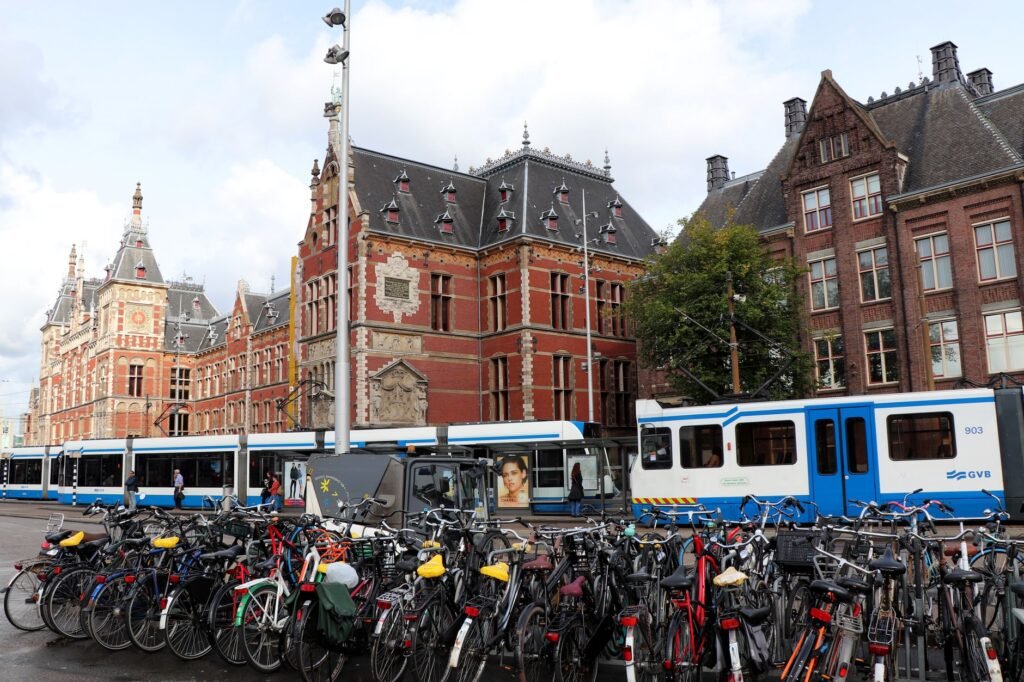
Amsterdam is small enough that the real question is not tram or bike, but where the handover happens.
A bike beats transit whenever your stops are close together; transit beats a bike in rain, over long distances and after midnight.
This guide covers the joins between the two: taking a bike onto GVB and onto trains, which hire schemes actually operate here, and what a badly parked bike costs to get back.
Taking A Bike On Public Transport
GVB carries bikes on the metro for a supplement, and the price is the GVB Fietskaartje at €2.30.
Bought together, a one-hour ticket plus the bike supplement comes to €5.70.
The IJ ferries are the exception that makes bikes work here at all, because they carry bicycles across the water free of charge on every route.
Full-size bikes are not carried on trams or ordinary city buses at any time.
NS trains take bikes outside weekday rush hours and require a bicycle ticket in addition to your own.
A folded bike is treated as luggage and travels differently, which is why so many commuters here own one.
Plan the awkward leg first: ferry across the IJ, ride in Noord, then metro back if the weather turns.
Hiring A Bike, And Which Apps Actually Work Here
Three models operate side by side in Amsterdam, and they suit different lengths of stay.
Shop hire from MacBike, Black Bikes or Yellow Bike gives you a bike for a day or a week, with ID and a card deposit at the counter.
Donkey Republic is the app-based option, with bikes locked at fixed racks around the city that you unlock from your phone and must return to an approved spot.
OV-fiets is the railway’s own hire scheme, picked up at station bike parks and aimed at the last few kilometres of a train journey, which makes it the cheapest way to add a bike to a day trip.
Swapfiets is the subscription model, a monthly fee that includes repairs and a replacement bike, and it only makes sense if you are here for months rather than days.
Ask for a bike with hand brakes if you have never ridden a coaster brake, and test it on a quiet street before entering the centre.
Parking A Bike Without Losing It
Amsterdam removes bikes that are parked where they should not be, and the recovery process is neither quick nor free.
Removed bikes go to the Fietsdepot at Bornhout 8 in the Westelijk Havengebied, and collecting one costs €26.
Having it delivered instead costs €46, and a bike lifted out of a municipal bike park costs €35 to release.
The depot opens Monday to Friday from 12.00 to 16.30 and Saturday from 09.00 to 12.30, with queues of up to an hour after eleven on Saturdays.
Take valid ID, your bike keys and a card, because payment happens at collection.
The large underground garages at Stationsplein and beneath the IJboulevard are the sanctioned places to leave a bike at Centraal.
Everywhere else near the station, the no-parking zones are marked and enforced.
When Transit Wins
The Noord/Zuidlijn is the fastest way to cross the city north to south, linking Noord, Centraal, De Pijp and Zuid in minutes.
Trams remain the better tool inside the canal belt, where the stops are close together and the metro does not reach.
Buses fill the outer districts and the small hours, which is where most visitors forget to look.
Paying is simplest with OVpay: tap a contactless card or phone in and out, one payment method per person.
A GVB day ticket costs €10 and covers trams, buses, metro and the ferries, but not NS trains or the regional buses that reach the airport.
For the airport and the wider region, the Amsterdam & Region Travel Ticket is the product that covers both.
The GVB app handles city routes and the NS app handles anything involving a train.
Airport, Noord, And Day Trips
The train from Schiphol into Centraal takes about fifteen minutes and beats every alternative if you are staying near a station.
Bus 397 is the better choice for hotels near Museumplein, the Rijksmuseum or Leidseplein, because it drops you there without a change.
For Noord, take the ferry first and the metro second, because the ferry is free and lands you on the waterfront rather than under it.
If you are heading to Haarlem, Zaanse Schans or Volendam, check your ticket before you leave, because a city-only GVB pass covers none of them.
For daily notes on what is happening across the city, the Essentially Amsterdam newsletter is free.
Riding Here For The First Time
Ride on the right, pass on the left, and never stop in the middle of a cycle lane.
Signal turns with an outstretched arm, because everyone behind you is going faster than you think.
Cross tram rails at a right angle, since a front wheel that drops into a groove will put you on the ground instantly.
Early morning is the calmest time to learn, before the commuter flow builds.
Frequently Asked Questions
These cover the joins between bike and transit, where most of the confusion sits.
How do I rent a bike in Amsterdam if I’m visiting as a tourist?
Shop hire from MacBike, Black Bikes or Yellow Bike needs ID and a card for the deposit, and gives you the bike for a fixed period.
Ask for hand brakes rather than a coaster brake if you have not used one, and try it on a quiet street first.
Which bike rental apps work best in Amsterdam, and how do they work?
Donkey Republic is the main app-based hire scheme here, with bikes locked at fixed racks that you unlock from your phone and must return to an approved spot or pay a penalty.
OV-fiets is the railway’s scheme at station bike parks, best for the last leg of a train trip, and Swapfiets is a monthly subscription with repairs included that suits longer stays.
Can I take a bike on Amsterdam’s trams, buses, metro, or trains?
Not on trams or city buses at any time; on the metro you can, with a GVB bike supplement costing €2.30.
The IJ ferries carry bikes free, and NS trains take them outside weekday rush hours with a bicycle ticket bought on top of your own.
What are the most important cycling rules and etiquette to follow?
Keep right, pass on the left, signal turns with your arm and never halt in a lane to look at your phone.
Cross tram rails at a right angle and watch for scooters and e-bikes closing far faster than the traffic around them.
Where can I find safe, scenic cycle routes in Amsterdam?
Vondelpark, the Amstel southwards and the whole north bank after the ferry are the three routes that stay pleasant even at busy times.
Noord in particular has wide paths and little tourist traffic, which makes it the sensible place to build confidence.
What happens if my bike is removed for bad parking?
It goes to the Fietsdepot at Bornhout 8 and costs €26 to collect, €46 to have delivered, or €35 if it was taken out of a municipal bike park.
Check verlorenofgevonden.nl first to confirm it is there, and bring ID, your keys and a card.