The colour of the number plate tells you which rules apply, and it is the only thing that reliably does.
Blue plate means a snorfiets, capped at 25 km/h; yellow plate means a bromfiets, capped at 45 km/h; no plate at all means the law treats it as a bicycle.
What changes between those three is where you may ride, whether you need a helmet, and whether you need a licence.
The Four Classes, And What Each One Requires
A bicycle needs no plate, no licence, no insurance and no helmet, and belongs on the cycle path.
An e-bike whose motor assists only while you pedal and cuts out at 25 km/h is legally a bicycle, with all of the same freedoms.
A speed pedelec assists to 45 km/h and is legally a bromfiets: blue plate, AM licence, third-party insurance, and a helmet approved for speed pedelecs rather than an ordinary cycling helmet.
A snorfiets carries a blue plate, is limited to 25 km/h, and requires an AM licence and insurance.
A bromfiets carries a yellow plate, is limited to 45 km/h, requires an AM licence and insurance, and requires a helmet everywhere and always.
The minimum age for an AM licence is 16, and a Dutch category B car licence includes AM entitlement automatically.
The Amsterdam Rule That Catches People Out
Inside the A10 ring, snorfietsen were moved off the cycle path and onto the carriageway in April 2019, and riders there must wear a helmet.
That is a city rule, not a national one, so a snorfiets that may legally use the cycle path in Utrecht may not use it in central Amsterdam.
Bromfietsen already belonged on the carriageway inside built-up areas, and continue to.
Outside built-up areas the pattern reverses: mopeds generally use the cycle path where the signs allow, and the carriageway where they do not.
Read the blue moped signs on the cycle path itself rather than assuming, because they vary street by street.
Fat Bikes And Modified Motors
A fat-tyre e-bike is a bicycle in law only while the assistance stops at 25 km/h and only works while you pedal.
Fitting a throttle, or having the limiter removed, converts it into an unregistered moped, which means no plate, no insurance and no licence for a vehicle that legally needs all three.
Police check this, and the consequence is not a warning but the confiscation of the bike alongside the fine.
If you are buying a second-hand fatbike, ask specifically whether it has been “opgevoerd” - derestricted - because the liability moves to whoever is riding it.
Insurance, Plates And Enforcement
Third-party liability insurance is compulsory for every plated moped, and it is checked automatically against the registration rather than by being stopped.
The plate must be fitted and legible; a missing plate on a snorfiets is an offence in itself.
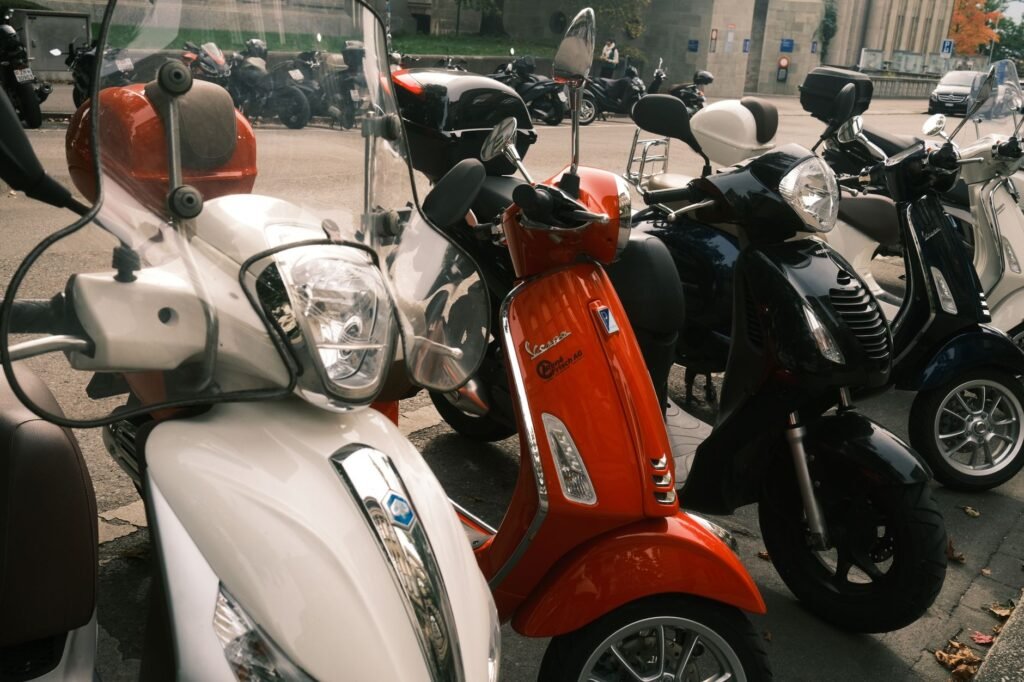
Mopeds parked on the pavement or blocking a cycle rack are removed by the city, and reclaiming a towed scooter costs considerably more than reclaiming a bicycle.
Amsterdam’s emission zones have their own rules for scooters, bromfietsen and snorfietsen, separate from the rules for cars.
Motorcycles are outside the emission zones entirely.
Choosing Between Them
For getting across Amsterdam, the bicycle still wins, because it can use every cycle path and park almost anywhere.
An e-bike makes sense for a commute from Noord, Nieuw-West or Amstelveen, where the distances are real and the wind is worse.
A snorfiets is the awkward middle option in this city specifically, because inside the ring it is stuck in car traffic at 25 km/h.
A bromfiets or a speed pedelec is worth it only if you regularly cover distances a bicycle makes tiring, and you accept the helmet, the licence and the insurance that come with it.
Frequently Asked Questions
What is the difference between a snorfiets and a bromfiets?
A snorfiets has a blue plate and is limited to 25 km/h; a bromfiets has a yellow plate and is limited to 45 km/h.
Both need an AM licence and insurance, and the bromfiets needs a helmet everywhere.
Do I need a helmet on a snorfiets?
Yes inside the A10 ring in Amsterdam, where snorfietsen have been on the carriageway since 2019.
The rule is set by the city, so it does not follow you to other Dutch cities.
Is my e-bike a bicycle or a moped?
A bicycle, if the motor only assists while you pedal and stops assisting at 25 km/h.
A speed pedelec assisting to 45 km/h is a moped, with a plate, a licence, insurance and a specific helmet.
Does my car licence let me ride a moped?
A Dutch category B licence includes AM, so yes.
A foreign car licence does not automatically carry moped entitlement, so check what your own licence covers before renting one.
Where may a moped ride?
On the carriageway inside built-up areas, and on the cycle path outside them where the signs allow it.
In central Amsterdam that applies to snorfietsen as well, which is the local departure from the national rule.
Are fat bikes legal?
Yes, as bicycles, provided the assistance stops at 25 km/h and only works while pedalling.
A derestricted one is an unregistered moped, and it is confiscated rather than warned about.
What happens if I park a scooter on the pavement?
It is removed by the city, and recovering a towed scooter costs substantially more than recovering a bicycle from the Fietsdepot.
Use the marked scooter bays instead.
Related reading
In the news
- Segway launches road-legal e-step in Amsterdam 14 September 2026
- Early data shows local fatbike bans are reducing park and city center nuisance 1 August 2026
- Volt proposes opening IJtunnel to microcars and scooters 30 July 2026