
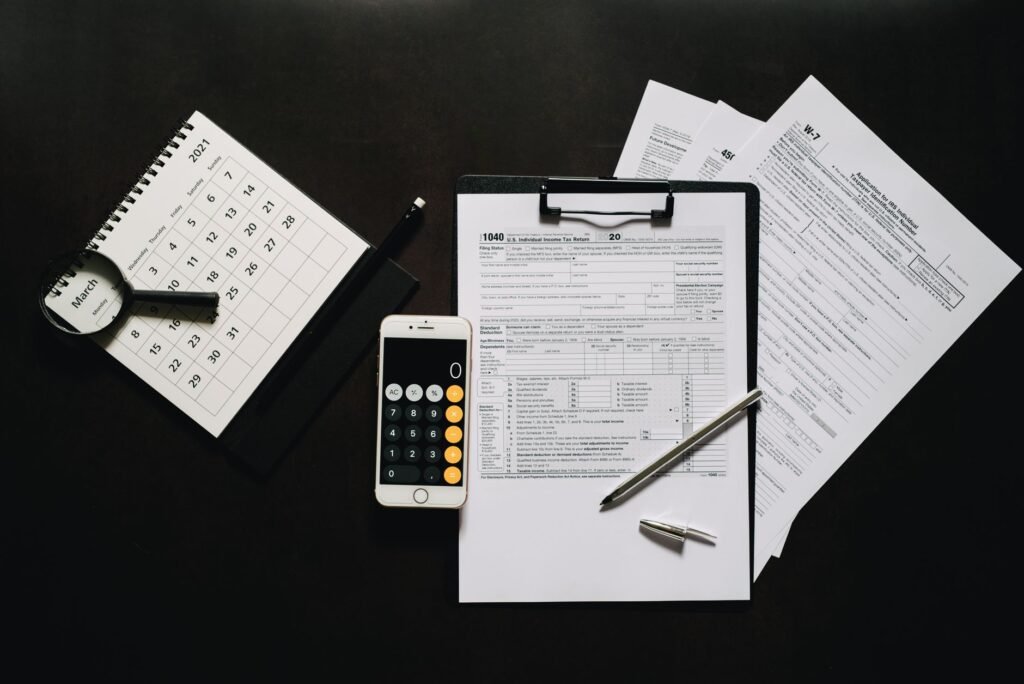
The Dutch system sorts your income into three boxes and taxes each one separately.
A loss in one box cannot be set against a gain in another, which is the rule that surprises people arriving from a single-return system.
Below are the 2026 rates for all three, plus how residency is decided, what your employer already withholds, and when an adviser is worth the fee.
The Three-Box System
Box 1 covers income from work and from owning the home you live in: salary, freelance profit, business income, pensions and some benefits.
The three boxes are defined in law rather than by the tax office, so which box something falls into is rarely negotiable.
For 2026 Box 1 runs at 35.75 per cent on income up to €38,883, 37.56 per cent from there to €78,426, and 49.50 per cent above that.
Those thresholds move every January, so a calculation from last year’s brackets will be wrong at the margins.
Mortgage interest on your own home is deductible in Box 1, set against an imputed rental value the tax office assigns to the property.
Pension contributions are deducted before tax by your employer, which lowers taxable Box 1 income without you doing anything.
Self-employed people can reduce taxable profit further through the entrepreneur allowances, subject to the hours test set out in the guide to freelancing in the Netherlands.
Box 2 applies if you hold a substantial interest in a company, normally 5 per cent or more of the shares.
For 2026 it is charged at 24.5 per cent on the first €68,843 of dividends and gains and 31 per cent above that, with the 15 per cent dividend withholding tax credited against the final bill.
Box 3 covers savings and investments - accounts, shares, bonds, crypto and second properties - and it does not tax what you actually earned.
It applies a deemed return depending on the asset type, currently 6.00 per cent for investments and a provisional 1.28 per cent for savings, and taxes that at 36 per cent.
The tax-free allowance for 2026 is €59,357 per person, or €118,714 for fiscal partners.
Only net assets above that are counted, which is why the split between savings and investments on 1 January matters more than what happened during the year.
The Supreme Court ruled the old deemed-return system unlawful where it overstated real returns, and the promised replacement based on actual returns has slipped repeatedly.
What is in force now is a stopgap, which means anyone investing in the Netherlands should expect this box to change again.
Two credits cut across everything: the algemene heffingskorting, a general credit that tapers away as income rises, and the arbeidskorting, an additional credit for people in work that also tapers.
Both are applied automatically in payroll, which is why your marginal rate in practice differs from the headline bracket.
Who Pays, And On What
Residency decides whether you are taxed on worldwide income or only on Dutch-source income, and it is judged on facts rather than a day count.
Where your permanent home, your family and your economic life are located is what settles it, so keeping a house here while working abroad usually still makes you resident.
Non-residents pay only on Dutch-source income such as work performed here or income from Dutch property.
Arriving or leaving mid-year puts you in a split-year return, which is one of the situations where doing it yourself stops being sensible.
The 183-day rule appears in most Dutch tax treaties.
Spend under 183 days in any twelve months with a foreign employer that has no Dutch establishment, and your salary may fall outside Dutch tax altogether.
Double taxation is handled by treaty, normally through a credit for foreign tax rather than an exemption.
Americans have the Foreign Earned Income Exclusion available, though against Dutch rates the foreign tax credit usually produces the better result.
Social security follows separate rules again, and a posting from a foreign employer can leave you in your home system under a totalisation agreement.
That is worth confirming in writing before the first payslip rather than arguing about afterwards.
The 30 per cent ruling lets a qualifying incoming worker take up to 30 per cent of gross salary free of tax for up to five years, subject to an annual salary threshold.
It becomes a flat 27 per cent from 1 January 2027 for anyone who started using it from 2024, one of several changes covered in Dutch laws changing in 2026.
None of this works without a BSN number, which the tax office, your employer and your bank will all ask for.
What Is Withheld And What You Still File
Employers withhold loonheffing, a single deduction combining wage tax and social security contributions, and pay it directly to the Belastingdienst.
The net figure on your Dutch payslip already reflects the tax credits.
That withholding is an advance rather than a settlement.
The annual return reconciles it, and Box 2 or Box 3 income, foreign earnings or deductions your employer could not apply will produce either a bill or a refund.
Filing is online through Mijn Belastingdienst and needs a DigiD, the government login that everything else here also runs on.
Get a Dutch account open early so a refund has somewhere to land - the options are in banking in the Netherlands.
The window opens on 1 March and the deadline is normally 1 May, with extensions available on request.
An invitation letter makes filing compulsory, but filing without one is often worth it where you have mortgage interest, large medical costs or gifts to approved charities.
When To Pay For Advice
A single Dutch employer and no foreign income is a return most people can file themselves, since the form pre-fills from data the tax office already holds.
The interface is Dutch with partial English guidance, which is manageable for a simple case and not for a complicated one.
Pay for advice if you arrive or leave mid-year, apply for the 30 per cent ruling, own property abroad, run a company, or draw pension income from more than one country.
Dual US-Dutch filers are the clearest case of all, because the two systems interact badly and the penalties sit on the American side.
Look for an adviser registered with the NOB or the RB, the two Dutch professional bodies, and ask specifically about international experience.
For anything that turns legal rather than fiscal, the Amsterdam lawyers guide lists firms with tax specialists.
Frequently Asked Questions
How does Dutch income tax work for residents and non-residents?
Residents are taxed on worldwide income across all three boxes, while non-residents pay only on Dutch-source income such as work done here or Dutch property.
Treaties normally prevent the same income being taxed twice, usually by crediting foreign tax.
What are the 2026 income tax brackets?
Box 1 below state pension age: 35.75 per cent up to €38,883, 37.56 per cent to €78,426, and 49.50 per cent above.
Box 2 is 24.5 per cent up to €68,843 and 31 per cent above.
How is Box 3 taxed in 2026?
Net assets above €59,357 per person, or €118,714 for fiscal partners, attract a deemed return that is taxed at 36 per cent.
The deemed rate depends on the asset type rather than on what your portfolio actually did, and a replacement system based on real returns is still pending.
Which deductions and credits reduce a Dutch tax bill?
The general and employed-person credits apply automatically, and the main deductions are mortgage interest on your own home, pension contributions, entrepreneur allowances and medical costs above a threshold.
For anyone with a Dutch mortgage, the interest deduction is usually the largest single item.
How do I work out my tax residency?
It rests on where your home, family and economic interests are, not on a day count, so registering with a municipality and living here most of the time will normally make you resident.
The moving to the Netherlands checklist covers the registration steps that establish it.
What is the corporate income tax rate?
Vennootschapsbelasting is 19 per cent on the first €200,000 of taxable profit and 25.8 per cent above that.
A BV, an NV or a cooperative must file, as must a foreign company with a permanent establishment here, on its Dutch profits.


![Top [count] Travel Blogs to Follow - OnToplist.com](https://www.ontoplist.com/images/ontoplist31.png?id=6a8dcf108f478)