
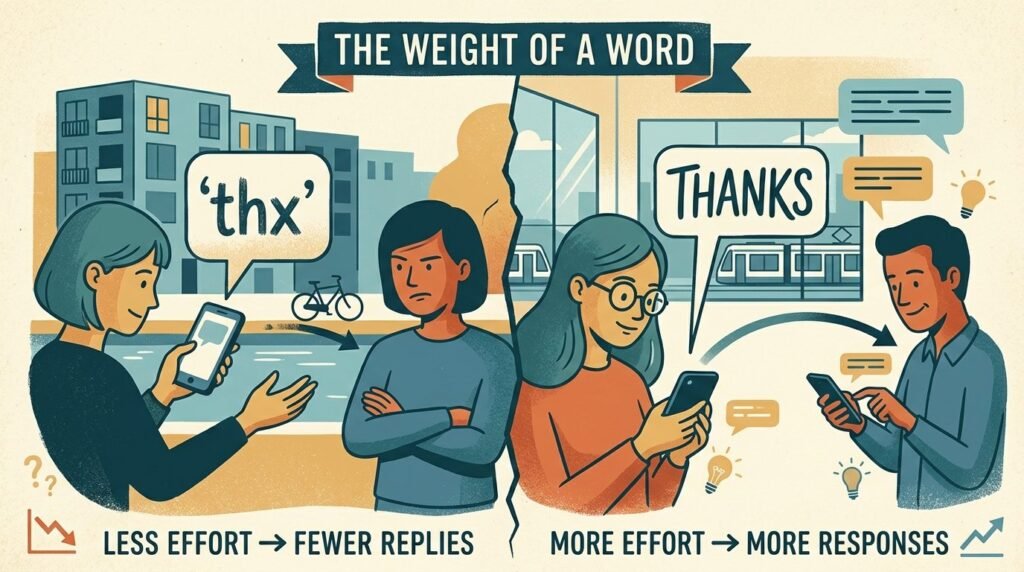
Researchers from Stanford University and the University of Toronto found that people who use texting abbreviations are perceived as putting less effort into a conversation – and are less likely to get a response.
The findings could be worth keeping in mind in Amsterdam, where WhatsApp is woven into everyday life.
It is used to message colleagues, contact landlords, arrange playdates, speak to customers, follow up with recruiters and coordinate everything from football practice to neighbourhood plans.
Being brief is often useful.
But the new research suggests there may be a difference between being concise and looking as though you could not be bothered to type the full word.
Shorter messages get fewer replies
The study, published in the Journal of Experimental Psychology: General, brought together eight separate studies involving 5,306 participants.
Researchers tested a wide range of abbreviations, including shortened words such as “msg” for “message,” acronyms such as “ttyl,” phonetic spellings such as “thanx,” and single-letter replacements such as “u” for “you.”
The effect was remarkably consistent.
People receiving abbreviated messages tended to judge the sender as less sincere.
They were also less inclined to respond, and when they did respond, they often put less effort into their answer.
One of the clearest examples came from a real-world experiment conducted on Discord.
Researchers sent messages to 1,889 users, with some receiving abbreviated versions and others receiving otherwise equivalent messages written out in full.
About 20% of people who received full-text messages replied.
Among those receiving abbreviated messages, the response rate fell to roughly 15%.
That may not sound enormous, but it represents around one-quarter fewer replies simply because of the way the words were written.
Your reply may get shorter too
The effect did not stop at whether somebody answered.
In another experiment, participants were asked to respond to messages containing either abbreviations or full words.
Replies to abbreviation users averaged about 16 characters, compared with around 26 characters when people were responding to messages written in full.
The researchers also rated those responses as showing less effort.
In practical terms, low-effort communication appeared to produce more low-effort communication in return.
That could matter in situations where a conversation needs to continue: arranging an appointment, following up with a new client, asking somebody for information or trying to establish a new professional relationship.
Why does ‘thx’ sound different from ‘thanks’?
The problem does not appear to be that people cannot understand abbreviations.
Almost everybody in the research had used them.
According to the study, 99.3% of texters had used abbreviations at some point and around 90% regularly incorporated them into their messages.
Instead, the researchers found that recipients interpreted abbreviation use as a sign of reduced effort.
That matters because people often use effort as a shortcut when deciding how much another person values an interaction.
Compare these two messages:
“Can you send me the address? Thx.”
“Can you send me the address? Thanks.”
The practical meaning is identical.
But the second message requires slightly more effort to type, and that tiny difference can apparently influence how the person behind the message is perceived.
The effect is largely subconscious.
Recipients are unlikely to sit there thinking that somebody who typed “thx” saved three keystrokes and therefore does not care about them.
Instead, they simply come away with a slightly weaker impression of the sender’s sincerity.
Direct is not the same as abbreviated
That distinction may be particularly useful in Dutch working life.
Dutch communication is often direct and economical.
A message does not necessarily need a long introduction, elaborate pleasantries or several lines of small talk.
“Can you send the invoice today?
Thanks” is still a very concise message.
The research does not suggest that people should suddenly start writing formal letters on WhatsApp.
Instead, it points to a narrower problem: visibly shortening individual words can create the impression that the sender is investing less effort in the interaction.
That could be especially important when messaging somebody you do not know well.
A freelancer contacting a potential client, a job applicant messaging a recruiter, a new employee speaking with a colleague or someone following up after a networking event all have relatively little history to fall back on.
Small signals can therefore carry more weight.
Even friends don’t completely let you off
You might expect abbreviations to stop mattering once two people know each other well.
The researchers tested that possibility too.
Participants still tended to perceive abbreviation users as less sincere even when the people involved had a closer relationship.
The researchers also examined whether abbreviations became less important during longer conversations.
Again, the effect remained.
Even the number of abbreviations did not provide much of an escape route.
Messages containing relatively modest levels of abbreviated language were still rated less favourably than those written in full.
The team tested numerous abbreviation styles, from acronyms and shortened spellings to homophones and phonetic versions of words.
None consistently avoided the effect.
It also showed up in dating
Business communication was not the only context where the pattern appeared.
During Valentine’s week in 2024, the researchers conducted an online speed-dating experiment in which some participants were instructed to use abbreviations.
Afterwards, only about 21% of participants wanted to continue communicating with somebody who had used abbreviated language, compared with almost 37% when the messages were written in full.
The researchers also analysed more than 202,000 Tinder messages from 686 people across 37 countries.
People who used more abbreviations tended to have shorter conversations.
Even after researchers accounted for factors including age, gender, education and conversation content, greater abbreviation use remained associated with shorter exchanges.
The point was not that typing “thx” guarantees the end of a conversation.
Rather, the same general pattern appeared repeatedly across controlled experiments, real-world messages, dating conversations and large collections of existing chat data.
Most of us don’t realise we’re doing it
Perhaps the most interesting finding is that people seem largely unaware of the effect.
When researchers asked participants beforehand what they expected to happen, only about 16% correctly anticipated that abbreviation users would be seen as less sincere.
Around 80% thought abbreviations would make little or no difference.
That creates a peculiar contradiction.
Most people use abbreviations themselves, most assume other people do not care, but they nevertheless appear to react differently when receiving them.
So the next time you are firing off a WhatsApp to a colleague, client, recruiter, landlord or somebody you have just met in Amsterdam, it might be worth typing the whole word.
“Thanks” takes only a fraction of a second longer than “thx.”
According to the research, the person on the other end may notice the extra effort even if they have no idea they are noticing it.


![Top [count] Travel Blogs to Follow - OnToplist.com](https://www.ontoplist.com/images/ontoplist31.png?id=6a8dcf108f478)