Dutch care is split across three separate laws, each with a different body deciding whether you qualify and a different route in.
Knowing which one your situation falls under is most of the battle.
Care providers in Amsterdam
Maternity care dominates this category, so the two providers most useful for an elderly parent or a recovery after surgery are listed first, and only one residential home appears at all.
Several of these run around the clock; the office hours given are when someone answers the phone, not when care stops.
Zuster Jansen
Private round-the-clock home care and night nursing, arranged from an office on Asterweg in Noord that answers weekdays from nine to five.
This is the one to ring when the need is overnight cover rather than a district nurse’s morning visit, and 84 reviews put it at 4.6.
Ariane Zorg
The broadest brief here: nursing, personal care, home help and disability support, from Slotermeerlaan in Nieuw-West.
Weekdays nine to five, with 52 reviews at 4.7 and 88 per cent of them five-star.
Woonzorgcentrum Het Schouw
The only residential home on this page, on Dollardplein in Noord, offering assisted living and elderly care within the wider Amstelring network that also covers Amstelveen and Haarlemmermeer.
Its 69 reviews average 4.2 and are genuinely mixed, with under half at five stars, which is worth reading through before a visit.
HerfstZorg
Home care from Pond Sterlinglaan in Buitenveldert, and the only provider here open seven days a week, nine until six.
It has built a particular focus on supporting people living with fibromyalgia, and its 111 reviews sit at 4.9.
Pregnanta Geboortezorg
Midwifery and maternity care from Koekoeksplein in Noord, reachable at any hour of any day, which is the point of the service.
Of its 241 reviews, 99 per cent are five-star - the strongest record in this category by both measures.
Geboortecentrum
Midwives and home care together on De Genestetstraat in Oud-West, also on call around the clock.
Its 202 reviews average 4.8, with 92 per cent at five stars.
Which law covers you
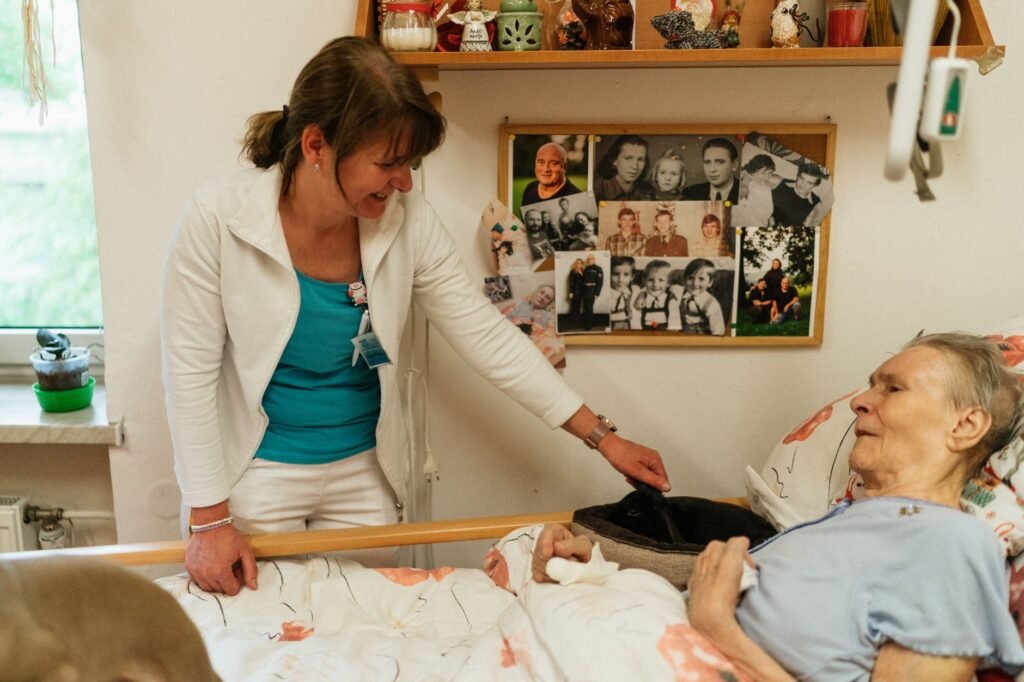
District nursing at home - wound care, injections, help washing and dressing - is paid for out of your ordinary health insurance.
No formal assessment body is involved.
A district nurse decides what you need, and you can contact a provider directly or ask your huisarts to.
Household help, adaptations to the home and day activities come instead from the municipality, under the Wmo, and are applied for at the borough’s Wmo desk.
Full-time care, the kind a nursing home provides, sits under the Wlz and is assessed by the CIZ, the national indication body.
You, your huisarts or your district nurse can put that application in, and the CIZ usually visits before deciding.
Registering with a huisarts comes first
Nothing in Dutch healthcare starts without a family doctor, and in Amsterdam practices regularly close their lists.
Register when you move in, not when you need something, and register the person needing care in the borough where they will actually live.
One of the city’s doctors is the gateway to every referral, assessment and prescription that follows.
Kraamzorg, which surprises almost everyone
After a birth in the Netherlands a trained maternity carer comes to your home, normally spread across the eight to ten days that follow.
They check mother and baby, help with feeding, and do enough of the household running to make the first week survivable.
Basic health insurance covers it, subject to a small personal contribution per hour.
Book in the first trimester.
Amsterdam agencies fill their calendars months ahead, and a due date is not a booking.
Choosing a home, and waiting for one
A Wlz indication does not produce a place; it produces a position on a waiting list, and in Amsterdam those lists are long.
Start the conversation while the person still has choices, not in the week after a fall.
Visit at an ordinary hour rather than a scheduled one, and watch how staff speak to residents who are not expecting visitors.
Ask what the staffing is at night, and ask what proportion of carers are agency rather than permanent, because continuity is what families actually notice.
Practical notes for internationals
Basic health insurance is compulsory for residents and must be arranged within four months of arrival, backdated to your registration date.
Long-term care under the Wlz carries an income-dependent contribution collected by the CAK, so it is not free even where it is granted.
Ask providers directly whether carers speak English rather than assuming; many in Amsterdam do, but it varies by shift as much as by agency.
Keep every indication letter and decision in one folder.
Almost every subsequent step asks for the previous one.
Browse the full range of Amsterdam home care and nursing homes to find support near you.
Related guides
- Amsterdam Psychologists and Therapists: A Guide to Finding Support
- Finding a Martial Arts Club in Amsterdam
- Amsterdam Pharmacies: A Guide for Newcomers