
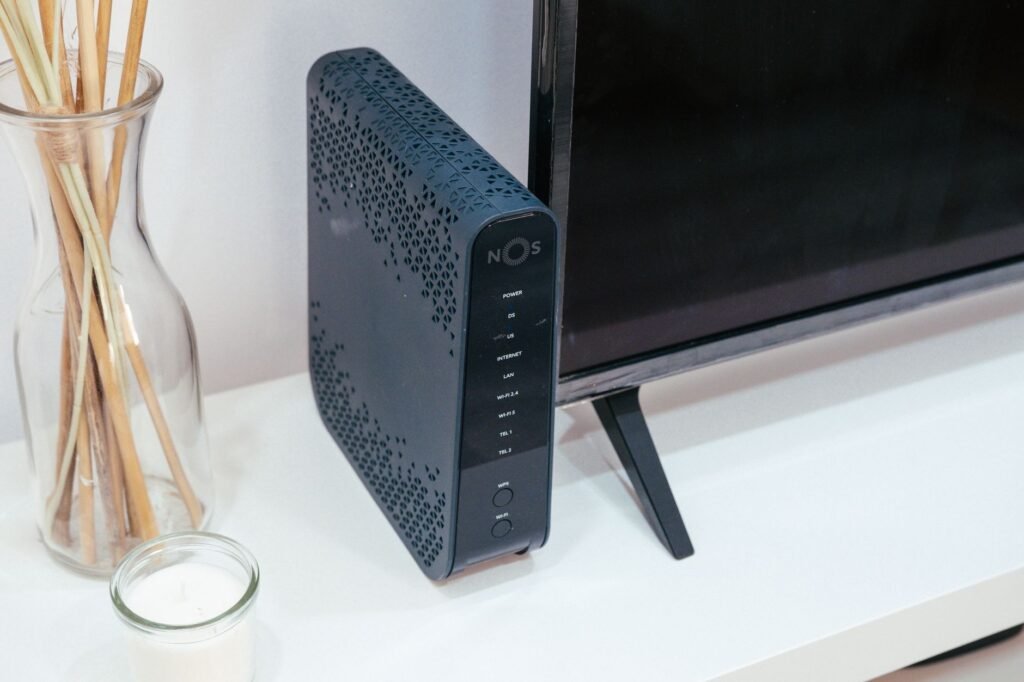
Run a postcodecheck before you compare anything.
Your address, not your budget, decides which of the three network types you can have, and half the offers you will see online are not available at your door.
Internet-only plans run about €32 to €70 a month.
Adding TV and a landline pushes that up, sometimes by less than buying them separately.
Start With Your Address
Every Dutch provider prices from your six-digit postcode plus house number, and each runs its own check on its own site.
It takes half a minute and tells you which of DSL, cable and glasvezel actually reach the property.
Do this while you are still looking at flats, not after you have signed a lease.
A canal-house top floor with only DSL is a different proposition if you work from home.
The Three Connection Types
DSL runs over the old telephone line and tops out around 100 Mbit/s down, which is enough for one or two people streaming.
Cable, almost entirely Ziggo’s network, reaches up to 1,000 Mbit/s and covers most of the country.
Glasvezel is fibre, and where it is installed it is the one to take - symmetric speeds, and packages running to several gigabits.
The rollout is well advanced but not universal, which is exactly why the postcode check comes first.
How Much Speed You Need
One person browsing and streaming is comfortable at 50 to 100 Mbit/s.
A household of four with 4K streaming and video calls wants 200 to 500 Mbit/s.
Look at the upload figure as well as the download one, which most people never do.
Fibre gives you the same speed both ways; cable and DSL give you a fraction of it upward, and that is what makes a video call stutter.
Who Sells What
National
Ziggo owns the cable network and sells up to 1,000 Mbit/s, usually alongside TV.
KPN owns the DSL and the largest fibre network, and is normally first to sell on a newly fibred street.
Odido, formerly T-Mobile Thuis, resells over KPN’s fixed network and competes on price, particularly if you take your mobile from them too.
Ziggo and Vodafone belong to the same parent company, VodafoneZiggo, with home internet sold under the Ziggo brand and mobile under Vodafone.
Regional
Delta is the main provider in Zeeland and parts of South Holland, and Delta Fiber is laying glasvezel across smaller towns.
Caiway serves particular regions and, like Delta, tends to score better on support than the national brands.
Budget
Youfone, Budget Thuis and Hollandsnieuwe undercut the big names on the same physical networks.
Online.nl and Solcon also run over KPN’s network, so the connection is identical and only the billing and support differ.
Internet Only, Or A Bundle
Alleen internet starts around €32 a month and is the right answer if you watch everything on streaming services.
Add a subscription or two later and you will still be below the cost of a TV package - see TV and radio options.
An internet-and-TV package adds roughly €10 to €25 a month and makes sense for Dutch channels and live sport.
Ziggo supplies a set-top box; KPN and Odido deliver TV through an app, which also works on a tablet.
Alles-in-1 adds a landline and attracts a combivoordeel discount.
Sometimes that discount makes the three-service bundle cheaper than internet and TV alone, so price it rather than dismissing the landline you will never use.
Contracts, Switching And Installation
Contracts run one or two years, with the longer term cheaper per month and the first year often discounted further.
Check what the price becomes in month thirteen, because the promotional rate is not the rate you will pay for most of the contract.
Check the notice period, usually a month, and whether the contract rolls on automatically at the end.
Dutch rules let you cancel monthly once an initial term has expired, so an auto-renewed contract is not a trap if you act on it.
To change provider, use the overstapservice: your new provider cancels the old contract and lines up the activation so you are not offline in between.
You do not contact the old provider at all, and the whole thing takes about two weeks.
Most connections come as a self-install kit you plug in yourself.
A new fibre connection needs an engineer and a hole in an external wall, so get your landlord’s written permission before booking it.
You will need a Dutch bank account and a BSN to sign up for anything on direct debit.
If you are also choosing a mobile plan, check the combination discount before committing to either separately.

![Top [count] Travel Blogs to Follow - OnToplist.com](https://www.ontoplist.com/images/ontoplist31.png?id=6a8dcf108f478)