Amsterdam is roughly 750 years old, which makes it young for a European capital and explains why almost all of it was built in two bursts - the seventeenth century and the late nineteenth.
Here is the timeline first, and then what you can still walk to.
The Timeline
- c. 1250 - a dam is thrown across the Amstel where it meets the IJ, creating both a crossing and a working harbour. The settlement takes its name from it.
- 1275 - Count Floris V exempts the people living “apud Amestelledamme” from tolls, the first document to name the place and the city’s official birth certificate.
- c. 1300 - the bishop of Utrecht grants city rights, allowing Amsterdam its own courts, walls and markets.
- 1345 - the Miracle of Amsterdam turns the city into a pilgrimage destination, an event still marked every March by the Stille Omgang, a silent night walk through the centre.
- 1421 and 1452 - two catastrophic fires burn most of the wooden city. Building in wood is heavily restricted afterwards, which is why the centre is brick and stone.
- 1578 - the Alteratie. Amsterdam switches sides in the revolt against Spain in a bloodless coup, expelling the Catholic city government and joining the Dutch rebels.
- 1585 - Antwerp falls to the Spanish and its merchants, capital and trading networks relocate north. Amsterdam inherits an entire commercial economy in a decade.
- 1602 - the VOC is founded and issues tradable shares to the public, creating the first stock exchange. The company’s wealth and its violence both flow through this city.
- 1609 - the Wisselbank opens, making Amsterdam the place where Europe settles its debts and fixes its exchange rates.
- 1613 onwards - the Grachtengordel is dug in planned phases, adding the Herengracht, Keizersgracht and Prinsengracht rings and roughly quadrupling the city’s area.
- 1637 - the tulip market collapses, the first speculative bubble anyone recorded in detail.
- 1648 - the Peace of Munster ends eighty years of war, and the city starts a new town hall on Dam Square to celebrate. It is now the Royal Palace.
- 1669 - Rembrandt dies bankrupt and is buried in an unmarked grave in the Westerkerk.
- 1795–1813 - French occupation, a British blockade and the collapse of the trade that funded everything. Amsterdam spends a century poor.
- 1876 - the North Sea Canal opens a direct route to open water and the port revives.
- 1889 - Centraal Station is built on artificial islands in the IJ, turning the city’s back on the harbour that made it.
- 1928 - the Olympic Games come to Amsterdam, and the Olympic Stadium in Zuid still stands.
- 25 February 1941 - the February Strike. Dockers, tram drivers and civil servants stop work in protest at the first raids on Amsterdam’s Jews, the only mass strike against Jewish persecution anywhere in occupied Europe.
- 1944–45 - the Hongerwinter. Food and fuel run out, trees in the streets are cut for firewood, and thousands die in the city before liberation in May 1945.
- 1965–1975 - Provo, the squatting movement and the Nieuwmarkt riots against metro construction reshape how the city is governed and stop the demolition of the old centre.
- 2010 - the seventeenth-century canal ring is inscribed as a UNESCO World Heritage Site.
How The City Got Its Shape
Amsterdam is built on peat bog, which is why nothing here stands directly on the ground.
Every building of any age rests on wooden piles driven through the soft layers into sand, and the Royal Palace on Dam Square sits on 13,659 of them, a number Amsterdammers recite like a football score.
The Grachtengordel was a property development, not an ornament.
The three main rings were dug outwards in stages from 1613 and sold as building plots, with the Herengracht going to the richest buyers and the Jordaan laid out beyond it on the existing field pattern - which is why its streets run at an angle to everything else.
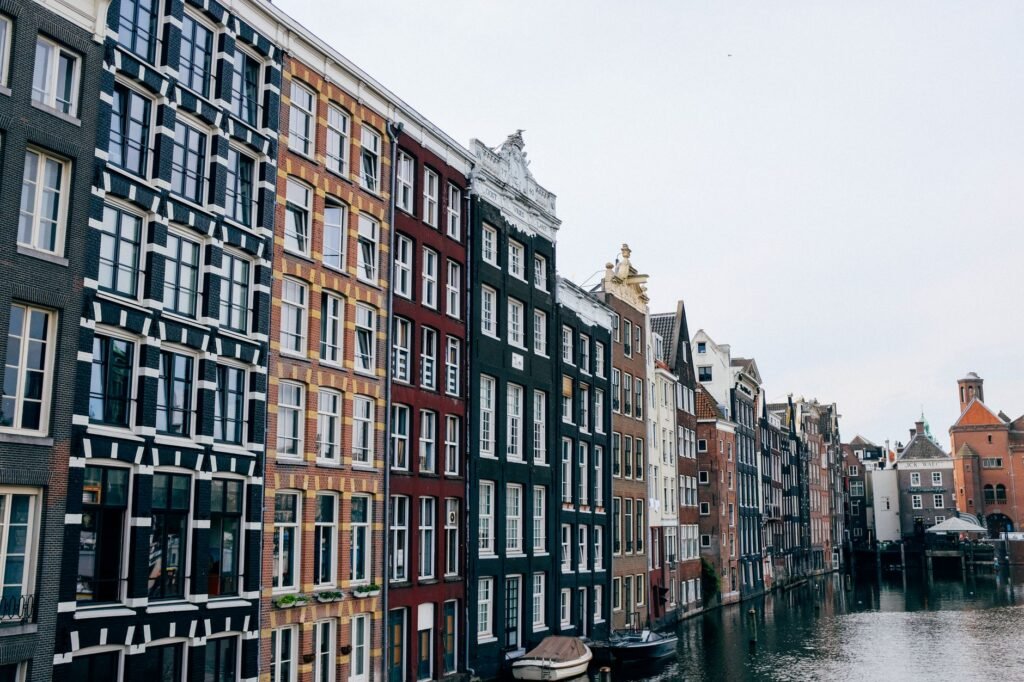
Canal houses are narrow because plots were taxed on their width, and tall and deep because the owners still needed the space.
The hoisting beam under the gable is not decorative: goods went up the outside because the staircases were too steep to carry anything, and the buildings lean forward deliberately so the load clears the facade.
Where You Can Still See It
Dam Square is the dam, and the Royal Palace is the merchant republic’s town hall, designed by Jacob van Campen and finished in the 1660s at the height of the city’s wealth.
The Nieuwe Kerk beside it has been the setting for royal inaugurations since 1814.
The Begijnhof, a walled courtyard off the Spui, holds the Houten Huys from around 1528, one of only two wooden houses in the centre to survive the fire regulations.
Its hidden Catholic chapel dates from the period after 1578, when Catholic worship was banned but tolerated as long as it was invisible from the street - the practical compromise that defines this city more than any grand principle.
For the Golden Age’s other side, the Rembrandt House on Jodenbreestraat is the painter’s actual home and studio, furnished from the inventory taken when he went bankrupt.
The Portuguese Synagogue nearby, finished in 1675, still has no electricity and is lit by candles.
The war is marked in specific places rather than in general.
The Anne Frank House on Prinsengracht is the annexe itself, and the Dokwerker statue on Jonas Daniël Meijerplein commemorates the February Strike with a wreath-laying every 25 February.
If you want the city’s past connected to daily life here now, the Essentially Amsterdam newsletter covers both.
Frequently Asked Questions
How old is Amsterdam?
The city dates its founding to 1275, when Floris V granted toll exemption to the people living by the dam on the Amstel, making it about 750 years old.
Settlement on the site is older, but that document is the first time the place is named.
Why is Amsterdam the capital if the government is in The Hague?
The constitution names Amsterdam as the capital and it is where monarchs are inaugurated, but parliament, the ministries, the Supreme Court and the royal residence are all in The Hague.
The split is a deliberate legacy of the Dutch Republic, in which no single city was allowed to hold both commercial and political power.
What were the Golden Age and the VOC?
The seventeenth century, when Amsterdam was the richest port in Europe, financed by the VOC - the trading company founded in 1602 that issued the world’s first publicly traded shares.
The wealth built the canal ring and the museums, and it came from a trading empire enforced by force and, in Asia and the Atlantic, from slavery.
Why are the canal houses so narrow and tilted?
Narrow because plots were taxed on street frontage, and tilted forward on purpose so that goods hoisted on the beam under the gable would clear the windows below.
Any lean that is sideways rather than forward is subsidence, which is a different and less charming story.
What was the February Strike?
A general strike across Amsterdam on 25 February 1941, called after the first mass arrests of Jewish men, in which dockers, tram drivers and factory workers walked out for two days before the occupiers crushed it.
It remains the only mass public protest against the deportation of Jews in occupied Europe, and the city marks it every year.
Which single place explains the city best?
The Begijnhof, because it holds the oldest house, a hidden church from the years when Catholicism was banned but not policed, and a quiet courtyard thirty seconds from the busiest shopping street.
Tolerance here was always a working arrangement rather than an ideal, and that courtyard is what it looks like.
Related reading
In the news
- Slotermeer’s first residents lived in a windmill 7 October 2026
- History plaques now mark 600 Amsterdam streets 26 September 2026
- Historic sites open doors across Amsterdam 10 September 2026
- Weesperstraat redesign highlights brutalist architectural heritage 9 September 2026
- Action video game set in 17th-century Amsterdam sets August release date 13 August 2026