
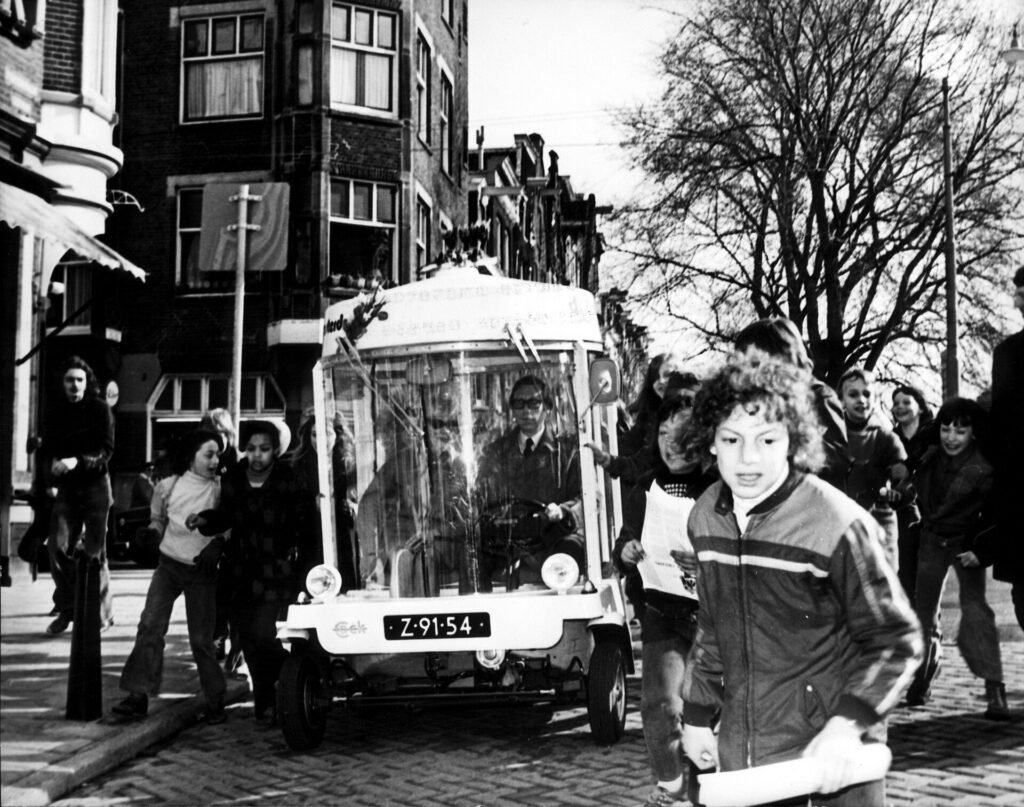
Dutch industrial designer and politician Luud Schimmelpennink conceived the Witkar in 1968 as an electric car that members could share instead of each owning one.
The tall, two-seat white cars could travel about 6.2 miles on a charge at up to 20 mph, and overhead conductors at the stations recharged them in around 10 minutes.
When the scheme opened in 1974, more than 4,000 people paid a 25 guilder fee to join and received a plastic key with a built-in sensor.
Members entered their destination station on a keypad, and a central computer logged each trip and charged about one guilder.
A small network limited its reach
Most journeys were around 3.1 miles, but there were only five stations for the 35 cars.
Plans for more stations and a fleet of up to 1,400 cars never materialised, and the Witkar ended in 1986.
Amsterdam turned to trams, the metro and cycling instead, and Witkar examples can now be seen in Dutch museums, including the Louwman Museum near The Hague.
If sharing a car rather than owning one still appeals, here is how car sharing works in the city today.