Amsterdam’s churches are woven into the very fabric of the city, from soaring medieval landmarks on the main squares to hidden chapels tucked quietly behind ordinary canal-house facades.
Whether you come to worship, to admire the architecture or simply to sit for a while in the cool and the quiet, they offer some of the most rewarding stops anywhere in town.
Churches to start with
These six span Catholic, Protestant, English-speaking Reformed and Armenian Apostolic rather than repeating one denomination across one district.
Hours are what will catch you out: one is open noon to seven every day, two unlock for barely ninety minutes on a Sunday morning and not at all otherwise.
Basilica of Saint Nicholas
Amsterdam’s Catholic basilica and cathedral stands on the Prins Hendrikkade directly opposite Centraal Station, which makes it the easiest of the six to reach and the first most arrivals see.
The window is narrow - a quarter past twelve to half past three on weekdays and Saturday, longer on Sunday morning - and its 3,306 reviews at 4.7 are the largest count of any church in the city.
Westerkerk
Prinsengracht 279 is the address of the best-known Protestant church in the city, open eleven to three from Monday to Friday and shut both weekend days.
That weekday-only pattern is the reverse of most of this list, and 1,539 reviews at 4.4 make it the second most-visited of the six.
De Krijtberg
Three hours a day, two until five, every day of the week without exception, is the whole of De Krijtberg’s public window on the Singel.
It is listed as a visitor attraction as much as a working parish, and 827 reviews at 4.8 make it the best rated of the larger churches here.
English Reformed Church
Inside the Begijnhof courtyard sits the English-speaking congregation, tied to both the Church of Scotland and the Protestant Church in the Netherlands.
It opens to visitors for ninety minutes on Sunday mornings only, from half past ten, and holds 4.6 across 225 reviews.
Noorderkerk
Noon to seven, seven days a week, is the widest window of anything on this list, from the Noordermarkt in the Jordaan.
Concerts, services and hall hire all run out of the same building, and its 350 reviews sit at 4.5.
Armeens Apostolische kerk
Krom Boomssloot 22, a listed monument on a quiet canal east of the old centre, is the Armenian Apostolic church and the only one of its denomination in this block.
Sunday is the only day it opens, and 96 per cent of its 53 reviews are five-star, the highest share of the six on much the smallest count.
The great landmarks
The city’s oldest and grandest churches anchor its historic center and are quite impossible to miss.
The soaring Basilica of Saint Nicholas near Centraal Station greets nearly every arriving visitor, its twin towers and central dome forming a first, memorable glimpse of the old city for anyone stepping off the train.
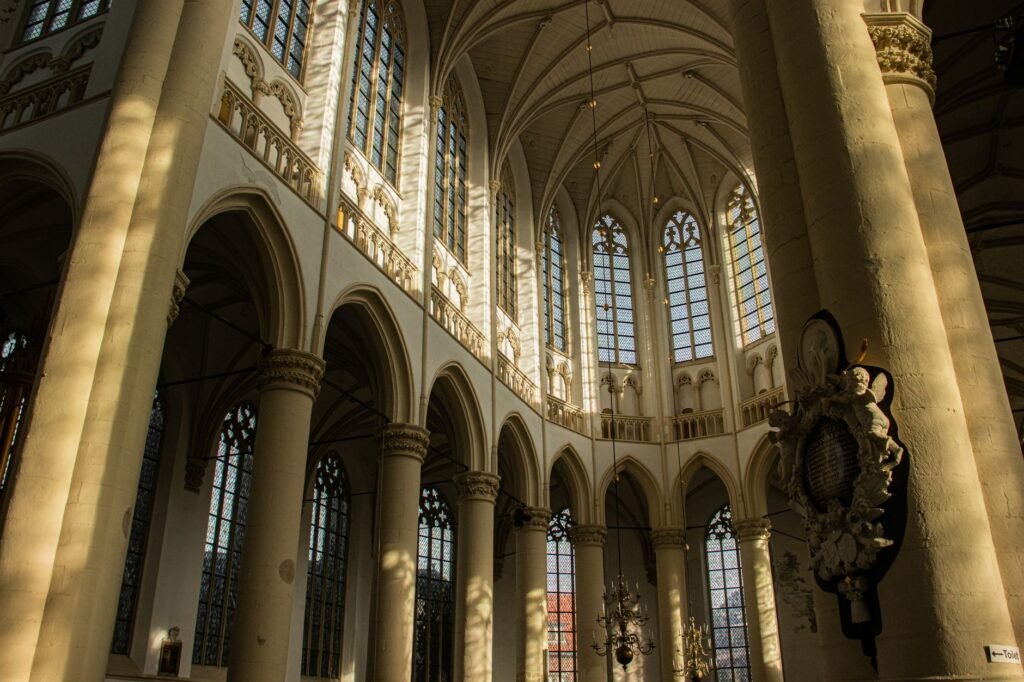
These buildings genuinely reward a slow look, both from the outside and within, where centuries of detail repay the patience.
Many of them sit within easy walking distance of the city’s museums and attractions, making them a natural addition to any day of sightseeing.
Arriving early in the day usually means quieter, far more contemplative visits before the crowds gather.
Hidden churches and history
One of Amsterdam’s most fascinating historical chapters is its clandestine churches (schuilkerken), places of worship cleverly concealed inside ordinary houses during periods when certain faiths could not gather openly in public.
From the street they look like any other canal home, yet inside they hide astonishingly complete sanctuaries, galleries and altars.
Exploring these tells you as much about the city’s long history of pragmatism and quiet tolerance as any conventional museum ever could.
They are a vivid reminder that Amsterdam’s religious life has always run discreetly through its neighborhoods, and they pair beautifully with a guided walk from one of the city’s tour operators who know exactly where to look.
Psalm 64 and the Orpheus of Amsterdam
One particularly direct historical connection between Amsterdam’s churches and the Bible can be found in the work of Jan Pieterszoon Sweelinck.
Often called the “Orpheus of Amsterdam,” Sweelinck was the city organist at the Oude Kerk, where he played from 1562 – 1621, and became one of the most influential musicians of his age; Amsterdam still houses an esteemed music academy named after him.
Sweelinck composed elaborate choral settings of the complete Genevan Psalter, including a six-part version of Psalm 64, beginning with the French words Enten à ce que je veux dire.
The psalm asks God for protection against secret plots, false accusations and words sharpened like weapons.
Sweelinck transformed that dark and anxious text into intricate music in which the different voices answer, overlap and gather force.
Sweelinck’s music belonged to the world of the Oude Kerk and the rapidly growing seventeenth-century city around it.
Visitors can still find his grave inside the church, while the Oude Kerk’s continuing organ and concert tradition preserves something of the musical environment in which his psalm settings were created.
It is a reminder that Amsterdam’s churches are not only architectural monuments, but places where biblical texts have been interpreted through music for centuries.
Music and acoustics
Amsterdam’s churches also double as some of its finest concert venues.
Their soaring stone interiors and historic pipe organs make for genuinely extraordinary acoustics, and many host regular recitals, choral evenings and atmospheric candlelit concerts that are open to absolutely everyone, believer or not.
Simply checking a church’s schedule can turn up a memorable evening out for very little money, and the setting elevates the music well beyond anything a modern concert hall can offer.
It is exactly the kind of cultural find worth passing on to visitors, right alongside a recommendation for their hotel and a suggested walking route through the center.
Active congregations
Beyond their history and beauty, many of these churches remain genuinely living communities rather than mere monuments.
Amsterdam’s large international population is well served here, with English-language services and congregations spanning a wide range of denominations and faith traditions right across the city.
For newcomers in particular, a warm and welcoming congregation can be one of the fastest ways to build a social circle and start to feel properly rooted in an unfamiliar new home.
A quick look at service times and the languages offered will point you toward one that fits, whether you are a lifelong regular worshipper or simply curious to visit once.
Many congregations also run midweek gatherings, volunteering and social events that make settling into a new city feel a good deal less lonely.
Visiting respectfully
When you do visit, remember that these are places of real meaning as well as monuments to admire.
Dress modestly, keep your voice low, avoid wandering around during services unless visitors are clearly welcomed, and always check whether photography is permitted before raising your camera or phone.
Some churches ask a small entry contribution toward their ongoing upkeep, which helps preserve these remarkable buildings for future generations to enjoy long after we are gone.
Approached with a little care and courtesy, they offer a genuinely peaceful counterpoint to the busy streets and crowded canals outside, a place to slow down for a quarter of an hour.
They are well worth building into any exploration of the city, perhaps one arranged through a travel agency.
Browse the full range of Amsterdam churches to plan your visit.
Related guides
- A Guide to Amsterdam’s Bookstores
- Cinemas in Amsterdam: Your Complete Guide to the City’s Movie Theatres
- A Guide to Amsterdam’s Cinemas
In the news
- Vondelkerk Restoration Is 3 Million Euros Short, and a Free Art Sale Is Trying to Close the Gap 17 August 2026
- Vondelkerk restoration faces a 3 million euro gap, and art is being sold to close it 16 August 2026
- Stadsherstel launches activities to support Vondelkerk restoration following fire 14 August 2026