
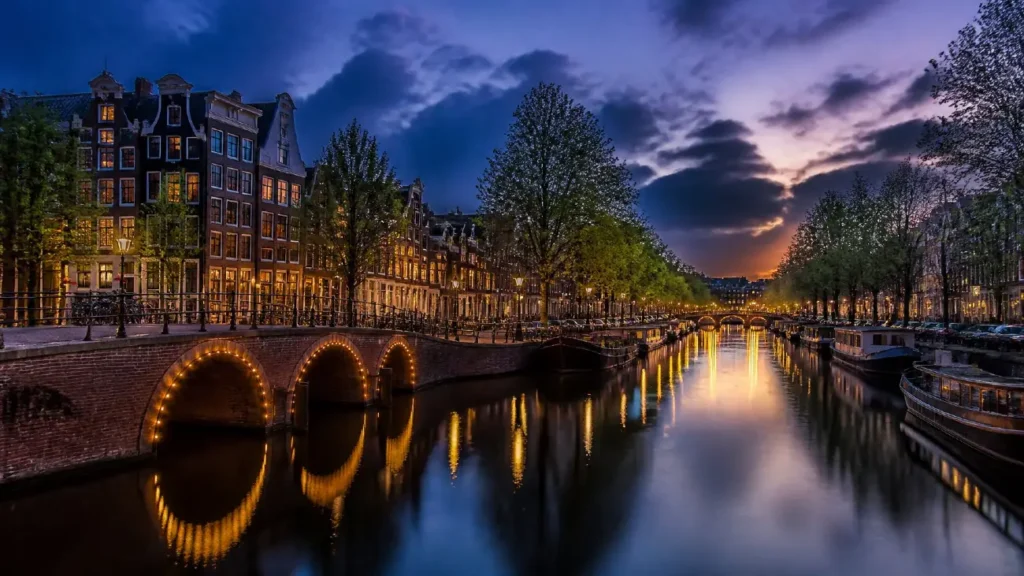
There is a Dutch word for sitting in the half-light at the end of the day and doing nothing much at all. Schemeren - from schemer, dusk - describes the habit of staying put as the light goes, without switching on a lamp, without reaching for anything.
It was once ordinary in Dutch households.
Then the twentieth century happened, electric light got cheap, evenings filled up, and the word survived while the practice quietly did not.
Over the past few months it has come back, and in a slightly improbable way: through the international press. The Guardian wrote about it in March, BBC Travel a fortnight later, and National Geographic in June.
All three landed on the same person, and the same city.
How a forgotten habit got a flag-bearer
The writer in question is Marjolijn van Heemstra, who is from Amsterdam and has spent years running night walks here.
The story of how she found schemeren is the sort of thing that would seem invented in fiction: an octogenarian on one of her walks mentioned it in passing, as something people simply used to do.
She went looking, and found references scattered through Dutch newspapers from the eighteenth century to the early twentieth.
Her case for it is not really about wellness. “It’s an act of resistance against the absurd idea that every second must be spent usefully,” she has written - which is a more interesting claim than the one the international coverage tends to make, and a harder one to sell as a lifestyle trend.
She now organises communal dusking sessions, where people sit together and listen to an audio piece combining narration with music while the light goes.
In Amsterdam these have happened along the Amstel and at Mediamatic, the cultural space on the eastern docklands.
Eindhoven’s Parktheater runs them too.
One thing worth clearing up
Several articles mention her book, Nachtgids, in the same breath as dusking, which has left some readers expecting a manual. It is not one.
Nachtgids is a novel.
Its protagonist, Mellie, is a change coach whose life has gone hollow, who finds something in the dark and starts a movement around it - night walks, switching off streetlights, protecting fireflies - until a woman is found unconscious during one of those walks and the whole thing turns uncomfortable.
The questions it asks are about activism and its costs, not about how to relax after work.
It is out in Dutch now, with an English edition expected next year. If you are looking for instructions, you will not find them there.
Fortunately there are none to find.
How to actually do it in Amsterdam
There is no equipment and no method.
You go outside, you sit, and you stay for thirty or forty minutes while the light drains out of the sky.
That is the whole thing.
The timing is the only part that takes any planning, and in this city it swings wildly.
In late July the sun sets around 21:40 and the last usable light lingers until nearly 22:30 - a long, slow, generous dusk.
By December the sun is gone before 16:30 and the whole business is over by teatime.
The Dutch winter, it turns out, is extremely well suited to a practice that requires darkness to arrive early.
Where you go matters less than you would think, but a few things help.
Water gives you a second sky to watch, which is why the Amstel works so well and why any canal will do at a pinch.
An open horizon beats a narrow street.
And somewhere you can sit without buying something is worth more than a good view - the point is to stop, and a terrace where a waiter is hovering is not stopping.
The obvious candidates are the parks, which are open and quiet at that hour once the picnics have packed up.
The eastern docklands and the IJ give you sky and water at once.
A rooftop will give you the most spectacular version of it, though it comes with the waiter problem attached.
Why it caught on now
It is tempting to be cynical about this, and the cynicism has some history behind it.
There is a well-worn pipeline in which the English-language press discovers an untranslatable word from a small northern European country, decides it encodes a superior philosophy of living, and processes it into merchandise.
Hygge went first, from Denmark, and within two years you could buy a hygge-branded scented candle in an airport. Lagom followed from Sweden.
Niksen - the genuinely Dutch entry, meaning roughly to do nothing on purpose - had its own cycle around 2019 and produced a shelf of books explaining a concept that, by definition, cannot be explained at book length.
The pattern is always the same.
A word that describes something ordinary and unbought gets translated into a practice, the practice gets a method, the method gets a product, and the original thing - which was free, and which nobody used to think about - becomes one more item on a list of ways you are failing to live properly.
Dusking has every quality needed to go the same way.
It already has a nice foreign name, an appealing simplicity, and three international features published within four months.
What makes it slightly more durable than its predecessors is that there is genuinely nothing to sell.
Hygge could be monetised because it involved objects: candles, blankets, cushions.
Niksen at least required a chair. Dusking needs the outdoors, some time, and the ability to tolerate your own company for half an hour.
You cannot improve at it, there is no equipment to upgrade to, and the only measure of success is that you stayed.
That is a poor foundation for an industry and a reasonable one for a habit.
But the underlying observation is sound, and it is not really Dutch at all. Almost nobody watches the light change any more.
We are indoors, or we are lit, or we are looking at a screen that is brighter than the sky.
Half an hour outside at the end of a day costs nothing, needs no app, and requires you to be no good at it.
Amsterdam in late July gives you an unusually long window to try. The sun goes down at twenty to ten, and it takes its time about it.
Looking for a place to sit? Browse our guide to Amsterdam parks.

![Top [count] Travel Blogs to Follow - OnToplist.com](https://www.ontoplist.com/images/ontoplist31.png?id=6a8dcf108f478)