Amsterdam runs more than forty official street markets, and most of them exist to sell cheese and socks to people who live two streets away.
A handful are worth crossing the city for, and which ones those are depends almost entirely on the day of the week.
The antiques come out on Mondays and Sundays.
Organic produce is a Saturday thing, secondhand books happen on Fridays, and the flea market that pulls visitors in from Belgium and Germany opens on roughly a dozen weekends a year.
The markets that run six days a week
Four general markets trade Monday to Saturday, which makes them the safe choice when you have one free afternoon and no interest in consulting a calendar.
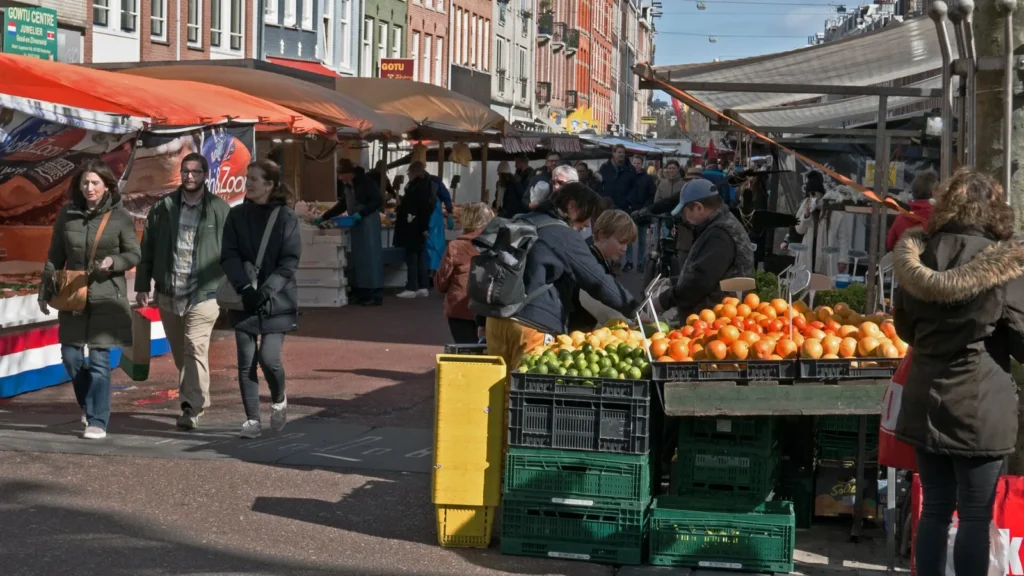
The Albert Cuypmarkt in De Pijp is the largest, with around 260 stalls running the length of Albert Cuypstraat.
It opens at 09:30 and packs up at 17:00, and it has been trading since 1905.
It is a working market rather than an attraction, which is both its charm and its limit.
Expect fruit, fish, cheese, fabric, phone cases and a stroopwafel griddle, and do not expect antiques.
The Ten Katemarkt in the Kinkerbuurt does the same job for West and stays open an hour later, 09:00 to 18:00.
It is smaller, far less photographed and noticeably cheaper.
The Dappermarkt in Oost is the third, also 09:00 to 18:00.
It is the most genuinely multicultural of the four, and Monday only became a full trading day there in the early 1980s.
Waterloopleinmarkt is the odd one out, because it sells almost nothing you actually need.
Around 300 stalls of vintage clothing, records, army surplus, bicycle parts and outright junk, open 09:30 to 18:00.
By its own reckoning it is the oldest flea market in the Netherlands, and more than 130 years old.
Waterlooplein metro station sits on the square itself, so it is the easiest of all of them to drop into.
Monday: antiques on the Noordermarkt
The Noordermarkt in the Jordaan is two different markets on two different days, and Monday is the one for browsing.
From 09:00 to 14:00 the square in front of the Noorderkerk fills with secondhand clothing, antiques and brocante.
Go early.
Dealers pack up at two, and anything good has usually moved before noon.
The same morning, a fabric market takes over the neighboring Westerstraat from 09:00 to 13:00, selling cloth by the meter.
Over in the canal belt, a small flowers-and-plants market runs on the Amstelveld from 09:00 to 18:00, also on Mondays.
Friday: secondhand books on the Spui
Every Friday around 25 booksellers from across the Netherlands set up on the Spui for de Boekenmarkt, from 10:00 to 18:00.
They deal in secondhand and antiquarian books, along with prints, pamphlets, posters and old magazines.
Stock runs in Dutch, English, French and German.
The market trades all year, and the organizers are clear that a rain shower is not a reason to cancel.
Saturday: organic produce and the Lindengracht
Saturday turns the Noordermarkt into three markets at once.
The organic Boerenmarkt begins by café Winkel and trades 09:00 to 16:00, with a general goods market filling the rest of the square.
Keep walking and you are on the Lindengracht, where a long general market runs 09:00 to 17:00.
The three flow into one another, so most people never work out where one stops.
The Nieuwmarkt has its own organic market on Saturdays, 09:00 to 16:00.
On Wednesdays and Saturdays there is also a stamp and coin market on the Nieuwezijds Voorburgwal, 09:00 to 16:00, which is exactly as specialized as it sounds.
Sunday: art, antiques and a travelling food market
From May to November, an antiques and curiosities market takes over the Nieuwmarkt on Sundays, 09:00 to 17:00.
It is the best of the city’s antique markets that does not require an entry ticket.
The Spui holds a Sunday art market from 10:00 to 18:00 between March and December, and Rembrandtplein runs one from 10:30 to 18:00.
Both sell work directly from the people who made it.
The Pure Markt is a travelling Sunday food market that rotates between the Amstelpark, the Amsterdamse Bos and Park Frankendael, 11:00 to 18:00.
The dates left this summer are 9 August at the Amstelpark, 16 August in the Amsterdamse Bos and 30 August at Park Frankendael.
The Sunday Market at the Westergas is a design and food market held on the first Sunday of every month, 12:00 to 18:00.
IJ-Hallen: the flea market worth planning around
IJ-Hallen at the NDSM wharf calls itself the biggest flea market in Europe, and on a summer weekend it puts 750 stands outdoors.
Doors are 09:00 to 16:30 on both days of a market weekend.
Entry is €6.50 for adults and €3.00 for children.
An early-bird ticket costs €11.00 and gets you in at 06:00, in the dark, before the dealers have finished unpacking.
The remaining 2026 dates are 8 and 9 August and 29 and 30 August outdoors, then 19 and 20 September, 10 and 11 October, 31 October and 1 November, 14 and 15 November, and 12 and 13 December indoors with 500 stands.
It is at NDSM-Plein 1 in Noord, and the free NDSM ferry from behind Centraal Station docks at the wharf.
The flower markets
The Bloemenmarkt on the Singel is the market every visitor has heard of and the one most residents will tell you to skip.
The city does not dress it up either: its own page on the market’s future notes that the stalls have ended up carrying a large supply of souvenirs instead of flowers.
It still sells bulbs, and bulbs are a reasonable thing to carry home.
For cut flowers and plants, the Monday market on the Amstelveld is the quieter option.
Before you go
The city keeps a map of every official market with its trading days and hours, which is the quickest way to see what is on near you today.
Markets close on a few public holidays, and the outdoor ones empty out fast in heavy rain.
For everyday shopping rather than browsing, our guide to groceries and markets covers the supermarkets and the indoor market halls.
Hopping between markets in one day is a tram job rather than a walk, and the public transport guide explains what a ticket costs.