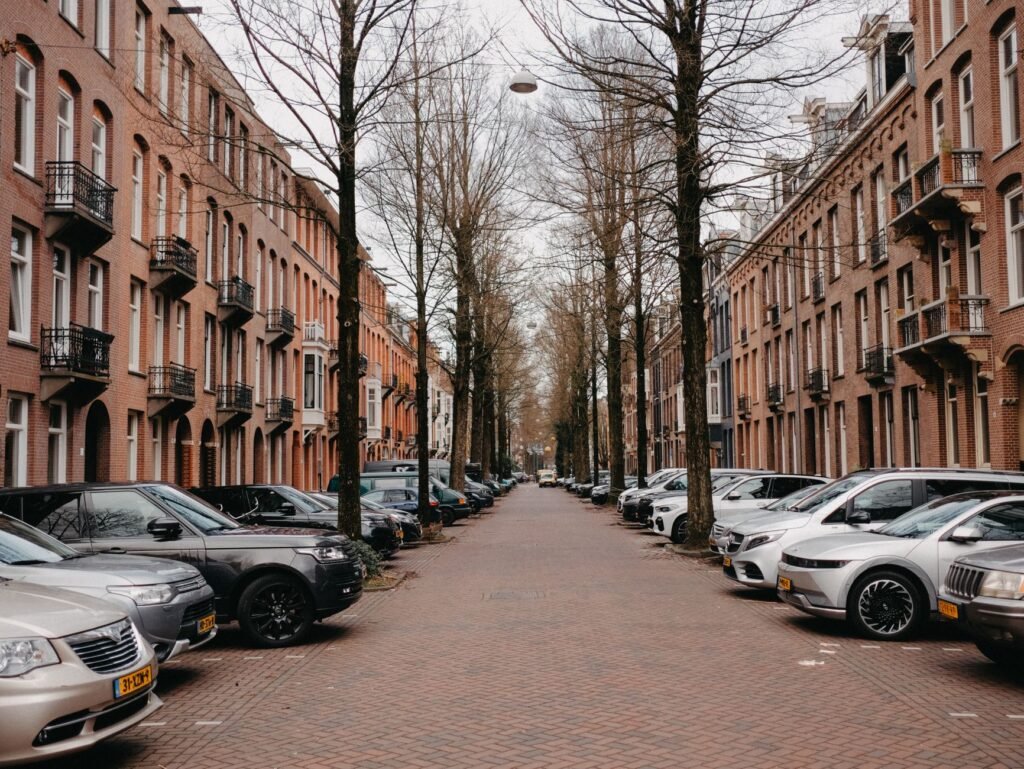
The car is not the expensive part of keeping a car in Amsterdam - the square metre it stands on is.
Street parking in the Centrum runs from €5.37 to €8.05 an hour, so a single day at a meter costs more than most people’s weekly transport budget.
What follows is what each element actually costs, what the city requires of you, and the one mechanism that stops the meter running when the car is not in use.
What Parking Costs, By District
Amsterdam is divided into parking zones, and the hourly rate depends on which one you stop in.
Centrum is €5.37 to €8.05 an hour.
Oost runs €4.19 to €6.98, while West and Zuid both run €3.01 to €6.98.
Nieuw-West is €1.72 to €5.37 and Noord is €1.72 to €4.19.
Zuidoost is a flat €1.72 an hour, and Weesp is €1.29, which is the difference the ring road makes.
Those rates are why a resident permit is not a convenience but the entire economics of car ownership here.
The Resident Permit, And The Waiting List
A resident parking permit is tied to your registered address and to a specific parking zone, not to the whole city.
Most central zones have a waiting list, and the wait varies enormously by street, so check your own address in the city’s Adreszoeker before you assume anything.
You pay six months in advance, by direct debit or by invoice, and the city does not offer instalments or payment plans.
If the invoice is not paid by the start of the new permit period the permit simply stops, and reapplying puts you back on the waiting list if your zone has one.
A permit also lets you park in certain municipal garages within your zone at no extra charge, which is worth checking because it solves the street-space problem entirely.
While you are on the waiting list you can sometimes apply for an overloopvergunning, a temporary permit for a neighbouring zone.
The Bills That Arrive Whether You Drive Or Not
Motorrijtuigenbelasting, the road tax, starts on the day the vehicle goes into your name in the RDW register and runs until the day it leaves it.
It does not care whether the car moves, and the amount depends on the empty weight, the fuel type and the province you live in.
Third-party liability insurance, WA, is legally required for every registered vehicle in the Netherlands, and driving without it is an offence detected automatically from the register.
APK, the periodic roadworthiness inspection, is due four years after first registration for a petrol or electric car, then every two years, then annually once the car is eight years old.
Diesel and LPG cars are inspected three years after first registration and every year after that.
If the car is off the road for a stretch - a long trip, a winter abroad, a sale that has not happened yet - you can suspend the registration with the RDW.
Suspension stops the road tax and the insurance requirement, but the vehicle may not stand on a public road at all while it lasts, which for most Amsterdam residents means it has to go into a garage or out of the city.
Emission Zones
Amsterdam operates both milieuzones and zero-emission zones, aimed at the most polluting vehicles, with separate rules for cars, vans, lorries, coaches, taxis, campers, boats and mopeds.
A fully electric or hydrogen vehicle may enter every one of them without restriction.
There is no emission zone for motorcycles.
The city runs a number-plate checker that tells you whether a specific vehicle may enter, though it only works with Dutch plates.
Check before you buy a second-hand diesel, not after, because the zones are the reason older diesels are cheap in this city.
Buying A Car Here As A Newcomer
Registration is done in your name at the RDW, and you need a BSN and a registered Amsterdam address to hold a vehicle.
Buying from a dealer transfers the registration on the spot; buying privately means both parties going to a post office or RDW counter with the vehicle papers and ID.
Check the number plate against the RDW’s own online register before paying, which shows the APK expiry, the recorded mileage history and whether the car is under any restriction.
Ask for the tenaamstellingscode from the seller, because without that code the transfer cannot be completed.
A pre-purchase inspection through the ANWB or a garage costs a fraction of what a hidden fault does.
Frequently Asked Questions
Is owning a car in Amsterdam worth it?
Inside the ring, rarely - the parking rate alone exceeds what most households would spend on transport, and a permit may take years to arrive.
In Noord, Nieuw-West and Zuidoost, where rates start at €1.72 an hour and permits are easier, the arithmetic changes completely.
What does street parking cost?
From €5.37 to €8.05 an hour in the Centrum, €4.19 to €6.98 in Oost, €3.01 to €6.98 in West and Zuid, and €1.72 flat in Zuidoost.
Rates and paid hours are set per zone, not per district, so check the specific street.
How do I get a resident permit and how long is the wait?
You apply against your registered address, and the wait depends entirely on the zone.
The city’s Adreszoeker gives an estimate for your own address, which is the only figure worth acting on.
What are the fixed annual costs?
Road tax based on weight, fuel and province; compulsory third-party insurance; and the APK inspection every one or two years depending on the car’s age and fuel.
The permit is billed six months at a time and cannot be spread further.
Can I stop paying while the car is not in use?
Yes, by suspending the registration at the RDW, which halts road tax and the insurance requirement.
The car may not be parked on a public road for the whole of that period.
Can a foreigner buy and register a car here?
Yes, with a BSN and a registered address in the Netherlands.
Bring valid ID and get the tenaamstellingscode from the seller, because the transfer cannot be done without it.
Will an older diesel be a problem?
It may be excluded from the milieuzone, which is a large part of why it is priced the way it is.
Run the plate through the city’s checker before buying rather than after.