
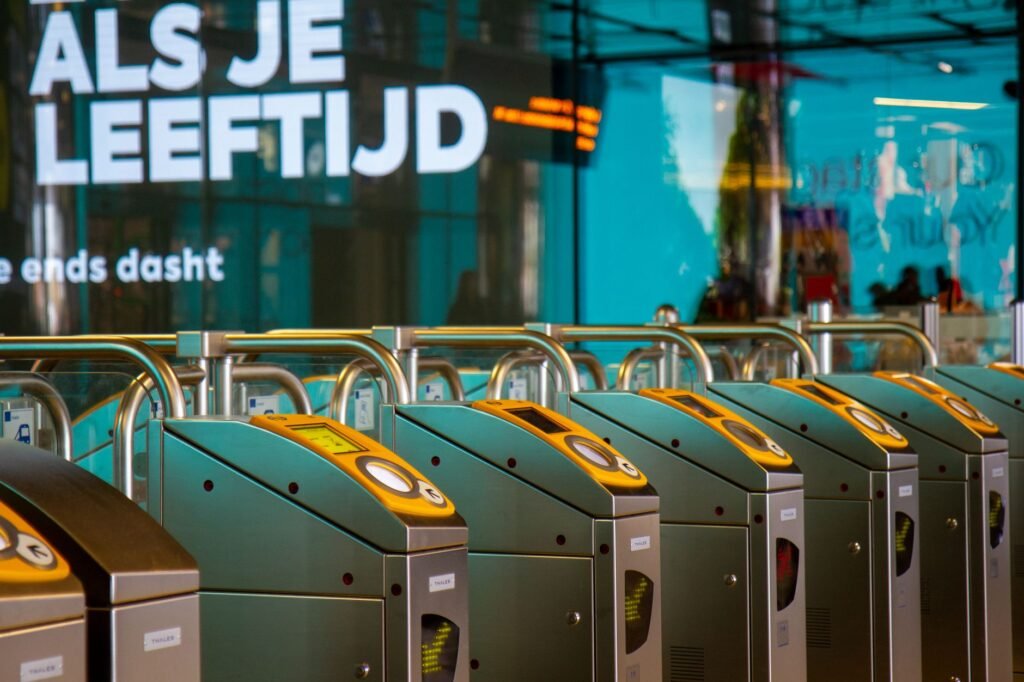
Commuters passing through Amsterdam Centraal may eventually be able to walk straight through ticket barriers without scanning a card or phone.
Technology firm Hitachi Rail and local public transport operator GVB recently completed a small-scale trial at the station to test hands-free gate access using ultra-wideband radio signals.
The test aimed to determine whether precise location tracking could automatically open station turnstiles as a passenger approaches, even if their device remains in a pocket or bag.
How the technology works
Unlike standard Bluetooth, which relies on signal strength to guess proximity, ultra-wideband technology measures the exact time it takes for radio waves to travel between a gate and a device.
This allows the system to pinpoint a traveler’s position within about four inches, preventing the wrong gate from opening or triggering accidental charges for nearby bystanders.
During the Amsterdam trial, testers carried small physical tags through the gate line while holding laptops and luggage, allowing them to pass through without pausing.
Testing in a busy, real-world station environment was considered a key step, as physical obstacles and crowd movement can interfere with radio signals in ways that lab tests cannot replicate.
Preparing for future transit upgrades
Hands-free access could significantly speed up passenger flow during peak commuting hours and make public transport easier to navigate for travelers with mobility challenges or heavy luggage.
However, widespread adoption depends on integrating the system directly into consumer smartphones and establishing standardized international rules for transport operators.
The trial comes as the Dutch public transport network transitions away from the traditional OV-chipkaart system toward account-based ticketing under the nationwide OVpay initiative.
While no further trials have been officially scheduled yet, developers view the Netherlands as a primary candidate for future testing given its existing digital transit infrastructure.
For help getting around today, read our guide to Amsterdam public transport.


![Top [count] Travel Blogs to Follow - OnToplist.com](https://www.ontoplist.com/images/ontoplist31.png?id=6a8dcf108f478)