It Isn’t Called Holland
The country’s official name is the Netherlands, not Holland.
Holland refers only to two of its twelve provinces, North Holland and South Holland, and Amsterdam sits in North Holland.
In January 2020 the Dutch government formally dropped “Holland” from its own branding and switched to “the Netherlands” everywhere, from passports to tourism campaigns.
A City Built on Wooden Piles
Amsterdam grew on soft, waterlogged soil, so its older buildings don’t sit directly on the ground.
Builders drove long wooden piles down through the mud to a firmer sand layer before laying a foundation, a technique used across the historic center for centuries.
The Royal Palace on Dam Square is one of the best-known examples still resting on its original wooden piles.
Narrow Houses, Steep Stairs and a Hook Over the Door
Canal-house plots were once taxed by how much street frontage they took up, so residents built narrow and deep rather than wide.
That left staircases too steep and tight to move furniture up, which is why many canal houses still have a hoisting beam and hook jutting from the top gable.
Sofas and pianos go in through the windows, winched up from the street, a system still in daily use during moving day.
More Canals Than Venice
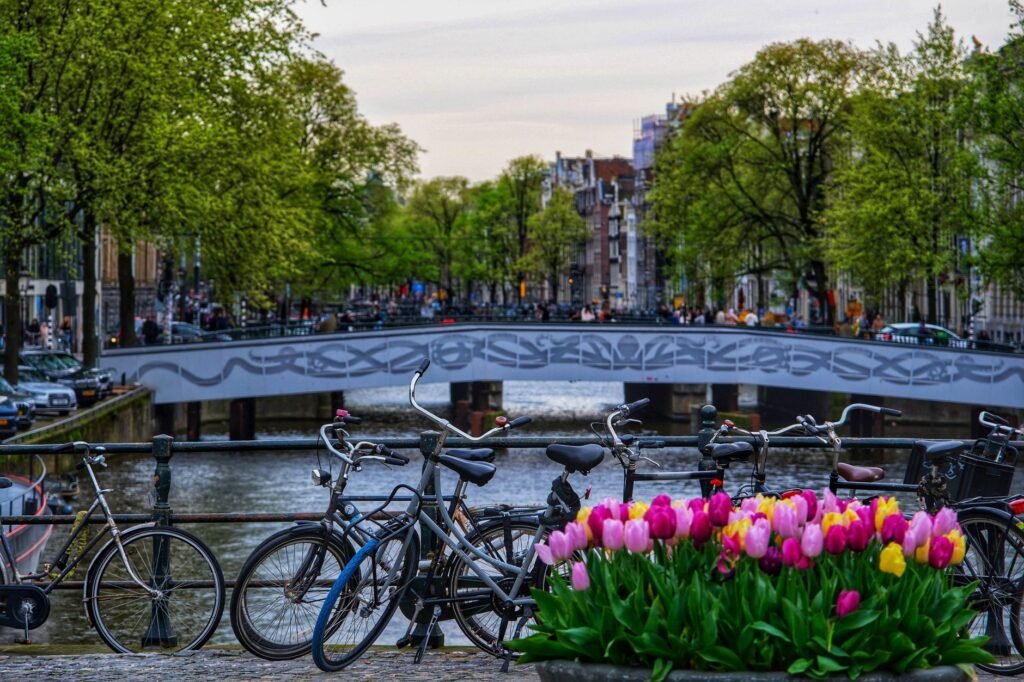
Amsterdam’s canal ring, the Grachtengordel, was laid out in the 17th century as a planned expansion of the city and is now a UNESCO World Heritage Site.
The city is regularly described as having more canals than Venice, threaded through with a dense network of bridges.
For context on how the ring fits into the city’s wider development, the clear history timeline for newcomers lays out what came before and after it.
Orange Runs Deeper Than the Soccer Shirt
Orange became the Dutch national color because of the royal House of Orange-Nassau, not the vegetable.
It shows up on King’s Day, at soccer matches and across Dutch sports uniforms generally.
Anyone curious how that royal history connects to everyday Dutch habits and etiquette can see it laid out in the Dutch culture guide for first-time visitors.
Tulips Are Immigrants Too
Tulips are closely associated with the Netherlands, but they aren’t originally Dutch.
They arrived from Central Asia in the late 16th century and were popularized here through the trade networks and plant breeding that later fueled the famous 17th-century tulip mania.
A Dam on the Amstel Gave the City Its Name
Amsterdam’s name comes directly from its origin: a dam built across the Amstel river around the late 13th century, in a settlement then called Amstelredamme.
Dam Square, still the city’s geographic center, marks roughly where that original dam stood.
The Dutch Really Are the Tallest
Average height in the Netherlands is consistently measured as the tallest in the world, a fact that surprises most first-time visitors within a day of arriving.
The reasons are more interesting than genetics alone, covered in full in Why Are the Dutch So Tall?
The Real Answer.
The Museum Quarter Is Small on Purpose
Amsterdam packs an unusual concentration of major museums into one compact square, Museumplein, including the Rijksmuseum on Museumstraat, the Van Gogh Museum and the Stedelijk.
It was designed as an open green space with the museums arranged around its edges, which is why it works so well on foot.
A practical walkthrough of what’s there and how to plan time around it is in Museumplein: What’s There and How to Plan a Visit.