You do not need Dutch in Amsterdam.
The Netherlands came first out of 123 countries in the 2025 EF English Proficiency Index, with a score of 624, and in practice that means the person at the counter will switch to English before you have finished apologizing for not speaking Dutch.
What a handful of Dutch words buys you is not comprehension.
It is the small social credit of having tried, which in a city with this many visitors is worth more than it sounds.
The ten you will actually use
Everything below is short, common and hard to get wrong.
Learn these and you have covered most of a week.
- Hoi — hi. Universal, all ages, all situations short of a job interview.
- Goedemorgen / goedemiddag / goedenavond — good morning / afternoon / evening. Shopkeepers use these, and returning one is the easiest small courtesy there is.
- Dank je wel — thank you. Dank u wel is the polite version, and bedankt works everywhere.
- Alsjeblieft — please, and also “here you go” when handing something over. You will hear it constantly at tills and counters.
- Sorry — sorry. It really is the Dutch word, used exactly as you would use it.
- Pardon — excuse me, for getting past someone on a tram.
- Mag ik… — may I have. Mag ik de rekening? gets you the bill.
- Ik wil graag… — I would like. Softer than “ik wil,” which lands as a demand.
- Spreekt u Engels? — do you speak English. Almost always redundant, and asking anyway is the polite move.
- Doei — bye. Casual and everywhere. Tot ziens is its formal cousin.
u or jij, and why it matters less than you fear
Dutch has a formal u and an informal jij, and getting it wrong is a very small crime.
As a visitor you will be forgiven either way, and Amsterdam leans informal to a degree that surprises people from Germany or France.
Use u with older people, in a bank, at a doctor’s office and in any letter.
Use jij with anyone your own age in a bar, a shop or a café.
There is a third form, je, which is the unstressed version of jij.
Genootschap Onze Taal, the Dutch language society, puts it simply: jij is for when the word carries emphasis, and je is the less emphatic alternative.
Three sounds worth ten minutes
The Dutch g and ch are the famous one, made at the back of the throat rather than in the mouth.
Amsterdam’s version is harder than the softer southern one, and there is no polite way to approximate it in English.
The ui in huis or uit has no English equivalent at all.
It is closest to the vowel in “house” with the lips rounded, and getting near it is enough.
The ij and ei are the same sound, somewhere between the vowels in “eye” and “hey”.
This is why IJburg and Leidseplein rhyme in the middle, and why the IJ is pronounced closer to “eye” than to “eee”.
Words with no clean English translation
Gezellig is the one everybody mentions, and the reason is that it covers cozy, sociable, convivial and pleasantly low-key all at once.
A bar can be gezellig, so can an evening, so can a person.
Lekker means tasty and also means good in a broader physical sense.
Lekker weer is nice weather and lekker geslapen is slept well.
Hoor is a softener with no meaning of its own, tacked on to take the edge off a sentence.
Nee hoor is a friendly no, where a bare nee can sound flat.
Even, pronounced “ay-fuh,” means briefly or just a moment.
Ik kom even langs is I will drop by for a second, and Dutch conversation is full of it.
The words you will read, not hear
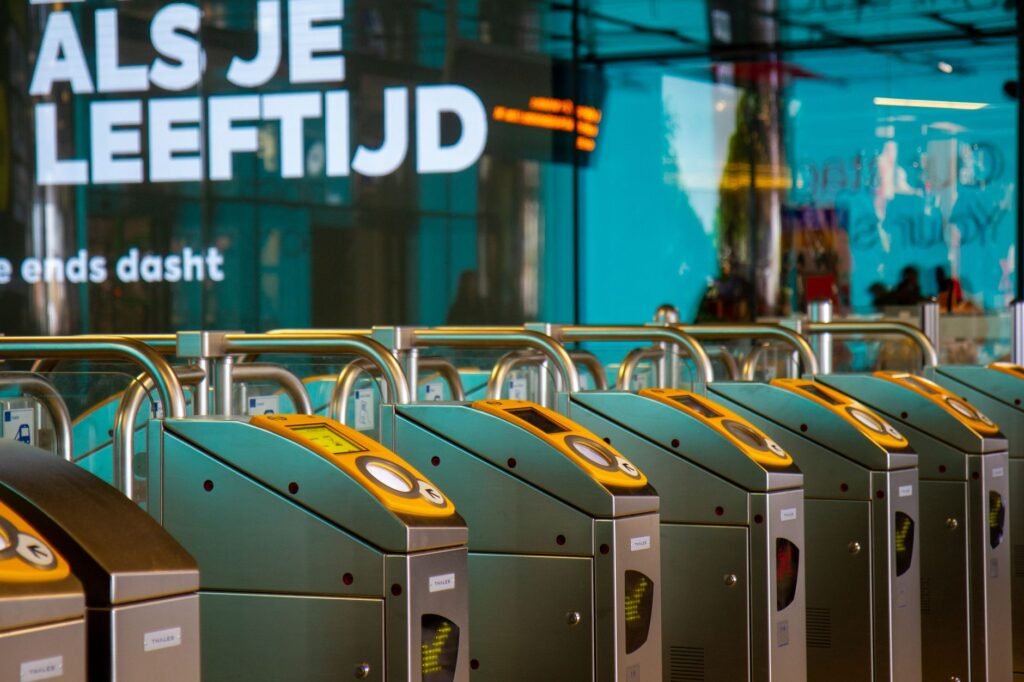
Signs are where a visitor’s Dutch actually earns its keep, because nobody is going to translate a door for you.
- Ingang and uitgang — entrance and exit.
- Duwen and trekken — push and pull.
- Geopend and gesloten — open and closed.
- Alleen pinnen — card only, no cash. Extremely common in Amsterdam, and it is the sign people most often walk past.
- Kassa — checkout or till.
- Spoor — platform, on every station board.
- Halte — stop, for trams and buses.
- Storing — a fault or disruption, the word to look for when a machine or a train line is not working.
- Werk in uitvoering — roadworks in progress.
One mistake worth avoiding
English speakers reach for ik ben warm to say they are hot, and it does not mean that.
The correct phrase is ik heb het warm, literally “I have it warm,” and the same pattern gives you ik heb het koud.
The same goes for hunger and thirst: ik heb honger and ik heb dorst, never ik ben.
Dutch treats these as things you have, not things you are.
Where to take it further
If you want to check a spelling rather than a phrase, the official list is Woordenlijst Nederlandse Taal, published by the Nederlandse Taalunie and known to everyone as the Green Booklet.
For usage questions, Onze Taal’s Taalloket is the standard reference.
For actually learning the language rather than surviving a week of it, our guide to the best ways to learn Dutch compares the methods, and the roundup of language schools in Amsterdam covers the classroom options.
The habits that go with the words are in our guide to Dutch etiquette.