
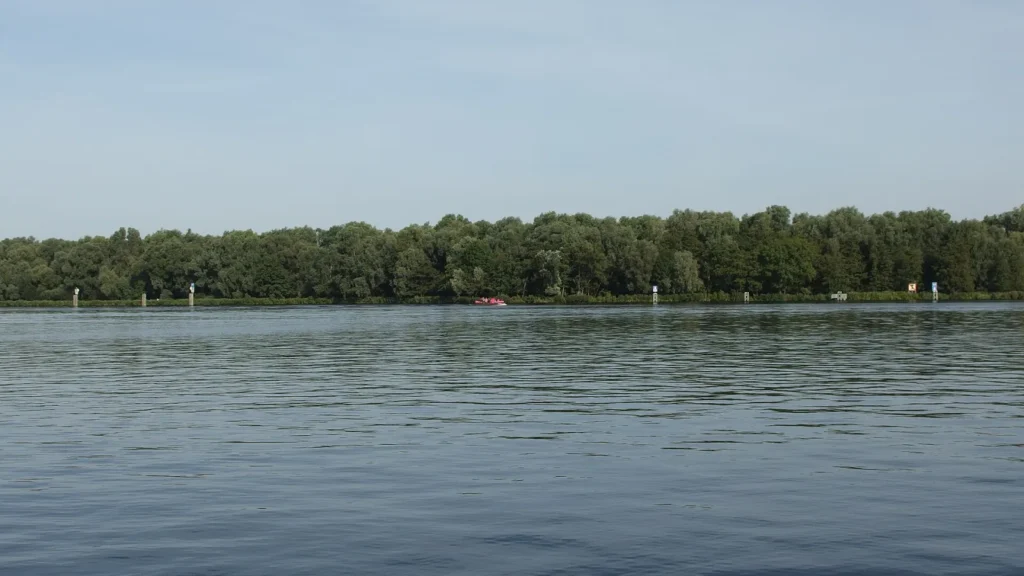
Amsterdam has plenty of sand and not much swimming.
The distinction matters more than it sounds, because a good half of the places people call city beaches are terraces with sand tipped on them, and the water in front of them is not water you should get into.
The province designates and tests official open-water swimming locations, and publishes the results at zwemwater.nl.
That register is the difference between a swim and a stomach bug, and it is the frame for everything below.
Where you can actually swim in the city
Nieuwe Meer West, off the Anton Schieperspad in the south-west, is an official designated swimming location.
It sits on the same lake as the Amsterdamse Bos and is the closest proper open-water swim to the center.
The Amsterdamse Bos has two official spots of its own: a swimming section in the Grote Vijver and the Amsterdecks jetty on the Nieuwe Meer.
Both are monitored by the province, which is the only reason to prefer them over the nearest convenient bank.
The Bos also fills two children’s paddling pools from May through September, on weekends and school holidays, 10:00 to 19:00, whenever it is dry and above 20 degrees.
On weekdays above 20 degrees only the smaller pool is filled.
North of the city, Het Twiske has seven beaches spread around its lakes, with the Doesstrand nearest the main entrance.
Baaiegat is the one on the official register, so it is the one with a published status you can check before you leave.
The Sloterstrand is off the list
The Sloterplas beach in West used to be the obvious city swim, and it is no longer an official swimming location.
The city’s own words are that the water “is not clean enough,” with too many fecal bacteria (E. coli) at times and a risk of blue-green algae.
Swimming there and anywhere else in the Sloterplas is at your own risk.
The city tests the water three times a week and posts the result on boards at the beach, so the sign is the thing to read, not the weather.
Dogs are banned from the Sloterstrand outright, which is part of the same problem.
The full explanation, including what the city is doing about the gulls, is on the water quality page.
Strand IJburg, and the closure that is coming
The beach on Strandeiland at IJburg is the city’s real seaside-shaped beach, and it is on borrowed time.
Through September 2026 nothing changes and you can use it as normal.
From October 2026 to April 2027 it closes to the public while the watersports clubs move out and the site is prepared for a bridge and a lock.
It reopens in May 2027, considerably smaller, and stays smaller until it is rebuilt after 2031.
Getting there needs checking right now.
Tram 26 was extended to Centrumeiland and Strandeiland, but the city’s own project page says the tram runs again on 17 August 2026 at the earliest, so until then the last stretch is not a tram journey.
Blijburg is the name most searches still return for this stretch of coast.
It no longer has a working website, and the beach at IJburg is the one the city now calls Strand IJburg.
Sand without swimming
Three well-known places give you the beach-day feeling and no swim, which is fine as long as you know it in advance.
Strand Zuid sits behind the RAI at Europaplein 22, open daily from 12:00 to 23:00, with Europaplein metro station at the door.
It is a large terrace with sand, deck chairs and a restaurant, not a swimming spot.
Pllek on the NDSM wharf has the best of the sand terraces, facing the IJ with the city skyline opposite.
It opens at 09:30 and runs to 01:00, or 02:00 on Fridays and Saturdays, with the kitchen closing at 22:00.
Hannekes Boom at Dijksgracht 4 is the closest of the three to Centraal, a waterside terrace on the Oosterdok with a mooring for boats.
It is open from 11:00 daily, until 03:00 at weekends.
The IJ is a working waterway with commercial traffic.
Nobody should be swimming in it, terrace or not.
The coast, by train
The North Sea is closer than most residents assume.
Zandvoort aan Zee is a direct 30-minute train from Amsterdam Centraal via Sloterdijk and Haarlem, twice an hour year-round and four times an hour in summer, and the station is about 200 meters from the sand.
Bloemendaal aan Zee has no station of its own.
The municipality’s own advice is to take the train to Zandvoort and pick up bus 81 from there, the only year-round bus to the beach, with line 84 added on summer weekends.
That bus is the pattern for most of the North Sea coast north of Haarlem.
The beaches at IJmuiden, Wijk aan Zee and Castricum all sit a bus ride from the nearest station, which adds a connection but also thins the crowd considerably on a hot Saturday.
For a full day rather than an afternoon, Texel is a train to Den Helder and then the TESO ferry across the Marsdiep.
It is a long way to go for a swim, and a genuinely different landscape once you are there.
Checking before you go
Two checks cover almost everything.
The zwemwater register tells you whether a spot is official and what its current status is, and the city’s signage at the water tells you what the last test said.
If the answer is no on both, the indoor option is not a defeat: our guide to swimming pools in Amsterdam covers the outdoor pools that open in summer.
For the green space around the water, start with the parks guide, and the ferry guide explains the free crossings to Noord.
Featured photo: Nieuwe Meer @ Amsterdam Bos by Guilhem Vellut, CC BY 2.0, via Wikimedia Commons.

![Top [count] Travel Blogs to Follow - OnToplist.com](https://www.ontoplist.com/images/ontoplist31.png?id=6a8dcf108f478)