
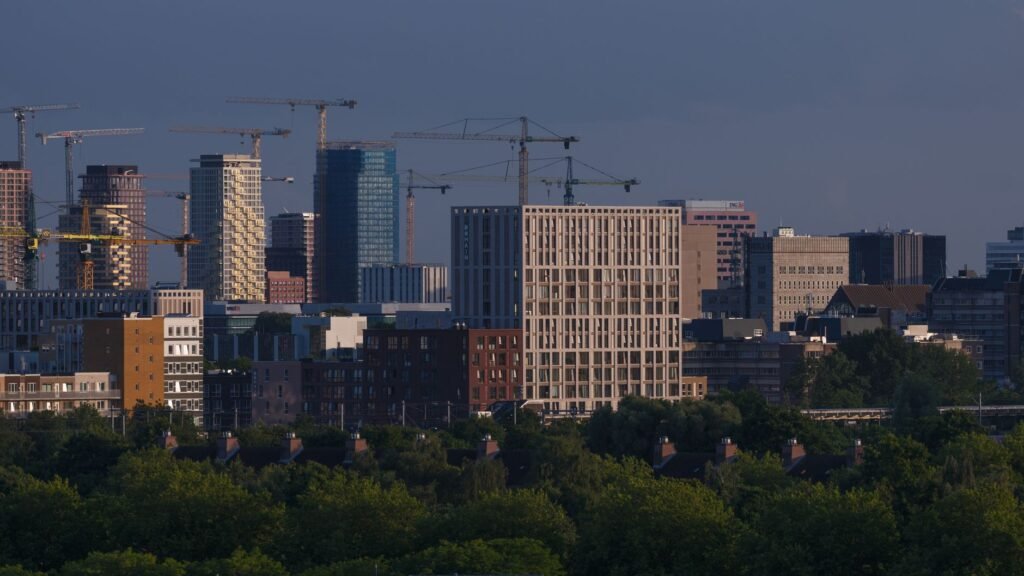
A Delft professor has put forward a practical way to ease the large funding shortfall on Amsterdam’s Zuidasdok project: capture part of the property-value gains that the work itself will create.
Wijnand Veeneman, professor of infrastructure and mobility governance at TU Delft, says public investment in the highway, rail and metro upgrades is already lifting the worth of nearby offices and homes.
That uplift, he argues, could be partly returned to help cover the project’s deficit of at least 1.1 billion euros.
The suggestion comes as cost overruns and delays continue to dog the long-running scheme.
Delft tunnel example
Veeneman lives beside the rail tunnel that was built under Delft in 2015 for 759 million euros.
In 2019 the Netherlands Bureau for Economic Policy Analysis calculated that buildings in a one-kilometer strip on either side of the tunnel gained 400 million euros in value within eighteen months.
He believes continued gentrification has likely pushed the total closer to the original construction cost.
His own house is now worth 70,000 euros more, while the extra property tax he pays is tiny by comparison.
Who pockets the gain
Veeneman calls the pattern “totally perverse.”
Government spending improves an area; private owners keep almost all of the resulting windfall.
At the Zuidas, Amsterdam’s densest office district, the effect will be far larger once the road tunnel and station works make the area more accessible and livable.
Higher rents, stronger tenant demand and rising home prices are the expected results.
Tools used elsewhere
France already lets municipalities charge firms for better accessibility.
Denmark can skim property-value gains around new infrastructure, a mechanism used to help fund the Øresund metro.
The Netherlands has no equivalent rules, Veeneman notes.
Although Zuidasdok construction is advanced, key parts such as the northern road tunnel have still not been tendered or fully financed.
Other options on the table
Owners of major complexes including the World Trade Center, Atrium and the ABN Amro building will benefit from those remaining works.
Veeneman says they could still be asked to contribute.
He also mentions tolls on the new roads, expanded peak-hour charges, or a local sales-tax approach of the kind used in parts of the United States.
Without fresher financing methods, he warns, both this project and wider Dutch infrastructure upkeep will remain stuck.

![Top [count] Travel Blogs to Follow - OnToplist.com](https://www.ontoplist.com/images/ontoplist31.png?id=6a8dcf108f478)