Amsterdam-Centrum is the historic heart of the city: the medieval core around the Dam, the seventeenth-century canal ring, the Jordaan, the Plantage and the old harbour islands.
It is where nearly every visitor spends most of their time, and it is also home to about 90,000 people.
This guide covers what Amsterdam Centrum includes, what to see, where to eat, its markets, how to get around, and what the official figures say about living there.
Where Amsterdam-Centrum is
Centrum is the city district inside and around the old ring of canals, bounded roughly by the IJ waterfront behind Centraal Station in the north and the Singelgracht in the south and west.
CBS divides it into ten districts, which group into a few clear areas:
- The Burgwallen, the medieval core on both sides of the Damrak and Rokin, including the red-light district, De Wallen.
- The canal ring (Grachtengordel), the Herengracht, Keizersgracht and Prinsengracht with the Nine Streets between them.
- The Jordaan and the Haarlemmerbuurt in the west; the Jordaan has its own Jordaan guide.
- Nieuwmarkt and the Lastage, the old Jewish quarter and the Plantage in the east, and the Oostelijke Eilanden, the former harbour islands behind the Scheepvaartmuseum.
South of the Singelgracht you are in Amsterdam-Zuid; see our De Pijp guide for the nearest part of it.
A short history
Amsterdam grew from a dam on the Amstel in the thirteenth century, and the Dam square still marks the spot.
The Oude Kerk, in the middle of De Wallen, is generally described as the oldest building in the city.
In the seventeenth century the city laid out the canal ring, a planned extension of merchants’ houses along concentric canals, which UNESCO added to the World Heritage List in 2010.
The Royal Palace on the Dam was built in the same century as the city hall, and the Nieuwe Kerk stands beside it.
Things to do in Amsterdam-Centrum
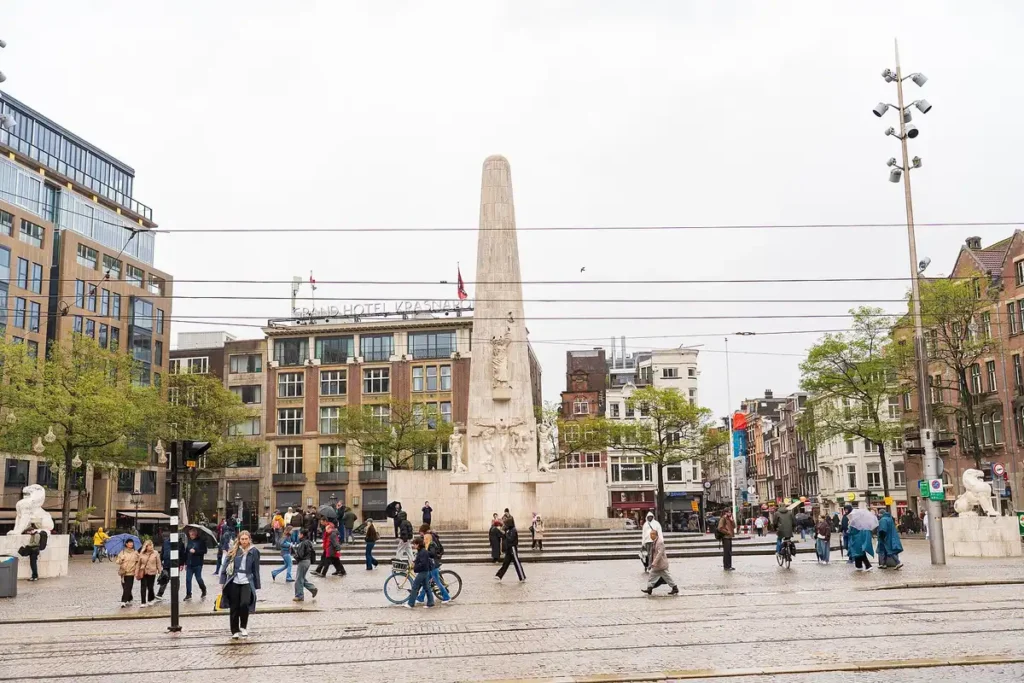
The Dam, with the Royal Palace, the Nieuwe Kerk and the National Monument, is the obvious starting point.
The Begijnhof, a quiet courtyard of old houses off the Spui, is one of the few places in the centre where you will hear almost nothing.
De Wallen is the historic red-light district; read our guide to the red-light district for the rules before you go.
The Rembrandt House Museum is on the Jodenbreestraat near the Waterlooplein, and the Plantage holds Artis zoo and the Hortus Botanicus.
The Nine Streets and the Haarlemmerstraat are the shopping streets most locals use; see our Amsterdam shopping guide.
Several attractions in the centre keep their listing up to date with us, including the Amsterdams Marionetten Theater on the Nieuwe Jonkerstraat, the Museum of Illusions on the Keizersgracht and the Museumhaven on the Oosterdok.
For exhibitions, concerts and events in the centre this week, see What’s On in Amsterdam, and for everything in our guides see the museums and attractions guide.
Where to eat and drink
The streets around the Dam and Damrak are mostly aimed at visitors; the side streets and the edges of the district are where residents eat.
Browse our directory of Amsterdam restaurants, Dutch restaurants and cafés.
A few businesses in the centre keep their own listing up to date with us:
- de Silveren Spiegel, a Dutch restaurant on the Kattengat.
- Petit-Restaurant De Rozenboom, a Dutch restaurant on the Rozenboomsteeg.
- Eetsalon Van Dobben, on the Korte Reguliersdwarsstraat near the Rembrandtplein.
- Van Stapele Koekmakerij, a cookie bakery on the Rokin.
- Lagom Amsterdam, a brunch café on the Snoekjessteeg.
- Phở Bà Năm, a Vietnamese restaurant on the Haarlemmerdijk.
- Roest, on the Jacob Bontiusplaats on the eastern islands.
- The Book Exchange, a second-hand English bookshop on the Kloveniersburgwal.
Markets
- The Waterlooplein market, the oldest flea market in the Netherlands, with about 300 stalls in the former Jewish quarter.
- The Nieuwmarkt, with a few stalls on weekdays and an organic farmers’ market on Saturday.
- The Noordermarkt in the Jordaan, on Monday and Saturday.
See them all in Amsterdam markets by day.
Getting there and around
Centraal Station is the hub for trains, metros, trams and the free ferries across the IJ to Amsterdam-Noord.
Metro 52 runs from Centraal under the Rokin to Vijzelgracht and on to De Pijp and Zuid; metros 51, 53 and 54 run from Centraal to Nieuwmarkt, Waterlooplein and Weesperplein.
Trams 2, 17 and 24 run from Centraal past Nieuwezijds Kolk, Dam, Paleisstraat and Koningsplein to the Leidseplein; trams 4 and 14 run down the Rokin, with tram 4 continuing to the Rembrandtplein and tram 14 to the Waterlooplein and Artis.
Tram 26 runs east from Centraal along the waterfront towards the Eastern Docklands and IJburg.
Lines and stops are taken from the GVB rail network map of 31 August 2026; check the GVB app for diversions.
Most of the centre is quicker on foot or by bike than by tram; check our bike theft by neighbourhood tool and our public toilets map before a long day out.
Living in Amsterdam-Centrum: the figures
Adding up its ten CBS districts, Centrum had 90,390 residents on 1 January 2026 (CBS, Kerncijfers wijken en buurten 2026).
It is a district of small households: 64% are one person, against 55% for Amsterdam, and only 12% include children, against 23% city-wide.
Children under 15 make up 6.9% of residents, about half the city share of 12.7%, while 17.8% are 65 or older.
The average WOZ value of a home was about €628,000, against €518,000 for the city, with the canal ring the most expensive part: Grachtengordel-Zuid averaged €908,000 and Grachtengordel-West €892,000 (CBS Kerncijfers wijken en buurten 2025, valuation date 1 January 2024; district average weighted by number of homes).
31% of homes are owner-occupied and 30% belong to housing corporations (CBS 2025 figures).
Rules on short-stay rental and holiday letting are strict in the centre; read our guide to Amsterdam’s housing rules before renting out or renting in.
Frequently Asked Questions
What does Amsterdam-Centrum include?
The medieval core around the Dam, De Wallen, the canal ring and Nine Streets, the Jordaan, the Haarlemmerbuurt, Nieuwmarkt, the Plantage and the Oostelijke Eilanden.
Is the Amsterdam canal ring a World Heritage Site?
Yes, the seventeenth-century canal ring inside the Singelgracht was added to UNESCO’s World Heritage List in 2010.
How many people live in Amsterdam-Centrum?
90,390 people on 1 January 2026, adding up the ten CBS districts that make up the city district.
Which metro lines serve the centre?
Metro 52 stops at Centraal Station, Rokin and Vijzelgracht; metros 51, 53 and 54 stop at Centraal Station, Nieuwmarkt, Waterlooplein and Weesperplein.
Where do people who live in the centre shop for food?
At the street markets, such as the Nieuwmarkt and the Noordermarkt, and at the supermarkets on the edges of the district; see our guide to Amsterdam supermarkets.
Other Amsterdam neighbourhoods
Read our guides to De Pijp, the Jordaan, Amsterdam-Zuid, Amsterdam-Oost, Amsterdam-West and IJburg, or start with the Amsterdam neighbourhood guide.
Not sure which suits you?
Take the Amsterdam neighbourhood quiz.
Photo: Dam Square by Deerpeter, CC BY-SA 4.0, via Wikimedia Commons.
Free Amsterdam tools: Which Amsterdam neighbourhood suits you? · Bike theft in Amsterdam by neighbourhood