Almost nothing about Dutch etiquette will get you into trouble in Amsterdam except the bike lane, and that one will.
The rest is a short list of local habits that are invisible until you break them.
This is the practical version: what to do on the street, at the till, on a terrace and in someone’s flat.
Public Space: The Rules With Consequences
The red asphalt is a road, not a wide pavement, and standing on it to look at a map is the single most resented thing a visitor does here.
Cyclists will not slow down, because from their side you are a stationary object in a traffic lane.
Cross a bike lane the way you would cross a road: look left, look right, then go without stopping halfway.
A bell ring behind you means move, not turn around, and turning around is how collisions happen.
On trams and metros, let everyone off before you board, and step out onto the platform if you are blocking the door at a stop.
The ferries behind Centraal to Noord are free and run all night, and cyclists board first and leave first, so wait for them.
Standing on the left of an escalator is fine here, but standing two abreast in a narrow street while people cycle past you is not.
Money, Payment And Splitting
Many Amsterdam cafés, bakeries and market stalls are card-only, and a good number of them still do not take credit cards at all.
A Dutch debit card or a contactless phone works everywhere; a foreign credit card does not.
Supermarkets expect you to bag your own shopping, quickly, while the next customer’s items arrive behind yours.
Bottles and most cans carry a deposit, statiegeld, refunded at a machine in the supermarket, and leaving them out on a wall for someone else to collect is normal and not rude.
Splitting a bill is done afterwards by Tikkie, a payment request sent by phone, and receiving one for a few euros is completely ordinary.
Service is included in Dutch prices, so tipping is rounding up, or roughly five to ten per cent for a meal you enjoyed.
Nobody will chase you for it and no percentage is expected on a coffee.
Terraces, Tables And Being Fed
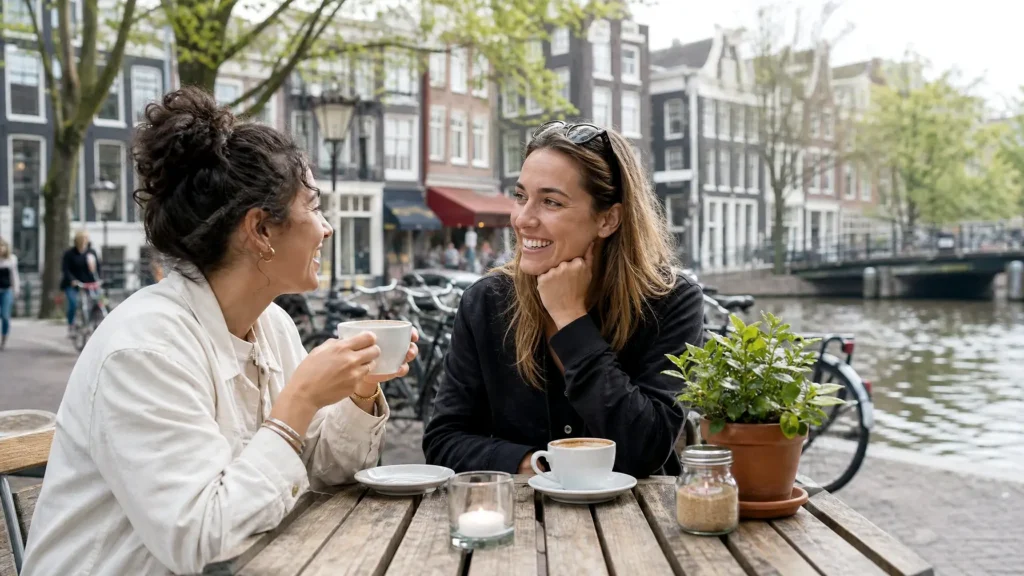
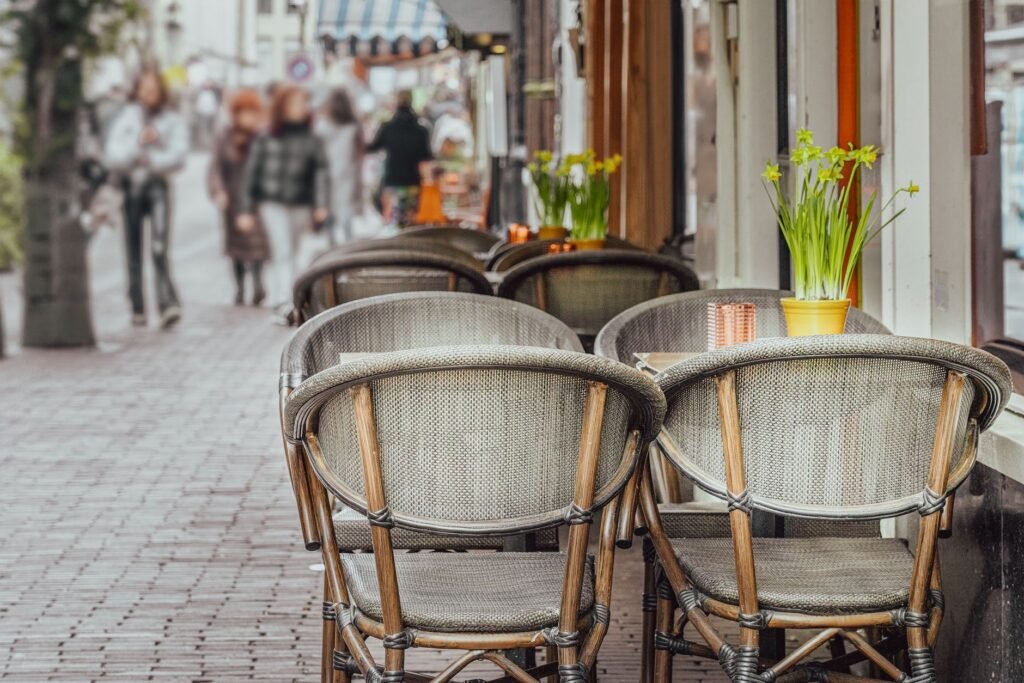
On a terrace you seat yourself and wait to be noticed, and flagging a waiter aggressively marks you out immediately.
You pay at the table when you are ready, not at a counter, and you say it out loud: “mag ik afrekenen?”
At a cheese, fish or butcher’s stall in a market hall, take a number ticket from the dispenser, because the queue is not a line.
If you are invited to a Dutch home for coffee, you get coffee and one biscuit, and that is the whole event rather than a prelude to dinner.
Invited to a birthday, you congratulate not just the birthday person but their partner, parents and anyone else in the circle of chairs.
Bring flowers, wine or something for the table, and take your shoes off only if the household clearly does.
Talking To People Here
Dutch directness is an efficiency, not an attack, and the honest answer arrives without the cushioning you may be used to.
Returning it flatly is fine; taking it personally is what causes the misunderstanding.
Open with “goedemorgen” or “goedendag” in a shop, and “dank u wel” on the way out, even if the whole exchange is otherwise in English.
Almost everyone in Amsterdam speaks fluent English and will switch immediately, so the Dutch greeting is read as courtesy rather than as an attempt to have the conversation in Dutch.
Visits are arranged, not dropped in on, and turning up at a friend’s door unannounced is genuinely unusual.
Punctuality is taken literally: fifteen minutes late to a dinner needs a message, and fifteen minutes early to someone’s home is worse than late.
Displays of wealth land badly, and “doe maar gewoon, dan doe je al gek genoeg” - just act normally, that is odd enough - is the sentiment behind it.
Frequently Asked Questions
What is the fastest way to annoy people in Amsterdam?
Stopping in a bike lane, and blocking a tram door.
Both are read as not noticing that other people are trying to get somewhere.
How much should I tip?
Round up on drinks and leave roughly five to ten per cent after a good meal.
Service is already in the price, so nothing is owed and nothing is expected on small orders.
Do I need cash?
Rarely, and in many places it is refused outright.
Carry a debit card or contactless phone rather than a credit card, which a lot of cafés and small shops still do not accept.
Is it rude to speak English?
No, and it will usually be the language of the conversation within one sentence.
Opening with a Dutch greeting is still worth doing, because it signals you are not assuming.
What do I bring if I am invited to someone’s home?
Flowers, wine, or something for the coffee table.
Arrive on the hour you were given, not before it.
What is a Tikkie?
A payment request sent by phone link, used constantly here to split bills, group presents and taxi fares.
Getting one for three euros is normal and is not a complaint about you.
Are there topics to avoid?
Salary, house price and rent, which are asked bluntly among close friends and not with strangers.
Beyond that, conversation here is unusually unguarded, and disagreement is not treated as a breach.