
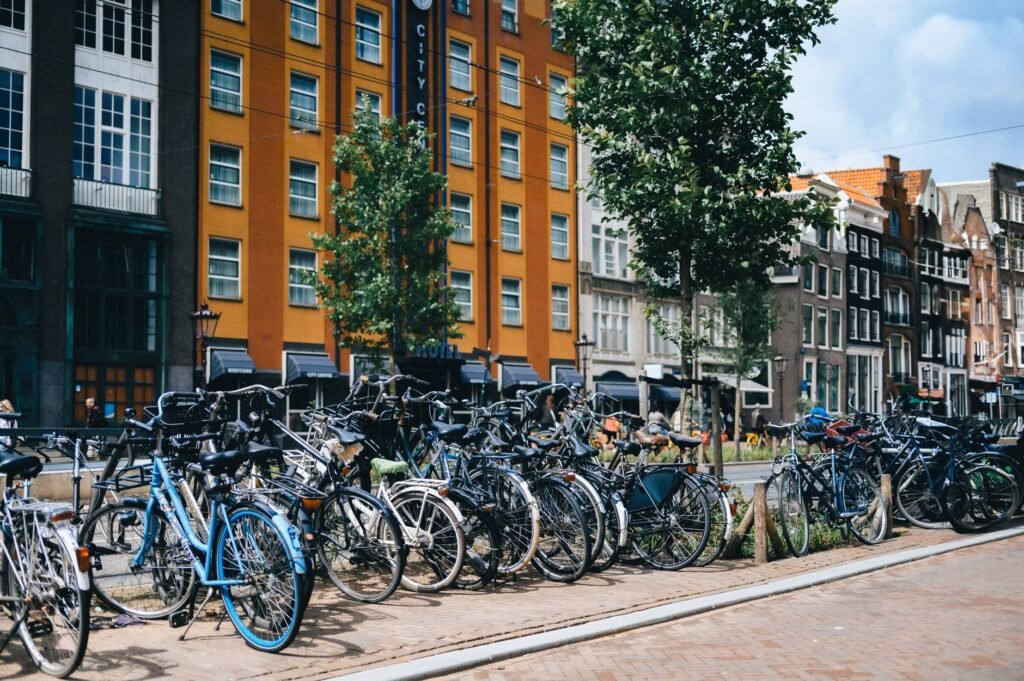
A city bike costs €10 to €18 a day in Amsterdam, and you can walk into a shop and ride away in about ten minutes.
Bring a passport or ID card and a card for the deposit, and that is the whole procedure.
The city is flat, almost every street has a separated bike lane, and most of what you came to see is within a fifteen-minute ride of the centre.
A day’s rental costs less than a handful of tram fares and covers far more ground.
Which Bike To Rent
The standard rental is a Dutch city bike: upright, heavy, with hand brakes rather than the coaster brakes locals often ride.
Say explicitly that you want hand brakes if you have never used a back-pedal brake, because shops stock both.
Ask for a small frame if you are under about 170 cm.
Dutch default frames are set for Dutch heights, and a bike you cannot put a foot down on is genuinely harder to ride in traffic.
An e-bike is worth the extra if you are leaving the city - Haarlem, the Waterland villages north of the IJ, or the routes in the day trips guide.
Budget about €32 a day and a refundable deposit of €250 to €500.
Cargo bikes carry small children in the box at the front and cost around €30 a day; children’s bikes are about €12; tandems sit near the cargo-bike price.
Book any of these ahead, because shops hold only a few of each.
Staying Longer
Swapfiets is a monthly subscription starting around €17 for a basic bike, with repairs and replacement included - the bikes are the ones with the blue front tyre.
It beats daily rental from roughly the two-week mark, and it is what most people moving here use for the first months.
If you buy instead, read the bike insurance guide before deciding whether cover is worth it.
Where To Pick One Up
Black Bikes runs the largest network in the city and lets you drop the bike at any of its shops rather than the one you took it from.
That matters if you want to start the day at Vondelpark and finish at Centraal Station with a train to catch.
Yellow Bike keeps two central pickup points, one at Centraal Station and one a few minutes from Dam Square.
MacBike has several centre locations and is the name most visitors recognise.
A-Bike opens seven days a week and discounts online bookings, with shops in the Jordaan and De Pijp that put you straight into the markets and the restaurants worth eating in.
If you have a Dutch transit account, OV-fiets is the cheaper option again: rental bikes at almost every station, billed per 24 hours, no shop involved.
Many short-stay rentals also keep bikes for guests, so ask before booking a shop.
Costs, Deposits And What To Bring
A city bike is €10 to €18 a day, with three-hour rentals from about €13 and a falling per-day rate over multiple days.
Booking online usually saves around 10 per cent.
Two locks come with every rental and you are expected to use both.
Theft and damage cover is offered at about €5 per rental, and it is worth taking, because the shop will otherwise charge you the full replacement value.
Bring a passport or ID card - shops check it, and some hold it or take a card imprint as the deposit.
Cards are the norm for payment; the currency guide covers which cards Dutch businesses actually accept.
Check the rain radar before you set off, because Amsterdam weather changes inside an hour.
One of the Dutch rain apps will tell you to the minute when it starts.
Riding Without Annoying Anyone
Stay in the bike lane, marked by red asphalt and separated from both the road and the pavement.
Cycling on the pavement is an offence and cycling the wrong way up a one-way bike lane is worse.
Signal every turn with an outstretched arm, because people behind you are riding on the assumption that you will.
Ride single file where it is busy, and never stop in the lane - pull fully out of it first.
Lights are legally required after dark, front and rear, and riding without them earns a fine.
So does holding a phone while cycling, which is enforced in the centre.
Tram rails swallow narrow tyres, so cross them at close to a right angle rather than at a shallow one.
Give way to trams and to traffic from the right at unmarked junctions.
Lock the frame and the front wheel to something fixed, every time, even for two minutes.
Park in the racks and not against a bridge railing or a canal-side post, because the city removes bikes left there to the fietsdepot and charges to release them.
Then take it somewhere worth going - the parks, or a slow lap of the canal ring ending at one of the rooftop bars.
Related reading
- What To Do When Your Bike Is Stolen In Amsterdam
- Amsterdam Bike Repair by Neighborhood Guide
- How to Choose a Bike Shop in Amsterdam
In the news
- Swapfiets cuts annual losses as revenue rises 30 August 2026

![Top [count] Travel Blogs to Follow - OnToplist.com](https://www.ontoplist.com/images/ontoplist31.png?id=6a8dcf108f478)